Why Building Capacity Is Key to Deliver Better Global Health Outcomes

Northwestern University Feinberg School of Medicine investigators, faculty, clinicians and community members gathered on May 4 for the Pathogen Genomics Symposium, an annual event highlighting advancements in the fields of pathogen genomics and infectious diseases. Hosted by the Center for Pathogen Genomics and Microbial Evolution (CPGME) at the Robert J. Havey, MD Institute for Global Health, the Pathogen Genomics Symposium featured a day of research talks, flash talks, research poster presentations and a keynote address.
Egon Ozer, MD, PhD, associate professor of Medicine in the Division of Infectious Diseases and director of CPGME, kicked off the day by welcoming attendees and noting the impressive quality of presentation topics.
“This is our fifth year organizing the Pathogen Genomics Symposium,” Ozer said. “The event brings together researchers at Northwestern and the larger Chicago area to showcase using genomics approaches to study infectious diseases."
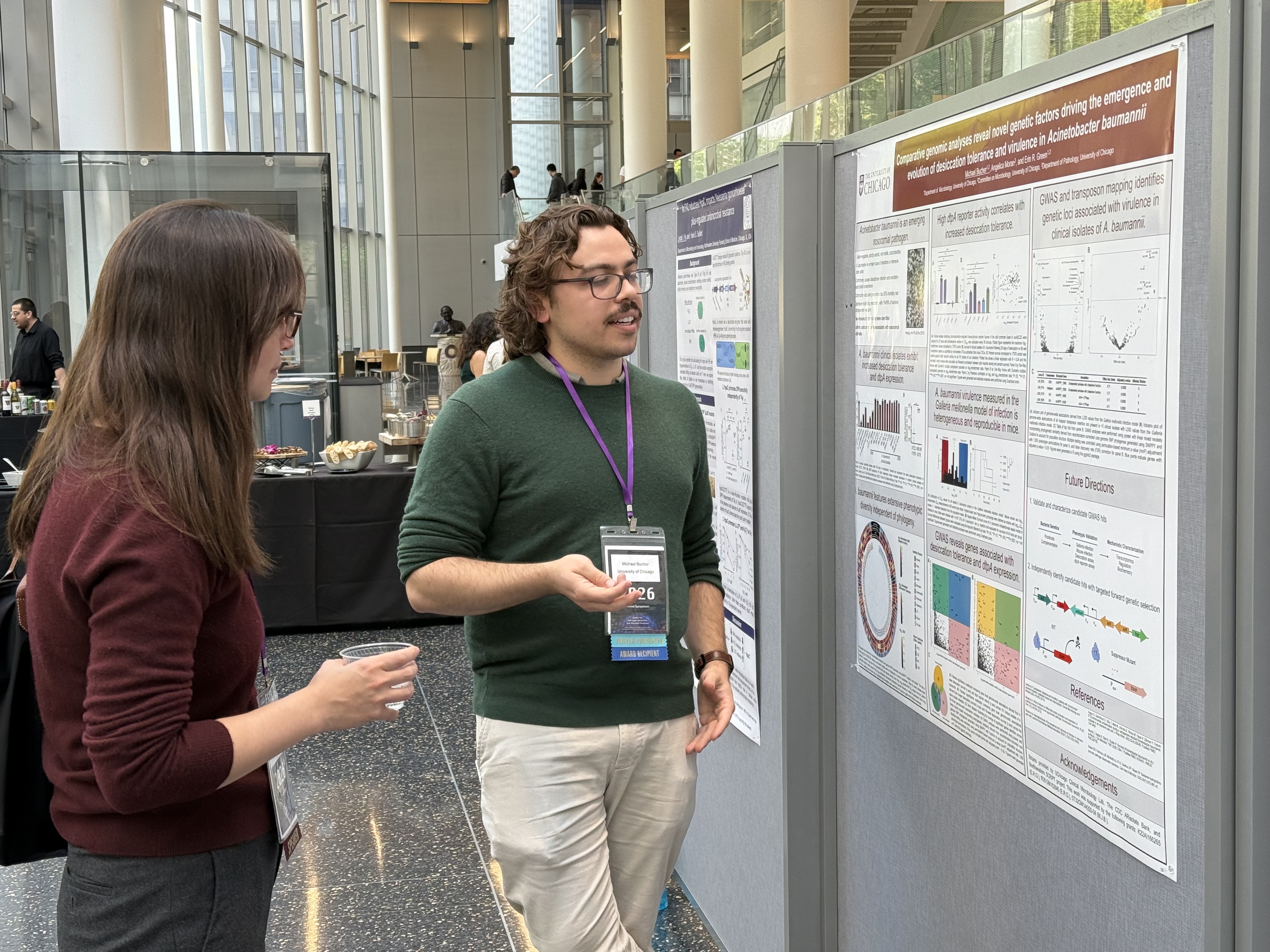
Students, faculty, staff and global health leaders joined Northwestern University’s Havey Institute for Global Health Center for Pathogen Genomics and Microbial Evolution for the annual Pathogen Genomics Symposium at the Simpson Querrey Biomedical Research Center on May 4.
The presentations highlighted five research presenters and a keynote speaker, as well as a poster session in which attendees learned about new pathogen genomics and microbial evolution research from Feinberg students, faculty and community partners. Top posters were selected by CPGME leadership for flash talk presentations.
“Twenty-seven abstracts were submitted for poster presentations, of which five were selected for five-minute flash talks to highlight outstanding work by trainees and early-career researchers in pathogen genomics,” said Ozer.
This year’s symposium featured speakers from the University of Chicago, Feinberg, the University of Michigan and Yale School of Public Health. Each speaker delivered presentations of their work in bacterial, viral or fungal pathogens.
Erin Green, PhD, assistant professor of Microbiology at the University of Chicago, kicked off the research talks with the presentation Exploiting genomics to identify mechanisms driving Acinetobacter baumannii persistence and spread. Tom Hope, PhD, professor of Cell and Developmental Biology and Obstetrics and Gynecology at Feinberg, followed with his presentation Spatial transcriptomic analysis reveals a unique viral microenvironment that functions as a sanctuary for the SIV reservoir of persistence.
The morning events continued with three more research presentations. Mark Mimee, PhD, assistant professor of Microbiology at the University of Chicago presented Phage-based approaches to eliminate or alter bacteria within complex microbial communities, followed by How does a bacterium mediate programmed, high-frequency gene conversion? from Hank Seifert, PhD, professor of Microbiology-Immunology and the John Edward Porter Professor of Biomedical Research at Feinberg. Teresa O’Meara, PhD, associate professor of Microbiology and Immunology, at the University of Michigan Medical School, ended the presentation portion of the program with her talk Genomic approaches for fungal pathogens.
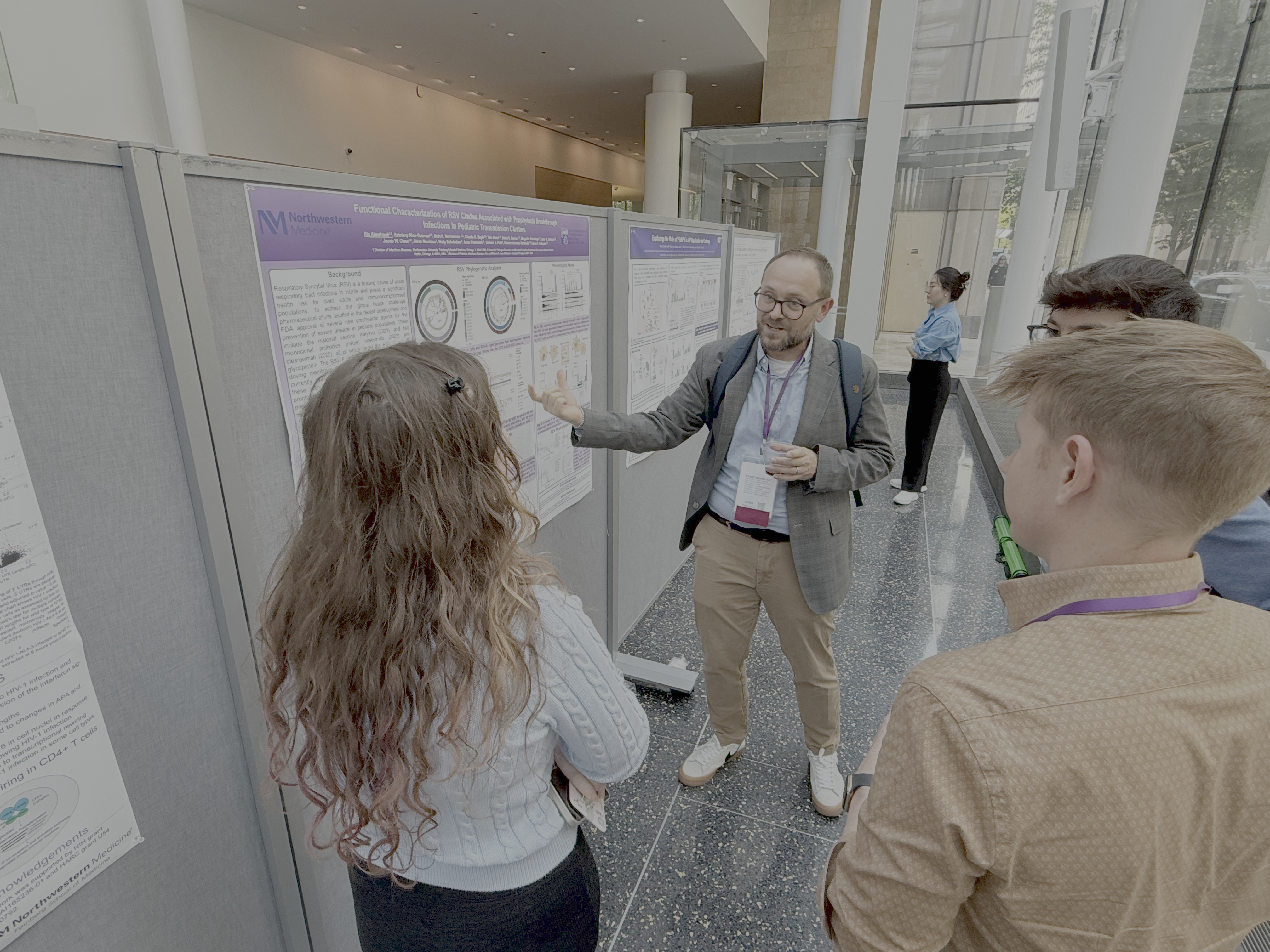
Attendees discuss poster presentations with the event's keynote speaker, Nathan Grubaugh, PhD, associate professor of Epidemiology (Microbial Diseases) at Yale School of Public Health.
The event was organized by CPGME leadership, which includes Ozer, Judd Hultquist, PhD, associate professor of Medicine in the Divisions of Infectious Diseases and Microbiology-Immunology, and Ramon Lorenzo-Redondo, PhD, assistant professor of Medicine in the Division of Infectious Diseases.
Nathan Grubaugh, PhD, associate professor of Epidemiology (Microbial Diseases) at Yale School of Public Health, delivered the keynote address, Dengue in the Age of Genomics. The presentation addressed the challenges and opportunities of using genomic sequencing to investigate the transmission of dengue virus and other infections around the world.
Following the presentations, the event concluded with a poster session, which highlighted pathogen genomics research and advances in microbial evolution studies and facilitated lively discussions amongst attendees.
CPGME provides specialized expertise in pathogen-specific sequence analysis and bioinformatics for emerging and ongoing infectious disease threats.
Poster Presentation Award Recipients
Daniel Amusin - Do Some Strains of Staphylococcus Aureus Cause Worse Pneumonia?
Katy Bond - Investigating the Paradoxical Effects of Oral Aspiration on the Lung Microbiome
Michael Bucher - Comparative Genomic Analyses Reveal Genetic Factors Driving the Evolution of Virulence in Acinetobacter Baumannii
Jasmine Gulik - APOBEC3B: R-loops, Transcription Termination, and m6A in HPV Pathogenesis
Kathryn Jackson-Jones - Auxiliary m6A Writer Complex Components Govern HIV-1 Replication in Primary CD4+ T Cells
Judd Hultquist, PhD; Egon A. Ozer, MD, PhD; and Ramon Lorenzo-Redondo, PhD are members of the Havey Institute for Global Health and Northwestern University Clinical and Translational Sciences Institute (NUCATS). Ozer and Lorenzo-Redondo are members of Institute for Public Health and Medicine (IPHAM).
Learn more about the Center for Pathogen Genomics and Microbial Evolution.
For details on events, news and funding opportunities, sign up for the Havey Institute for Global Health newsletter.