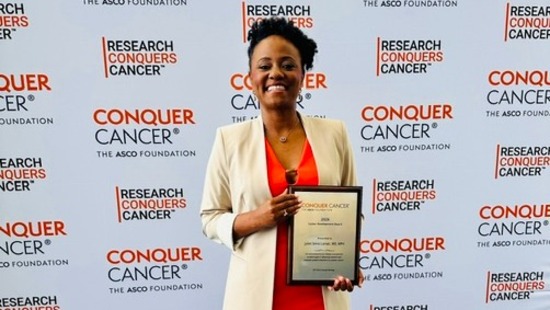
Lumati Awarded Career Development Award from ASCO’s Conquer Cancer Foundation
Ciaran Kohli-Lynch, PhD, is an assistant professor in the Department of Preventive Medicine in the Division of Epidemiology at Northwestern University Feinberg School of Medicine and assistant director of the Buehler Center for Health Policy & Economics within the Robert J. Havey, MD Institute for Global Health (IGH).

I strongly believe that everyone is entitled to high-quality and free at-the-point-of-service healthcare.”
- Ciaran Kohli-Lynch, PhD, assistant professor in the Division of Epidemiology at Northwestern University Feinberg School of Medicine and assistant director of the Buehler Center for Health Policy & Economics
How did you get involved in global health?
My background is in health economics, and I have always had an interest in how health policy operates across different healthcare settings. While completing my PhD studies, I had the opportunity to take a part-time position at the University of the Witwatersrand in Johannesburg, South Africa as they were searching for a researcher who could teach decision analysis and contribute to a stream of health economic studies.
Fortunately, my supervisor at the time, Andrew Moran, MD, MPH, at Columbia University, was very supportive of me pursuing this opportunity. I ended up splitting my time between New York and Johannesburg for several years, contributing to both teaching and a range of interesting studies in Johannesburg.
What interests and motivates you about global health?
As a health economist, one of the most compelling elements of global health is how different health systems are operated and the varied constraints that are imposed by decision makers. The role of an economist isn’t just to define the cheapest or most effective option for a decision-maker, but to identify policies that meet broader decision-making objectives — for example, improving population health, advancing health equity or promoting a health workforce.
I have personally enjoyed working in South Africa where policymakers are undertaking a comprehensive restructuring of the healthcare system through the National Health Insurance program. The goal of this is to promote greater access to healthcare for all inhabitants in an equitable and sustainable way. Balancing these competing goals requires thoughtful consideration of the outcomes associated with different health policies. This is intellectually interesting and leads to meaningful research.
What is the goal of your research?
I primarily conduct cost-effectiveness analysis, which means that I study how health systems can design sustainable benefit packages based on the objectives of policymakers. I strongly believe that everyone is entitled to high-quality and free at-the-point-of-service healthcare. The goal of my research is to help policymakers design sustainable and comprehensive benefit packages that enable them to expand access, improve population health and reduce health inequalities.
What countries/regions is your work focused on?
While I am always looking to work across a wide range of settings, I have spent most of my time working in South Africa. This has included many economic evaluation studies, including research on optimal strategies for seasonal influenza vaccination, the cost-effectiveness of a pregnancy support grant, and the quantification of the health and economic burden of hypertension in the country. More recently, I have been working on a UNICEF-funded project that estimated the cost-effectiveness of interventions to improve childhood nutrition in South Africa, Tanzania and Namibia.
Have you recently published any work?
Recently, I contributed to an economic evaluation study of the COST-FIN trial led by Juliet Lumati, MD, MPH, from the Division of Surgical Oncology at Northwestern University Feinberg School of Medicine. This study will examine the benefit of financial navigation to reduce catastrophic health payments and improve treatment adherence among adults in Nigeria with breast, colorectal or prostate cancer. We looked at ways to expand this study to quantify longer-term health and cost outcomes. I’m also hoping to publish our recent work on childhood nutrition in South Africa, Tanzania and Namibia in the coming month.
What types of collaborations are you engaged in across campus and beyond?
IGH has many established partner organizations. These relationships have enabled me to engage in interesting collaborations recently. I have submitted a grant application with the Society for Health Allied Research and Education, based in Hyderabad, India, focusing on the cost-effectiveness of door-to-door cervical cancer screening. I am also working with the Clínica de Familia La Romana in the Dominican Republic to evaluate the costs and benefits of HIV care provided in the clinic.
Who inspires you?
So many people inspire me. As someone who is often the “economist in the room,” I am inspired by the clinician-scientists I work with who balance patient care with research skills. This is particularly true of people like Samer Attar, MD, a professor in the Department of Orthopaedic Surgery, Victoria Rose, MD, a plastic surgeon helping victims of war in Gaza, and local physicians who put their lives at risk supporting healthcare services in Gaza and other conflict zones. More broadly, I’m inspired by researchers and activists who are pushing to make high-quality healthcare freely accessible to everyone who requires care.
(I’m also quite inspired by Glasgow Celtic manager Martin O’Neill who just led us to an unlikely league-cup double.)
Learn about the Buehler Center for Health Policy & Economics.
For details on events, news and funding opportunities, sign up for the Havey Institute for Global Health newsletter.
