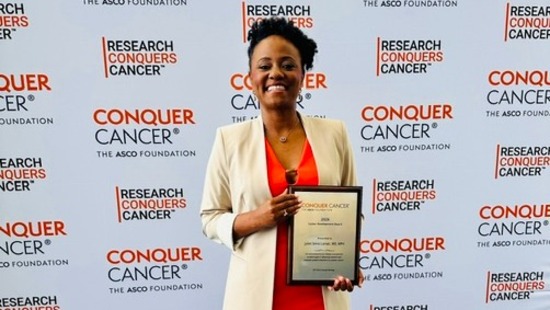
Lumati Awarded Career Development Award from ASCO’s Conquer Cancer Foundation
More than 150 participants from 30 countries came together on July 9 for the virtual event, Accelerating Hepatitis Elimination: Closing Care Gaps Through Policy and Partnerships, convened by the Center for Global Pediatric Health, a partnership between the Robert J. Havey, MD Institute for Global Health (IGH) and the Ann & Robert H. Lurie Children's Hospital of Chicago, and collaboration with the Coalition for Global Hepatitis Elimination within The Task Force for Global Health.
Held in conjunction with the 2026 United Nations High-Level Political Forum (HLPF), the 75-minute event brought together clinicians, researchers, advocates, policymakers and representatives from international organizations to discuss how collaboration across sectors can accelerate progress toward eliminating hepatitis as a public health threat by 2030.
Moderated by Ravi Jhaveri, MD, chief of Infectious Diseases in the Department of Pediatrics Division of Infectious Diseases and the Virginia H. Rogers Professor of Infectious Disease, the program featured expert presentations and discussion with Claudia Hawkins, MD, MPH, professor of Medicine in the Division of Infectious Diseases and director of the Center for Global Communicable and Emerging Infectious Diseases at the Havey Institute for Global Health, Gibril Ndow, MBChB, PhD, director of Research for the Centre for Operational Research on Hepatitis B at the Coalition for Global Hepatitis Elimination, Su Wang, MD, MPH, FACP, medical director of Viral Hepatitis Programs and the Center for Asian Health at the Cooperman Barnabas Medical Center, and Nida Ali, MD, director of Government Affairs and Partnerships Coalition for Global Hepatitis Elimination. Together, they explored practical solutions for expanding access to diagnostics, preventing mother-to-child transmission, improving treatment access and strengthening patient-centered models of care.
Speakers also emphasized the importance of elevating hepatitis within the Sustainable Development Goals agenda and broader United Nations (UN) discussions on global health.
A central theme throughout the discussion was the critical role of partnerships. Achieving hepatitis elimination will require sustained collaboration among governments, healthcare systems, researchers, civil society organizations and affected communities to ensure policies are grounded in evidence and responsive to local contexts.
The event welcomed a diverse international audience representing academia, civil society, ministries of health, Permanent Missions to the United Nations and leading organizations including the World Health Organization (WHO), UNICEF, UNITAID, the U.S. Centers for Disease Control and Prevention (CDC), and Médecins Sans Frontières (MSF).
Although HLPF 2026 concluded, the conversation is far from over. As the global community approaches the final years of the Sustainable Development Goals and begins shaping the next chapter of the UN's development agenda, continued engagement from civil society will be essential. The expertise, lived experience and evidence contributed by frontline organizations will help ensure future global health priorities are equitable, scalable and informed by those closest to the challenges.
If you were unable to attend—or would like to revisit the discussion — the full event recording is available on the Havey Institute for Global Health YouTube page.
Building on the success of the HLPF event, the Center for Global Pediatric Health is exploring an opportunity to convene a parallel event during the 71st Session of the United Nations Commission on the Status of Women (CSW71) in New York in March 2027. CSW is the UN’s largest annual gathering dedicated to gender equality and women’s rights, bringing together thousands of government representatives, UN leaders, civil society organizations, advocates, researchers and other experts from around the world.
The 2027 priority theme will focus on accelerating gender equality and empowering all women and girls in the context of the 2030 Agenda for Sustainable Development, with additional attention to climate change, environmental and disaster risk reduction, poverty and women’s economic empowerment.
These issues intersect directly with global health—and with expertise that already exists across the Havey Institute for Global Health. The center wants to bring that expertise into the global conversation.
What could be showcased? Perhaps a moderated panel, rapid-fire presentations highlighting research or case studies, innovative approaches to persistent global health challenges, lessons from implementation in diverse settings or an entirely different format that sparks conversation. The center is especially interested in ideas that connect health with the experiences, rights and opportunities of women and girls globally.
Could your work help inform conversations happening at the UN? If you have research, programs, partnerships, innovations or an idea for an engaging CSW71 event, please reach out to ashimek@luriechildrens.org.
To learn about the Center for Global Pediatric Health, visit their website.
For details on events, news and funding opportunities, sign up for the Havey Institute for Global Health newsletter.
