Bonus Episode: AI, Equity, and Community Power in Global Health with Solange Baptiste
Recorded at the Consortium of Universities for Global Health annual meeting in Washington, D.C., this special episode of Explore Global Health features Solange Baptiste, executive director, ITPC Global and explores how AI can either advance equity or deepen existing disparities and why community leadership must remain at the center.



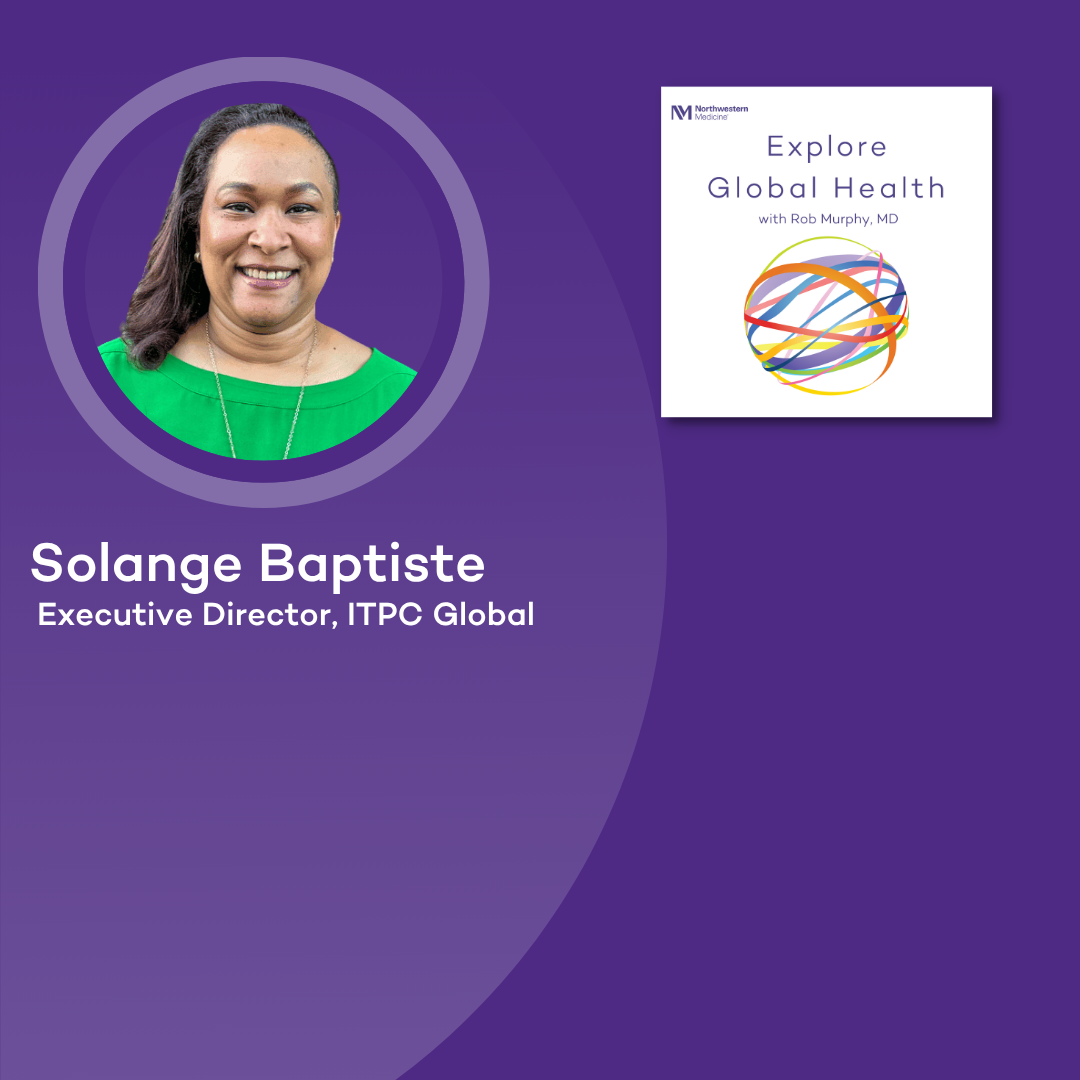
We worry about AI replacing community-led interventions. Because it can be done quicker and faster, but do you actually need a human in the loop? You do need a human at some point because of that judgment, that discernment, that ability to say, ‘let's look at the wider context, what's the best solution here?’ is not always just based on patterns and we look to spit out an algorithm and here's the answer. So, I think we really need to be cautious about making sure that it is framed as a tool in the hands of the community, not replacing community.”
Topics Covered in the Show:
-
The episode opens from the CUGH annual meeting in Washington, D.C., where global leaders are examining how emerging technologies—especially AI—are shaping the future of global health.
-
Solange Baptiste explains why community involvement is foundational, arguing that those most affected by health challenges must help design the solutions, rather than being treated as passive recipients.
-
The conversation explores AI as a powerful but double-edged tool, with risks of reinforcing bias, extracting data from vulnerable populations, and accelerating inequities if not implemented responsibly.
-
Baptiste highlights the importance of data ownership and trust, noting that communities often value their personal data deeply—even more than biological samples—and deserve transparency in how it’s used.
-
The discussion emphasizes that AI should not replace community-led interventions, but instead support them, with human judgment and lived experience remaining essential in global health decision-making.
-
In closing, Baptiste shares advice for the next generation: anchor your work on purpose, stay committed to equity, and use your voice to represent communities—even in spaces where they are underrepresented.
Show Transcript
[00:00:00] Dr. Robert Murphy: Welcome to the Explore Global Health Podcast. I’m Dr. Rob Murphy, executive director of the Havey Institute for Global Health at Northwestern University Feinberg School of Medicine.We’re recording in Washington, D.C., at the annual meeting of the Consortium of Universities for Global Health, or CUGH. We’ve recently heard from Keith Martin, founding executive director of CUGH, who laid out a broad vision for the future of global health and the important role universities play in shaping it. That future is also being shaped by rapidly evolving technologies, including artificial intelligence, and how these tools are applied in real-world settings. Here at CUGH, one of the key conversations focuses on how AI can be used in global health—from implementation and funding priorities to ethics, governance, and equity, especially in resource-constrained settings. For more on that, I’m joined today by Solange Baptiste, who is part of a global commission examining how AI can be used responsibly and effectively in HIV programming, and how to ensure these innovations truly serve the communities most affected. She is a Johannesburg, South Africa–based member of CUGH and serves as the executive director of ITPC Global—the International Treatment Preparedness Coalition—a leading voice in advancing health equity through community-driven approaches, data, and accountability. Welcome, Solange.
[00:01:36] Solange Baptiste: Thank you very much
[00:01:37] Dr. Rob Murphy: My first question I would like to ask you today is that an important part of your work centers on community power and global health. Why is it so critical that communities are involved in shaping solutions?
[00:01:51] Solange Baptiste: I think it's really a question of how you see the world, and I think if you do not believe that the people who are most affected by anything, whether it is an actual outbreak, a pandemic, a specific disease, or if it's related to. Dunno, climate events, whatever it is, they should have a say in how things are designed and what the solutions are. That's a core belief It's in IPC's DNA, and I think it's generally in the DNA of those who are in public health and in the field. You can also think about. You know what also you gain when you work with communities or you ensure that communities are in the lead or in the driver's seat because they're the closest to the experience.And I think we often have this sort of. Oh, you are the victim of this situation. Come, let me help you sort of save your mentality that we actually don't realize communities can generate some of the best solutions. We often come around with solutions saying, Hey, we have a solution. Where's your problem? I might be able to retrofit my solution to it rather than saying, hey. Maybe you could help us because you might have a solution that we don't see, and then we could co-design something together. So I think that's just the ethos of it and how I see it as well.
[00:02:58] Dr. Rob Murphy: It's really great that here at CUGH and in many other areas too, this community engagement is getting the attention that it really deserves. There's no point building a. A great thing, a vaccine or treatment or whatever, people are not going to be taking it for whatever reason. You're speaking here at the CUGH meeting about integrating AI into HIV programming. What opportunities and risks do you see with AI and global health?
[00:03:24] Solange Baptiste: I think that AI is often not really remembered, maybe ' cause we know it in theory that it's a tool and that it's a tool that's put into the hands and depending on whose hands it is in, you will have a certain amount of benefits, especially to communities or you will have risk or, perpetuating more of the inequities that we are already trying to sort. The idea that your data from a community perspective is embodied, that you are connected to it, it is part of who you are, is often seen in this sort of survey that we do, where we ask people, would you prefer to give us your, browsing history on your computer, or would you prefer to give us your, swab of DNA from like your cheek and your saliva? And sometimes, depending on the audience, it can go half, or people are overwhelmingly preferring to give you their saliva, not their data. So it kind of reminds you that people are protective that their data belongs to them, yet we don't always think about AI and how you build a large language model and how these big data sets come and what actually goes back to communities. Just putting a caution over everything. There's that whole extractive notion of these big companies coming to extract data, especially from resource constraints, settings where you don't actually realize your data is quite valuable and you're just giving it up. We also don't realize how much we are already using ai. So your idea of using Google to find the nearest coffee shop is already, AI is an artificial intelligence that's looking for patterns and finding you the directions they will find you. The fastest route
[00:04:53] Dr. Rob Murphy: and then giving you ads on coffee shops the next hour.
[00:04:56] Solange Baptiste: Exactly. Now it knows exactly who you are and when you like to drink coffee and all the things. But this idea is related to the risk and the benefit, right? Because you give up something in exchange for something else. And then in public health in HIV, it's about giving up that kind of data with the hope that you will get better health in the long run. But that better health doesn't come in an instant. So the question is. Is it actually being used to perpetuate inequities? Like the stigma that can come, the discriminatory kind of the models are learning based on whether you correct it or not, what date of, junk in, junk out. I think that is the biggest risk. The other thing from a community perspective that I will say is we worry about AI replacing community-led interventions because it can be done quicker and faster, but do you actually need a human in the loop? You do need a human at some point because that judgment, that discernment, that ability to say, let's look at the wider context, what's the best solution here is not always just based on patterns and we look to spit out an algorithm and here's the answer. So I think we really need to be cautious about making sure that it is framed as a tool in the hands of the community, not replacing the community.
[00:06:01] Dr. Rob Murphy: You've worked very closely with global organizations like UN AIDS and WHO. How can large institutions better partner with communities on the ground?
[00:06:12] Solange Baptiste: Fundamentally, it's. Your actual approach, the way you see the world. If you do not think that communities are important, you're gonna close quotes, like those sprinkles you put on a cake. Yeah. Let's just see what somebody can come in and validate what we've already designed. Did research, made the findings and the recommendations, all of that. What do you think? And then they just add in a few quotes from a person that is. Truly impacted. They're living on the front lines of the consequences of the things that you are going to do. And I think those bigger, larger organizations, and there have been many strides made. And I think that's the one big thing that HIV can teach to the rest of the sort of public health space. NCDs in particular are the importance of having a community voice, especially in governance. Where does the money flow? Who decides the priorities? How are you doing next? What would be the priority? All of that It's really important to have the voice of the person that is going to have to live out that experience.
[00:07:08] Dr. Rob Murphy: Absolutely. I experienced when I got involved with PEPFAR and uh, some of the early research training programs all focused on HIV. It's been really very rewarding to watch the evolution of. The capacity built both physically, laboratory wise and intellectually into many other fields. It's not limited and it's, we can't just focus on one thing. I agree completely with you. The final question I ask everybody on this podcast is. What advice do you have for young people, who are now just embarking or wanting to embark on a career in global health?
[00:07:42] Solange Baptiste: My personal belief is that life is short, and you have to be driven by your purpose. You need to know why you are here? There are easier ways to make money. There are faster ways to earn a living. But if inside of you you feel like you want to deal with inequity, you hate injustice, you feel that health is something that should be equal for all humans, just regardless of who they are, then you have to fall back on okay, so what is my why? Why am I doing this? And that is what is gonna take you through because hope is scarce in these times, and you have to kind of re-anchor yourself back to that passion. Why am I doing this? Because everything is gonna say, don't do it because it's hopeless. Look at everything. Everything is falling down. There's a crisis everywhere and we're fighting giants. When you're talking about communities you run into but why, the whole idea of you're not valued. Your data is not as good. You're why are you even in the room? So you have to have, again, more of that drive sort of fire in the blood to say no this is where I am required to be. And I'm, I may not bring everybody in the room with me, but I will represent their voices because we are trying to really leverage the space that we can get. So that's what I would say to a young person, really understand your why. And then once you know your why, go for it regardless of what you see around you. Because when you have that passion, you can actually make a difference.
[00:09:04] Dr. Rob Murphy: Understand why. I love that expression. Thank you very much for joining us today.
[00:09:09] Solange Baptiste: Thank you very much. It was a pleasure to meet you and to chat.