Bonus Episode: Building Resilient Health Systems in a Complex World with Jarbas Barbosa da Silva Jr., MD, MPH, PhD
Recorded at the Consortium of Universities for Global Health annual meeting in Washington, D.C., this special bonus episode of Explore Global Health features Jarbas Barbosa da Silva Jr., MD, MPH, PhD, Director of the Pan American Health Organization (PAHO), in conversation with Rob Murphy, MD. The discussion explores what it takes to build resilient health systems in an increasingly complex global landscape, drawing on lessons from the COVID-19 pandemic, the evolving role of primary health care, and the importance of regional collaboration, governance, and trust. Barbosa also shares insights on the future of global health, including the growing role of artificial intelligence and advice for the next generation entering the field.



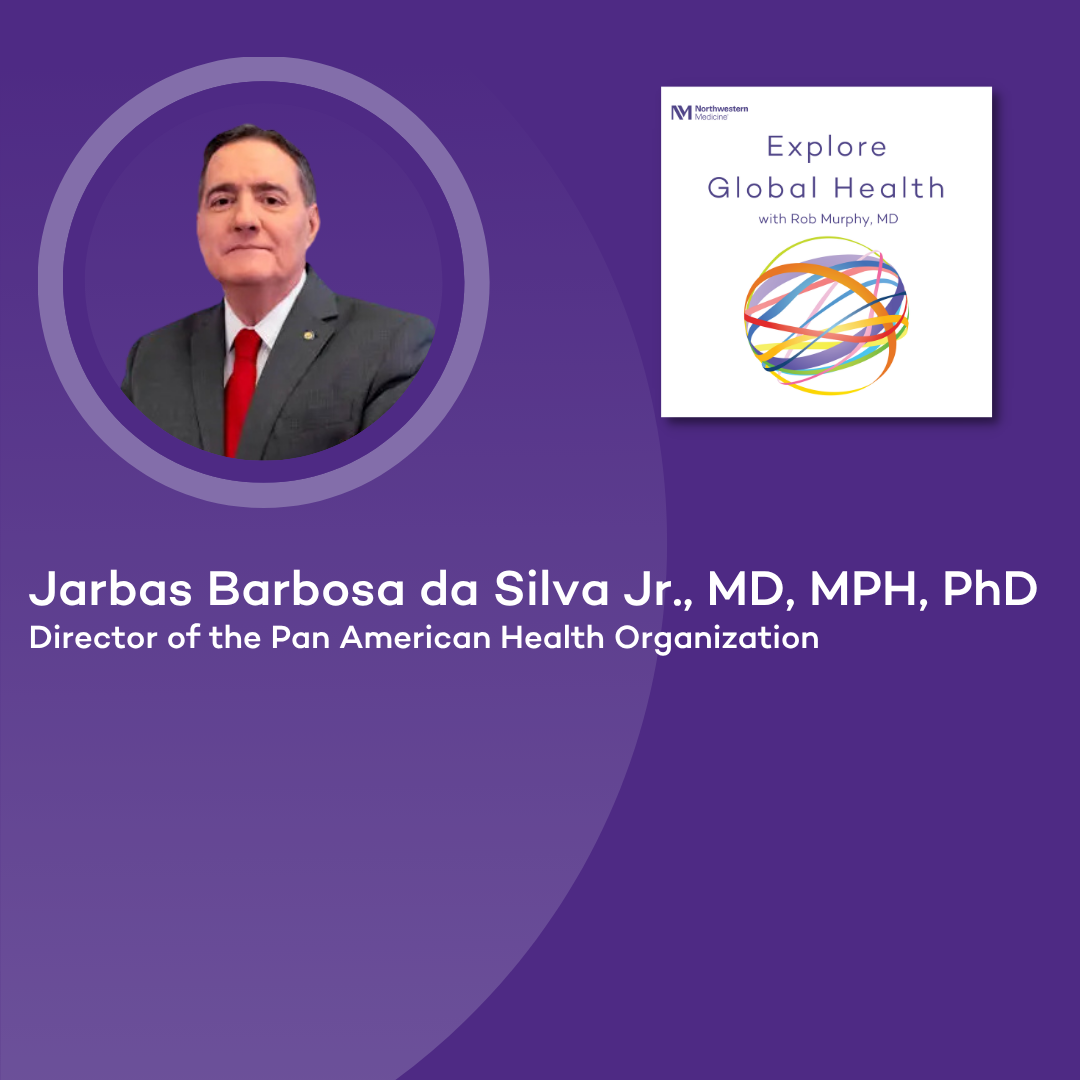
We think about primary health care not only as the entry point of the health system, but by being closer to the communities. Primary health care can provide and deliver promotion, prevention, and surveillance … that can use the technologies that are available—telemedicine and telehealth—and that can be better prepared to respond to noncommunicable diseases. We estimate that 34% of the deaths we have in the Americas related to noncommunicable diseases could be prevented if they were diagnosed earlier and followed up more effectively.”
- Director of the Pan American Health Organization (PAHO)
Topics Covered in the Show:
- Barbosa explains how the COVID-19 pandemic exposed weaknesses in global health systems, with widespread mortality due to overwhelmed hospitals, limited access to care, and underutilized tools such as telehealth, emphasizing the urgent need for systems that can continue functioning during crises and better reach populations facing access barriers.
- He says there is a need to renew and strengthen primary health care across the Americas, expanding its role beyond entry-point services to include prevention, surveillance, and early detection, while leveraging technologies like telemedicine and addressing noncommunicable diseases, many of which could be prevented through earlier diagnosis and follow-up.
- PAHO has dual roles as both a regional WHO office and a collaborative platform across the Americas. Barbosa describes its extensive country-level presence, real-time surveillance systems identifying over 1.2 million signals annually, and cross-border partnerships that enable coordinated responses to public health threats and emergencies.
- Barbosa underscores the importance of governance and public trust in effective health systems, noting that fragmented systems and lack of confidence in primary care limit access.
- His advice for future global health professionals to gain local experience, engage in global forums, and understand the growing impact of artificial intelligence in public health practice.
Show Transcript
[00:00:00] Dr. Rob Murphy: Welcome to the Explore Global Health podcast. I'm Dr. Rob Murphy, executive director of the Havey Institute for Global Health here at Northwestern University Feinberg School of Medicine. We're recording in Washington, D.C., at the annual meeting of the Consortium of Universities for Global Health, or CUGH. We are diving into the topic of building systems that are strong, adaptable, and prepared for the changes that may arise in the future of global health. I'm honored to be joined today by Dr. Jarbas Barbosa da Silva Jr., a national of Brazil and director of the Pan American Health Organization, also referred to as PAHO. He is leading efforts across the Americas to strengthen health systems and is speaking here at CUGH on building resilience in an increasingly complex global health landscape. Welcome to the podcast.
[00:00:50] Dr. Jarbas Barbosa: Thank you. Thank you for inviting me to be here.
[00:00:53] Dr. Rob Murphy: You're speaking here about building resilient health systems in a complex global landscape. What makes that landscape more complex today than it was even five or 10 years ago?
[00:01:03] Dr. Jarbas Barbosa: The pandemic really told us that we need to build more resilient health systems. During the pandemic, in all the countries where we have good quality data, the excess mortality was very important for almost every cause—for communicable diseases, noncommunicable diseases, cancer, diabetes, you name it. Because during the peaks of transmission, the health systems completely collapsed. The emergency rooms were overwhelmed with COVID-19 cases, health centers were closing, and people were not feeling comfortable going to a health center. Telemedicine and telehealth were already there, but they were used very little in reality. So I think that this was a very important message: we need to have more resilient health systems that can continue functioning and providing care for people during a crisis. But even in a regular period, the health system needs to be more resilient to reach people who currently face barriers to accessing care through traditional health system approaches. So I think that building resilience is really crucial.
[00:02:13] Dr. Rob Murphy: When you think about resilience and what core capabilities are, including digital tools. Do they have to change everything, or can they just incrementally improve things?
[00:02:28] Dr. Jarbas Barbosa: I think they need to renew and strengthen primary health care in a different way. The Alma-Ata Declaration 45 years ago was a revolution at that time. It stated that health is not only hospitals, but primary health care is a very important part of the health system. But when you see the Declaration of Alma-Ata related to what the epidemiological profile was at that time, it mostly focused on maternal and child health. It mentioned some endemic diseases, and that's it. Now we think about primary health care not only as the entry point of the health system, but by being closer to the communities, primary health care can provide and deliver promotion, prevention, and surveillance. The health service that detects that something is different, like an outbreak going on, is probably the health center. So we are thinking about primary health care that is adapted, that can use the technologies that are available—telemedicine and telehealth—and that can be better prepared to respond to noncommunicable diseases. We estimate that 34% of the deaths we have in the Americas related to noncommunicable diseases could be prevented if they were diagnosed earlier and followed up more effectively. So I think that, of course, hospitals are very important to the system, but if we don't provide a more balanced system having primary health care with these characteristics, we'll continue seeing lots of people who don't have proper access to health services.
[00:04:20] Dr. Rob Murphy: It's interesting that you brought up primary care as one of the directions we really need to go in. You would think that would be a logical choice, and yet it hasn't been. It's interesting that two of the last three speakers we've had on the podcast have said basically the same thing—to focus more on primary care. I'm happy to hear that at the highest levels in health care in the Western Hemisphere, if not the world. As a matter of fact, let's talk a little bit about PAHO.
[00:04:47] Dr. Jarbas Barbosa: The Pan American Health Organization was founded in 1902, making us the oldest international public health organization in the world. When the World Health Organization was created in 1948, PAHO and WHO signed an agreement so that PAHO also serves as the regional office for the Americas while keeping our autonomy and independence. We are a double organization: we are the specialized health agency that is part of the Inter-American system, and we also serve as the WHO Regional Office for the Americas. We have a very strong country presence. Our headquarters is here in Washington, D.C., but we have country offices in almost every country in the region. These country offices are not diplomatic representations; they have a technical team that works together with the Ministry of Health to advance the public health agenda. We also serve as a platform so countries can come together to address the main challenges they have. We run a regional surveillance system that is 24/7, looking for signals in social media and news like outbreaks, epidemics, or unknown diseases. In the last year, just to tell you how important this is, we identified more than 1.2 million of these signals. Based on the verification processes we conducted with the Ministries of Health, we were able to identify 130 public health emergencies in the region, from hantavirus outbreaks to measles. We work with the Ministry of Health to support their response. PAHO serves as a platform so countries can come together under the spirit of Pan-Americanism. So we can cross borders, collaborate, and work together to protect the entire region.
[00:06:52] Dr. Rob Murphy: Do you see improvement in the countries working together in this aspect?
[00:06:57] Dr. Jarbas Barbosa: I think you have a lot of good examples. In South America, for instance, where countries share borders, we have a lot of good experience responding to vector-borne diseases or having mechanisms where populations share health services like specialized cancer centers or dialysis. In the Caribbean, we have CARPHA, the public health agency for the Caribbean. So I think things are moving in the right direction. Of course, you cannot take this for granted. I think we need to tell the good stories every day to show that we cannot respond to diseases if we think about isolated countries. It is not feasible, because collaboration is the only way we can respond properly to the challenges we have today.
[00:08:05] Dr. Rob Murphy: How important are governance and public trust in building resilient health systems. And how can countries strengthen those?
[00:08:13] Dr. Jarbas Barbosa: Governance is crucial because in several countries in the region, we have fragmented health systems. We have the network of services belonging to the Ministry of Health, another for the social security system, and others for the military or public servants. If they don't establish a very strong mechanism of governance, the leadership of the Ministry of Health to identify and channel resources to address gaps will be limited. Trust is also very important. When we are talking about primary health care, if the population doesn't believe that going to a primary health care center will solve their problem, they will not go. They'll go to an emergency room and wait in crowded rooms for eight hours because they know they will eventually receive attention, an X-ray, or a laboratory test. So the best way we have to strengthen primary health care and use limited resources efficiently is for primary health care to have the trust of the population.
[00:09:39] Dr. Rob Murphy: What advice do you have for a young person who's just now embarking or wanting to embark on a career in global health?
[00:09:46] Dr. Jarbas Barbosa: In Brazil, I taught epidemiology in undergraduate public health courses. If you are interested in global health, it is important to have some local experience because you can understand on the ground how things work and what the difficulties are. It is also important to participate in forums and discussions. Let's not forget the use of artificial intelligence, which will be very important in the near future. This is not just the future; we are using AI today in prisons in Paraguay and in mobile X-ray machines where the first reading of the X-ray is made by artificial intelligence. It is really important to understand this transformation because it applies to every field in public health, from epidemiology and surveillance to management and planning.
[00:10:52] Dr. Rob Murphy: Dr. Barbosa da Silva, thank you so much for joining us today. Thank you for being such a big part of CUGH and coming to the meeting and being such a great role model for many of the people here. Thank you.
[00:11:05] Dr. Jarbas Barbosa: Thank you. Thank you. It was a pleasure to be here.
[00:11:08] Dr. Rob Murphy: Follow us on Apple Podcasts or wherever you listen to podcasts, to hear the latest episodes and join our community that is dedicated to making a lasting positive impact on global health.