Frontline Genomics and the Future of Global Health with Tulio de Oliveira, PhD
Tulio de Oliveira, PhD, a Brazilian-born scientist who calls South Africa home, has become one of the world’s most sought-after bioinformatics specialists and leaders in infectious disease outbreak surveillance. His contributions to global health are many and include the identification of major variants of concern during the COVID-19 pandemic, such as Beta and Omicron. Today, he is on a mission to ensure that genomic science in Africa doesn't just contribute to the field of global health, but helps lead it. In this episode, Dr. Rob Murphy talks to de Oliveira about his career path in global health and why he thinks now is a critical time for young people to enter the field.



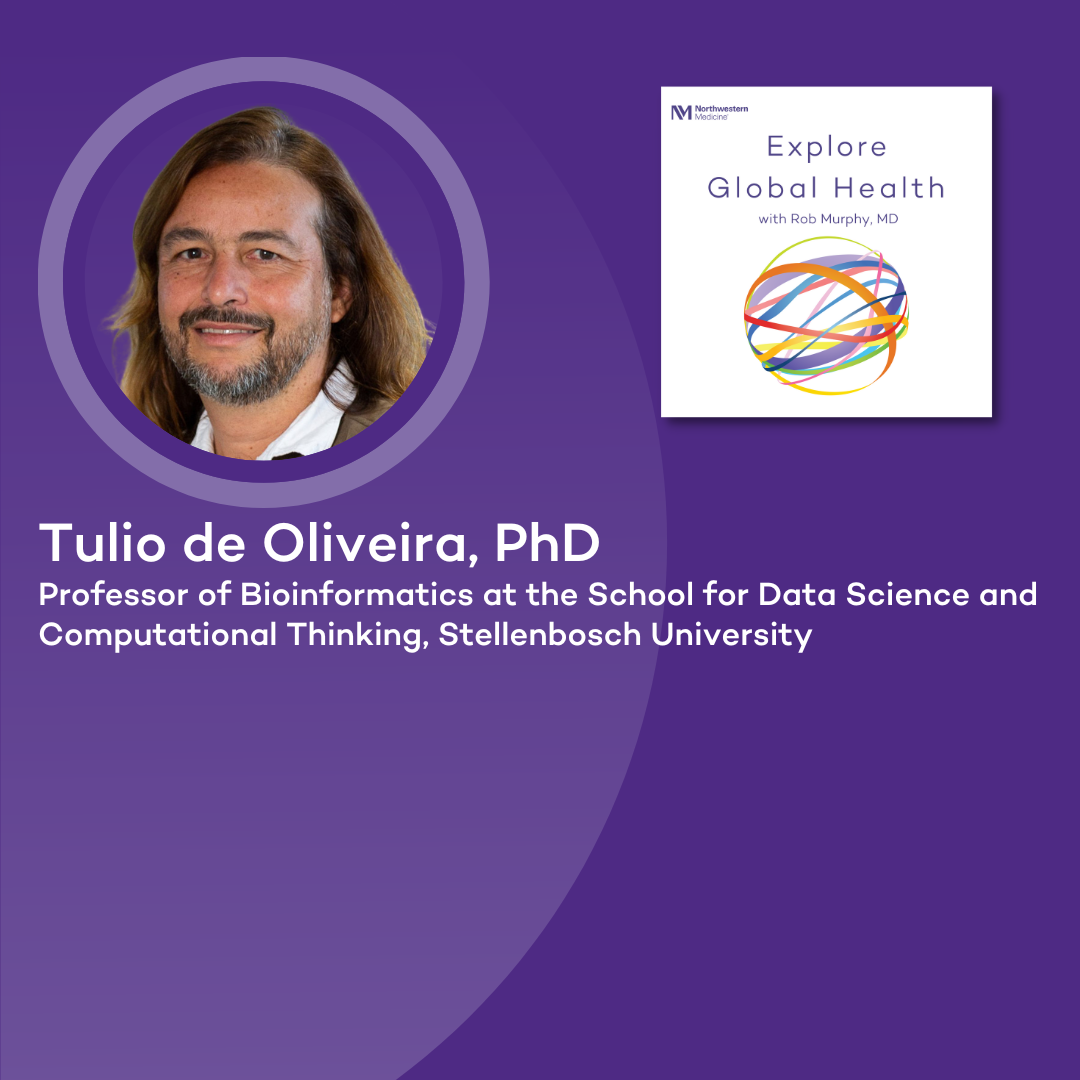
In the end, infectious diseases affect everyone. It doesn’t matter if you are from the center, the left, or the right, it will affect you.”
– Tulio de Oliveira, PhD
- Professor of Bioinformatics at the School for Data Science and Computational Thinking, Stellenbosch University
- Director: KRISP - KwaZulu-Natal Research and Innovation Sequencing Platform, UKZN, Durban, South Africa
Topics Covered in the Show:
-
Born in Brasília, de Oliveira was raised across Brazil, amid social activism and deep exposure to nature that shaped his worldview. As a gifted student, de Oliveira had an interest in computer coding at a young age, learning programming languages in the early 1990s.
-
In 1997, de Oliveira moved to South Africa during the post-apartheid transition. His mother led this move. She was originally from Mozambique and wanted to return to the area to use her background as an architect to improve public infrastructure design there. At the Nelson Mandela School of Medicine, later the University of KwaZulu-Natal, he trained in HIV genomics alongside leading scientists working at the epicenter of the global HIV/AIDS epidemic.
-
At the University of Oxford, during his postdoctoral fellowship, de Oliveira applied advanced genomic tools to an important international case involving an outbreak of HIV and hepatitis C in a children’s hospital in Libya. Using molecular clock analysis, his team showed that hundreds of pediatric HIV infections were the result of long-term hospital transmission—not deliberate wrongdoing—helping prevent the execution of accused medical workers. The case revealed the real-world power of genomics to influence justice and policy.
-
Along with his wife, who is South African, de Oliveira returned to South Africa in 2016 and founded the KwaZulu-Natal Research Innovation and Sequencing Platform (KRISP) before later leading the Center for Epidemic Response and Innovation at Stellenbosch University. During the COVID-19 pandemic, these efforts enabled rapid identification of variants such as Beta and Omicron. These discoveries landed him in Time Magazine's list of the hundred most influential people in 2022. Nature also named him as one of 10 researchers who shaped science in 2021.
-
Equally central to his mission in genomics is training the next generation of scientists, building sustainable, Africa-rooted genomic capacity that positions the Global South as a leader in global health. He says now is a defining moment for global health, amid misinformation, political polarization, and weakened public health systems, he says that scientists have a moral responsibility to stay focused on work that saves lives and improves livelihoods.
Show Transcript
[00:00:00] Dr. Rob Murphy: Welcome to the Explore Global Health Podcast. I'm Dr. Rob Murphy, executive director of the Havey Institute for Global Health here at Northwestern University Feinberg School of Medicine. My guest today, Tulio de Oliveira, is a bioinformatics specialist and infectious disease expert who works in genomic surveillance. He has helped inform and shape the global response to the COVID-19 pandemic and is well known internationally. His team in South Africa was the first to identify major variants of concern such as Beta and Omicron. This work helped alert the world to emerging threats in real time and landed him in Time Magazine's list of the hundred most influential people in 2022. Nature also named him as one of 10 researchers who shaped science in 2021. Tulio is the director of the Center for Epidemic Response and Innovation at Stellenbosch University in South Africa, and he is also collaborating with members of our institute, the Havey Institute for Global Health, through the Stellenbosch University and Northwestern University Global Health Knowledge Hub. Today we're gonna talk to Tulio about his incredible career journey and why he's working to ensure that genomic science in Africa doesn't just contribute to the field of global health, but helps lead it. Tulio, welcome to the podcast.
[00:01:25] Prof. Tulio de Oliveira: Thanks so much, Rob, for inviting me to your podcast. An honor to be here.
[00:01:29] Dr. Rob Murphy: Let's start at the beginning. You were born in Brazil and into a family that was influenced by activism and social justice. Can you tell us about your childhood and what you remember most about those early years in Brazil that shaped the way you see the world today?
[00:01:44] Prof. Tulio de Oliveira: What shaped me as a young person? As you mentioned, I was born in Brazil. I was born in the capital, Brasília. It was a new city, recently constructed. And then as a child I moved quite a lot. My father working in the—my father, my mother, they are architects. And they work designing public transport, very large public transport systems. And I lived in the northeast of Brazil, in the north, and then I moved to the deep south. Which—Brazil, it's very similar to the United States of America—is a country of continental proportions, quite different areas.
But one thing that really shaped me a lot in my childhood in Brazil was living in the deep south of Brazil. It is next to Argentina and Uruguay. To be honest, they call ourselves gaúchos. This means the cowboys, before they call the Brazilians. And it's a very interesting place with very large Italian and German immigration, quite a very socially active place. That's where they started the World Social Forum. That was quite exciting—to be in a city that went very diverse, thinking a lot about social issues.
And the other thing that shaped me a lot was my love for nature. My family always had a holiday house in the state of Rio de Janeiro, in the north of Rio, where it has some of the most beautiful coastlines in Brazil, full of islands. And so I spent a large time of my life—my childhood and young adult—under the sea, close to nature. And that's why it grew a lot, my love for biological science.
[00:03:15] Dr. Rob Murphy: I didn't realize you were from Brasília originally. It was one of those brand-new cities just built in the middle of the Amazon, really. Must have been very exciting growing up there.
[00:03:25] Prof. Tulio de Oliveira: Yes. As a child it was exciting, a newly designed city, very much what is Washington, DC, to the United States—the kind of central capital. And that's where a lot of the policies are run from the country. Yeah.
[00:03:38] Dr. Rob Murphy: You had an interest in computers and coding very early on. When did you first start coding, and what was it about computers that hooked you long before bioinformatics was a defined field?
[00:03:51] Prof. Tulio de Oliveira: When I was a child, around when I was 11 or 12 years old, I was classified as a—as what? In Brazil, they call a gifted child. And as part of that, I joined a program for gifted children at our main university in Brazil, the Federal University of Rio Grande do Sul, which I went to study there. And that was quite exciting.
So that time was like in the early nineties. Computers were just becoming mainstream. And then as part of that, I got a lot of classes on programming, some old language, BASIC and Prolog, which was considered to be one of the first artificial intelligence languages being developed. And then I got introduced to Unix and Linux when I was still growing, and that was quite exciting.
And that's what—that kind of programming base—that when I was at the university, at the Federal University of Rio Grande do Sul, which is one of the top three universities in Brazil, then I joined what was an emerging field—bioinformatics. I was working in the bioinformatics department as a research assistant, still doing my graduation. And that's when I tried to join the true passion for biological science with computer science and join a new area that was being formed that was named bioinformatics, using informatics for analysis of biological data, especially DNA and protein sequencing.
[00:05:12] Dr. Rob Murphy: As your interest in computers and science was growing, your life also took a very important turn. When you moved to South Africa in 1997, what led you to move to South Africa, and what did arriving there open up for you both personally and scientifically?
[00:05:28] Prof. Tulio de Oliveira: Moving to South Africa in 1997 was—was an experience. You have to remember that South Africa was going through the change. Mandela was still the president, Nelson Mandela. And why we moved to South Africa is because my mother went to Mozambique. She lived there as a child—we are from a Portuguese family also. And she went to Mozambique, which had just become—well, they became independent in the seventies, but it was in the late nineties that the civil war finished in Mozambique because that was funded by the apartheid.
So as apartheid fell, the civil war finished in Mozambique, and my mother went to Mozambique to lead many of the reconstruction programs of Mozambique that were part of the United Nations, the UN. And then my sisters and I stayed in South Africa, in Durban—a beautiful city by the coast on the east coast—because the universities in South Africa were much more developed than Mozambique. And it was still close enough that you could drive for a long weekend to Mozambique.
So it was a great time to be in South Africa when the country was transforming. Many people had very doom predictions about South Africa, but it was a magic time. It was a time that South Africa transformed from one of the most brutal discriminatory regimes in the world to an open society without any fighting or destruction of the country. The opposite—there was hope and love in the air at that time.
[00:06:59] Dr. Rob Murphy: Yeah, I remember the Durban AIDS conference in 2000. It was really a turning point in my career. And it was incredible. I mean, people were trying to scare us—oh, it's so unsafe. You know, everyone was all nervous about going. I remember getting down there and it was a beautiful city. There was a modern conference center. It was an incredible experience being in South Africa in the year 2000. By the way, did your mother do her architecture training in Brazil or in Mozambique or South Africa or where?
[00:07:30] Prof. Tulio de Oliveira: In Brazil. She went in Brazil, kind of in exile. She completed her university, had three children, and decided to go back to help Africa. And I also remember the Durban conference—it was one of my first conferences. I had some presentations there, and it was amazing to see both the international scientific community and the South Africans come together also to fight another scourge, which was HIV/AIDS. And that was also a pivotal moment on the HIV treatment, not only in South Africa, but in the whole world.
[00:08:02] Dr. Rob Murphy: Absolutely. You completed your undergraduate education and your PhD at the University of KwaZulu-Natal in South Africa, and you began working in HIV genomics. How did this work in proximity to people living with HIV and clinicians impact your desire to work in epidemic-scale infectious disease research?
[00:08:23] Prof. Tulio de Oliveira: When I was in Durban, I completed my degrees at what was called the Nelson Mandela School of Medicine, which is part of the University of KwaZulu-Natal now. And that was, again, a very incredible medical school. Why that? Just to give the example, as Nelson Mandela became the president, he gave his name to the school of medicine because it was the only school of medicine in South Africa that would cater for non-whites during the whole apartheid.
It was a university that not only was very active politically, but also took very seriously the discourse of HIV and AIDS because that would affect most the African population. And we had some key scientists there—some of my mentors that are now my friends—Ali Karim, Jerry Coia. They were the two chairs of the AIDS conference in Durban. And that was really like not learning only from the local, but learning from the best, because these were people that were really in the epicenter of the HIV pandemic. They were the ones developing a lot of the tools to fight that during the trials of the first antiretroviral therapies, prevention interventions, and so on.
So it was very motivating to be landing in South Africa, which many people would not expect to be scientifically advanced, but end up in the kind of center of scientific excellence in medical research, especially on HIV and AIDS, and at the same time seeing the impact on the population, which really motivated us to grow large programs of HIV research, treatment, and prevention.
[00:09:58] Dr. Rob Murphy: Next you went to the University of Oxford in the United Kingdom for your postdoc fellowship, and that experience was also extremely impactful for you and really revealed the real-world power of genomics. Can you tell us a little bit about that?
[00:10:12] Prof. Tulio de Oliveira: When I was at the Nelson Mandela School of Medicine, as I was doing my PhD, I also started working with a very large group from the Wellcome Trust, what was called the Wellcome Trust Africa Centre for Population Research. And that had very strong links to universities in the United Kingdom. The Wellcome is the biggest philanthropic funder of medical research in the UK. And that generated a lot of links with British research groups.
In addition to that, by that time I had published a bioinformatics software application that got very highly used. And then I started collaborating with international researchers, mostly Europeans and people from Oxford University. Then I applied for one of these very competitive fellowships called the European Commission Marie Curie, and then I was selected for that fellowship. And then I moved to the United Kingdom to live in Oxford, one of the top universities in the world, where I also ended up in a phenomenal group—the evolutionary biology group, probably one of the best groups that ever existed in the world.
And there we worked a lot on advancing not only software applications and bioinformatics tools, but also applying them for analysis of genetic data of multiple epidemics.
[00:11:28] Dr. Rob Murphy: While you were at Oxford, you and your colleagues sequenced HIV and hepatitis C virus in a case of the foreign medical workers who were accused of deliberately infecting children at a Libyan hospital. Could you tell us a little bit about that story? That was pretty exciting.
[00:11:43] Prof. Tulio de Oliveira: That was exciting and a scary story. So when I was in South Africa and while I was in the UK, every year I would go to Italy, to Rome, through what you call the National Institute of Health in Rome, to teach about bioinformatics. And then what happened was that there was a very large outbreak in Libya a few years before that infected 438 children at a hospital. The parents—the mothers and the fathers—were HIV negative, in Benghazi, Libya.
Which is also an Islamic town, and for people that understand the impact of Islamic culture on HIV transmission, some of the Islamic countries have the lowest rates of HIV in the world. So it was very shocking. And as part of that, the children went for treatment to receive state-of-the-art treatment, both in Rome and also in Geneva. And that's where some colleagues from Geneva and the National Institute of Health in Italy had sequenced the virus—both HIV and hepatitis C.
And then they asked for help to analyze the data, which of course we did help. The only caveat was that when they really asked for help, there were six to seven medical personnel that were accused of transmitting HIV to the children and were going to be executed in Libya. So we had seven weeks to analyze the data to see if that was really a problem of deliberate transmission or not.
I went to Rome because we said we need access to all the data. We started the analysis. And then we could see that the data was quite clear. As we applied new technologies called molecular clocks—which became very useful during the COVID pandemic—we could time when strains emerged. And then we could see that it was quite clear that this was not a unique event, as the medical personnel had been accused, but a long-lasting nosocomial infection. Nosocomial is a technical word for hospital-transmitted infection.
So we went back, finalized all the analysis in three weeks, working like 20 hours a day, accessing supercomputers, and then we submitted for publication in one of the top scientific journals, Nature. Because it was a very controversial case, they assigned nine reviewers to the paper—half of them closed and half of them open. And the results were quite clear that it was not a deliberate act.
And that was a very sad story—438 children infected—but the medical staff was not responsible. And then we started working to use that as evidence that it was not a deliberate transmission act.
[00:14:25] Dr. Rob Murphy: That was an incredible story—just incredible. Congratulations. A huge achievement, and to do it so quickly.
[00:14:31] Prof. Tulio de Oliveira: And the best achievement was not only the science, because the science was very good, but then we worked with science activists. We worked a lot with the Nobel College. We got 119 Nobel Prize winners to review the data and agree with the data. We worked with the UK Royal Society, and also trusted the data. And then we worked with what at that time was the director-general of the United Nations, Kofi Annan, to then talk with the president of Libya at that time, Gaddafi.
And that high-level scientific work together with politics ended up with a very positive result—the medical staff were not executed. And they were transferred to Bulgaria, where many of them were from, and they were freed on arrival.
[00:15:15] Dr. Rob Murphy: Wow. Absolutely wild story. Let's shift gears a little bit. A lot of young professors in your shoes would have stayed or moved to the global North, but in 2009 you went back to Africa to establish the next step of your career. Tell me about your decision to go back to South Africa and your work as director of what was then the Wellcome Trust Africa Centre's Genomics Program in the rural village of Somkhele.
[00:15:40] Prof. Tulio de Oliveira: Yes. Now I go back to South Africa not only for research, which was very advanced, but also because of love. I married a South African in the process.
[00:15:51] Dr. Rob Murphy: I think—
[00:15:51] Prof. Tulio de Oliveira: And she wanted to return to South Africa. She got offered a very nice fellowship at the University of Cape Town, where she completed her PhD. So she was with me in Oxford. She came with me to the UK, and then I followed her back. And then I ended up, after that, going back to the same organization that I was before my PhD, but now to lead the genomics program, which was the Wellcome Africa Centre.
[00:16:16] Dr. Rob Murphy: In 2016, you and your family—your wife and young children—you moved to Durban, the site of the University of KwaZulu-Natal's medical campus, and soon launched the KwaZulu-Natal Research Innovation and Sequencing Platform, known as KRISP—with a K. What was the vision behind this move?
[00:16:35] Prof. Tulio de Oliveira: So I spent seven years back at the Wellcome Africa Centre. And then I decided it was time to found a new institute—an institute that would be fully rooted in South Africa. I still worked a lot with British researchers. I still had multiple grants with Wellcome in Oxford. But we wanted to now create a new independent institute.
And that's what I did. I founded what was KRISP, the KwaZulu-Natal Research Innovation and Sequencing Platform, which was at the Nelson Mandela School of Medicine. And that was to create an independent research institute that would focus a lot on genomics and the interchange between genomics and clinical infection to fight epidemics.
And then again, for young scientists, it is always a big decision. Should I stay in a very well-resourced group, or should I start founding my own institute? With hindsight, it was a fine line between courage and stupidity. How do you leave one of the extremely well-funded research environments to found your own? But I had courage, and KRISP was a very successful institute. So in the end, that was the right decision.
[00:17:50] Dr. Rob Murphy: But in 2021, at the height of the COVID pandemic, you took a position at Stellenbosch University leading the Center for Epidemic Response and Innovation. So what's the vision of this center, and how did you end up in Stellenbosch where you are today?
[00:18:07] Prof. Tulio de Oliveira: During the pandemic, our research group at KRISP had a big leadership role in South Africa. We led the whole national genomics program. We helped the Africa CDC and WHO AFRO to lead the African genomics program. And we discovered multiple variants—Beta. We helped the UK to identify Alpha. We worked together to identify Omicron.
At that time, I was headhunted by many of the top research groups in the world. And then it was again going back to my wife and my children—would we like to move to Seattle, or back to England, or maybe to Scandinavia, or Stellenbosch? And they were quite clear—Stellenbosch.
And why Stellenbosch? It is still in South Africa, so it has a phenomenal scientific ecosystem, but it is extremely well run, extremely well resourced, and in one of the most beautiful scenic places in the world. So by creating a new institute here, not only did we have cutting-edge, state-of-the-art facilities, but also a very desirable place to live.
And that was crucial to me to move here, because in the last four years since I founded CERI—the Center for Epidemic Response and Innovation—we are now a team of 150 scientists under my directorship. And more importantly, we have brought back some of the top scientists in South Africa that were overseas, and many top international scientists moving from the global North to the South, not only to make a difference, but also to enjoy the absolute beautiful area we are in—what would be like the Napa Valley of the United States. We are in this beautiful wine region, in addition to being 30 kilometers from Cape Town, which has some of the most beautiful scenery in the world.
[00:19:53] Dr. Rob Murphy: Stellenbosch University is a long partner with Northwestern, and that's why we have this global innovation hub there. So we've really enjoyed working there. I actually visited your lab—you were in Durban at the time—but it's a very impressive facility, what you've put together there. It's absolutely amazing. Congratulations on that.
[00:20:16] Prof. Tulio de Oliveira: Let me mention that we are as excited to work with Northwestern as you are. Extremely beautiful campus, but the quality of the science there—I think we are a great match. So thank you for that.
[00:20:32] Dr. Rob Murphy: I want to talk about training young scientists. It was really encouraging to hear that you've been able to attract back South African scientists who have left the country and brought them back. Can you talk about what you think is important about training young scientists? Publishing papers and getting grants is part of it, but training the next generation is essential.
[00:20:56] Prof. Tulio de Oliveira: In relation to capacity building, that's something that is a big passion. We thought that was our moral duty. During the pandemic, we raised hundreds of millions of dollars. In addition to the scientific team, we have a very senior and very professional grants management and financial management team. We raised a lot of funding. We built phenomenal infrastructure.
But then we thought it would be our moral duty to give back to young scientists, especially from other African countries that only tend to experience this kind of very advanced, state-of-the-art facilities in the Northern Hemisphere. Then we started a very large fellowship program.
I worked with a basket of funders—some great funders like the Rockefeller Foundation, the World Bank, and a company not far from you in Chicago, Abbott Diagnostics—funding to create this fellowship program. And in the end, this is one of the things that fulfills our hearts. We are just about to hit 1,000 fellows that have been hosted in our centers. And many of them don’t come for weeks—they come for years, and they end up with very advanced degrees.
And one of my proud moments is that when I was listed in the Time 100 most influential people, I was listed together with one of my former PhD students. And that's so nice to see this large investment in young scientists start making a difference. We host fellows from 50 African countries and from another 38 Global South countries. And now we have this big program of exchange, with many top scientists from the U.S. and Europe coming here to help teach the fellows.
[00:22:36] Dr. Rob Murphy: That's really incredible what you've done. One final question, Tulio, and I'll let you go. What advice do you have for young people today, wherever they are around the world, who are just now embarking—or wanting to embark—on a career in global health?
[00:22:51] Prof. Tulio de Oliveira: As scientists, we have to focus on the task in front of us. It's a very difficult task, especially now with a very large amount of misinformation and destruction of public health and global health infrastructure. More than ever, I think my biggest suggestion for young scientists is that, yes, we need you. And not only do we need you—the world needs you.
Because more than ever, it's time for scientists to advance science that saves lives, and not only saves lives, but also improves livelihoods. At the moment, we are in a very difficult time in the world. I can see a lot of what is unfortunately happening in the United States of America with great polarity.
And what we need is that all this global disturbance will help fuel infectious diseases. And in the end, infectious diseases affect everyone. It doesn't matter if you are from the center, the left, or the right—it will affect you. It will affect your parents. It will affect your children.
So more than ever, scientists have to really focus on the big job ahead of us, the same way as a medical doctor when they graduate—they promise to save lives. I think scientists now have an equally important task ahead of us, and we need the brightest and most motivated people in the world.
[00:24:10] Dr. Rob Murphy: Tulio, you're a remarkable person. It's a pleasure to get to talk to you today and learn about your pathway in global health. I appreciate you taking your valuable time and helping us with this podcast.
[00:24:23] Prof. Tulio de Oliveira: And again, thank you for the invitation. It is a great pleasure to partner and work with Northwestern University and also to talk with you today. Thank you. Thank you very much.
[00:24:33] Dr. Rob Murphy: Follow us on Apple Podcasts or wherever you listen to podcasts to hear the latest episodes and join our community that is dedicated to making a lasting positive impact on global health.