Tracking Global Disease with David Hamer, MD
From the early days of the HIV epidemic to today's emerging and global threats, David Hamer, MD, has spent more than three decades studying infectious diseases around the world. In this episode, he discusses his path to global health, his work with major global health research and surveillance efforts, including projects on neonatal infections, emerging diseases, and pandemic preparedness and his concerns. He also shares advice for students entering the field of global health and his concerns about reduced U.S. global health funding and climate change–driven outbreaks. Hamer is a professor of global health and medicine at Boston University and an adjunct professor of nutrition at the Tufts University Friedman School of Nutrition, Science and Policy.



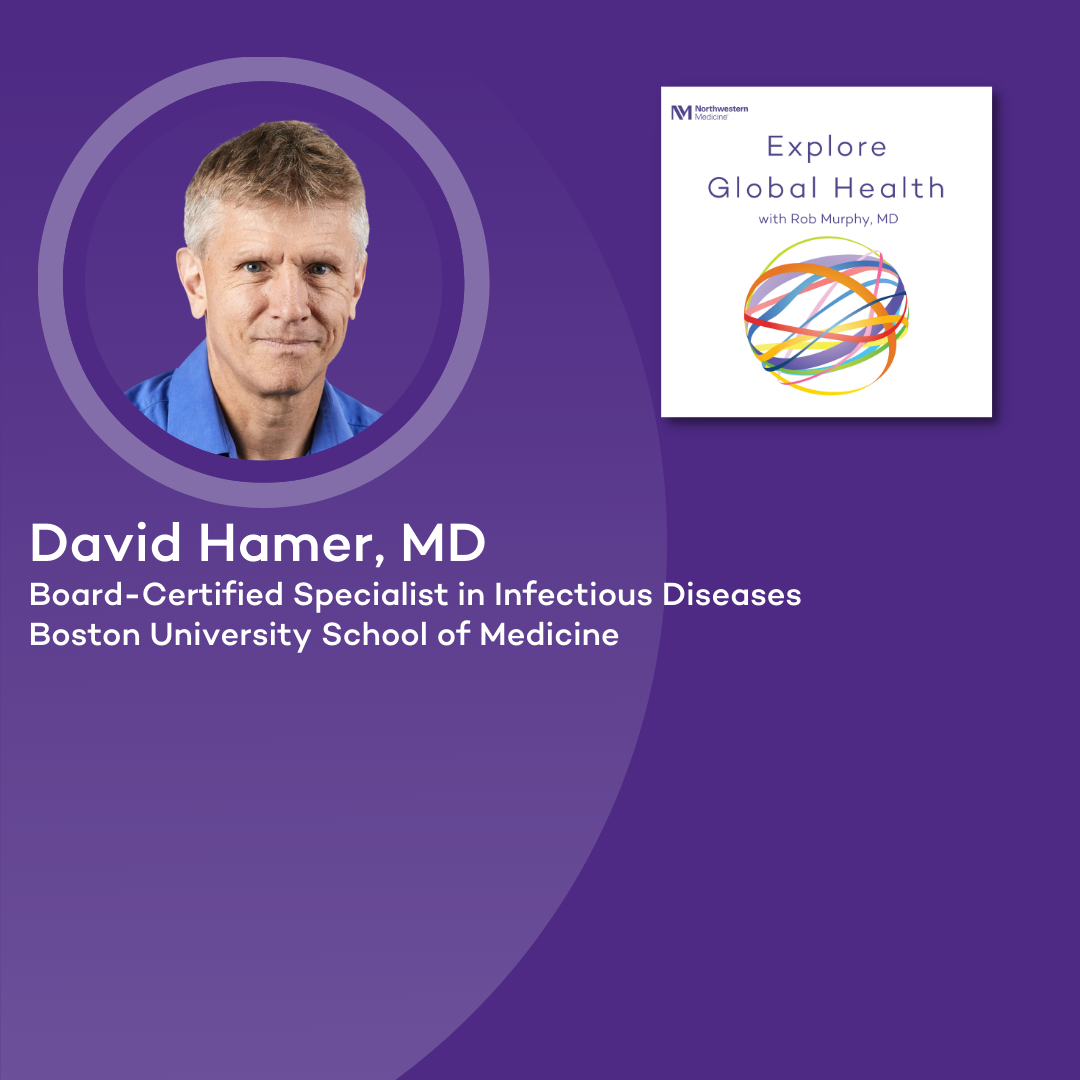
There are a lot of problems. I think (with) climate change, erratic weather patterns, we're going to be seeing a lot more outbreaks of arboviral infections in particular. I think malaria is going to continue to come back because of the peel-back of support from the President's Malaria Initiative and perhaps because of climate change. And, then there is likely to be more food and waterborne disease. So, there's going to be lots of global health questions to answer, but the question is, how are we going to have the resources to answer these?”
-
Professor of Global Health and Medicine, Boston University School of Public Health and Chobanian & Avedisian School of Medicine
-
Adjunct Professor of Nutrition, Tufts University Friedman School of Nutrition Science and Policy
Topics Covered in the Show:
- Hamer was born and raised in western New York, but gained a global perspective when living in Paris with his family his senior year of high school.
- During undergrad and medical school he took part in many international experiences and then cared for patients during the early days of the HIV epidemic in Washington, DC, which later led him to study HIV and opportunistic infections.
- Hammer says formative field experiences in Bangladesh, Bolivia, and India shaped his interests in nutrition, diarrheal disease, and tropical medicine.
- While in Zambia, Hamer helped shift failing malaria treatments from chloroquine to Artemisinin combination therapy and scaling diagnostics and community treatments.
- His wife, son, niece and two dogs lived with him while in Zambia and says the experience had a lasting positive impact on him and his entire family.
- Along with research and academic work, Hamer also leads the GeoSentinel Surveillance Network, which detects emerging outbreaks across the globe by tracking disease in travelers.
- During the COVID-19 pandemic, Hamer was involved in surveillance and response efforts and worked on emerging infectious diseases monitoring. He says some of the biggest lessons from the experience was the importance of rapidly developing and scaling diagnostic testing and the value of public health measures such as mask use.
- Hamer helps lead the GeoSentinel network, a global research and surveillance network of the International Society of Travel Medicine that tracks emerging infectious diseases through data from travelers and migrants.
- For those seeking a career in global health, Hamer advises students to seek field experience and cultural adaptability early in their training.
Show Transcript
[00:00:00] Dr. Robert Murphy: Welcome to the Explore Global Health Podcast. I'm Dr. Rob Murphy, Executive Director of the Havey Institute for Global Health here at Northwestern University Feinberg School of Medicine. Dr. David Hammer is a physician scientist whose career spans from the early days of the HIV epidemic to today's emerging and global threats. He's a professor of global health and Medicine at Boston University and an adjunct professor of nutrition at the Tufts University Friedman School of Nutrition, Science and Policy. David is also an infectious disease specialist with more than three decades of clinical care experience. His work is focused on malaria, HIV, maternal and child health, nutrition, and emerging infections with long-term research programs in Sub-Saharan Africa and Asia. Today he continues to lead major global health research and surveillance efforts, including projects on neonatal infections, emerging diseases, and pandemic preparedness. We're delighted to have him on the show today to talk about his career path in global health. Welcome, David.
[00:01:06] Dr. David Hamer: Thank you for having me.
[00:01:08] Dr. Robert Murphy: Let's go back to your very early days before medical school and the undergraduate years. Tell us about where you grew up and what first sparked your interest in science and medicine.
[00:01:19] Dr. David Hamer: I was born in Corning, New York, so western New York state and lived most of my life there other than a couple years in Virginia until I was 17, and, we were on vacation in Europe and had an extended vacation, partly 'cause my father had bought a new car and wanted to drive it a certain amount to bring it back as a used car 'cause there was less duty. And about two weeks before my senior year was going to begin, my parents said, we're not going home. We're gonna stay and live in Paris for two years. And so they enrolled us very quickly in the American School of Paris. I had actually studied Spanish for four years, and so I had to quickly pivot to French but because of that I could not go to Lycée. And basically, I became very interested in international travel and cultures and sort of cultural adaptability at an early age. I then went to Amherst College and on my first day in my dorm somebody walked down the hall and introduced himself to me and he was from Bangladesh. And he and I remain lifelong friends. But he kept saying, you've gotta go to Dhaka, you've gotta go to Bangladesh. And so I went through college. I did a double major in biology and French and eventually went to Bangladesh. But I can come back to that.
[00:02:24] Dr. Robert Murphy: You went to medical school, I understand at the University of Vermont and then trained in internal medicine before specializing in infectious diseases. How'd you end up at the University of Vermont? thought it was just everybody from Vermont and Massachusetts who used to buy seats at the University of Vermont.
[00:02:41] Dr. David Hamer: Yeah, so just a quick, after college, I spent two years working at Rockefeller University in New York. I actually had a pretty strong laboratory background when I started medical school because I'd done lab work also with a company called Ventrex And then the people that had run, that started Binax, which has been known for its diagnostic tests. Ventrex was based in Maine, so my parents were living in Maine and Maine, like Massachusetts had an agreement with the University of Vermont to take a handful of seats each year, and then the state of Maine would pay about half the tuition, but with a with aim that those people would return to the state of Maine once they'd completed residency and fellowship and then serve in underserved areas. By the time I finished the fellowship, I was focused on tropical medicine and Maine doesn't really have tropical medicine problems, so I ended up paying the state back. But that's how I ended up in Vermont.
[00:03:27] Dr. Robert Murphy: Okay, that's a very interesting story, how people end up in Vermont. 'Cause Vermont itself, of course, is such a small state with a low population, but they have a great medical school, obviously. Like me, you were treating patients during the early years of the HIV epidemic when people were often very sick and treatment options were very limited. How did that experience shape your career?
[00:03:47] Dr. David Hamer: It was tough. My internal medicine residency was done in Washington DC during a time when HIV was exploding. And also there's a concurrent crack epidemic. It was really tough. I would see people coming in with very low CD4 counts with AIDS wasting multiple opportunistic infections and then they would die. Either during that hospitalization or in the months to follow. And so it was really a very sad time. But then glimmers of hope arose when AZT became available. But then we very quickly realized that monotherapy wasn't good and then sort of combination therapy. And it really changed the disease from something that was basically a death sentence to something that could be managed and people could survive. And so that was a multi-year evolution and included time during my fellowship when I was focused on AIDS opportunistic infections. I did a lot of work on cryptosporidium and cryptosporidiosis in the context of AIDS and also AIDS wasting. And that created, I think, a long-term interest in HIV.
[00:04:42] Dr. Robert Murphy: When you were in DC were you at Georgetown or where were you?
[00:04:45] Dr. David Hamer: I was at the Washington Hospital Center, which is now affiliated with Georgetown. At that point in time, it had its own residency program. There were Fellows, GI, and certain other specialties from GW although the hospital center had its own infectious disease fellowship and they're very busy. I mean, it's a thousand bed hospital, all adults. There are, I think, like six ICUs. It really is an amazing place to train just because of the volume and the breadth of patients that are seen there.
[00:05:12] Dr. Robert Murphy: After your infectious disease training you began working in tropical medicine and travel medicine and gradually became more involved internationally. Other than living a couple years in Paris what drew you into this global health sphere?
[00:05:25] Dr. David Hamer: I think a couple things. One, during medical school, as I mentioned, my friend from Amherst College kept saying, you gotta go to Bangladesh. Well, I went to Bangladesh. I spent two months in Dhaka between my first and second year and did nutrition research and then also worked helping out with some race-based ORS studies at the I-C-D-D-R-B International Center for Diarrhea Disease Research, Bangladesh teaching hospital, and learned a lot about diarrhea, various tropical infections. And then also undernutrition and micronutrient deficiencies, which have become a long-term interest of mine. During fellowship, I purposely selected training programs that had a global health focus. And in the early nineties, there were a lot fewer of them than there are now. And Tufts was part of a Rockefeller funded network that was called geographic medicine. So, my department was actually infectious disease and geographic medicine, and they had a long-term relationship with the Christian Medical College in Vellore, India. And did a lot of collaborative work on diarrhea. So that began to perk my interest. In my fourth year of medical school, I went to Bolivia and spent two months working at four different hospitals and learned to moderately Spanish, but also saw a lot of tuberculosis and various viral and parasitic infections that were endemic in the country. And because of that, I began to be interested in global health. But it was really shortly after my infectious disease fellowship that I was offered an opportunity to apply to a position at the Harvard Institute for International Development, the health office. So. The Institute really was mostly economists doing both macro and microeconomics and helping low and middle income countries. But the health office was doing policy and guideline relevant implementation research on child health.
[00:07:04] Dr. Robert Murphy: Let's Talk about BU, my alma mater. You joined in 2001 and built a global research program focused on malaria, maternal and child health, nutrition, and infectious diseases. What were some of the major questions you wanted to answer early in your career?
[00:07:19] Dr. David Hamer: Early in my career, my major focus was on malaria, but also a little bit on micronutrient interventions. And there were a number of questions. One we looked at very early on was looking at the potential role of zinc as an adjunct to treatment of malaria. At that point in time, there had been a whole body of work done for zinc and diarrhea where there's clear evidence of benefit and shortening duration of an episode, but also preventing subsequent episodes. There was some work on zinc and pneumonia. In fact, I ended up doing some work on that in Ecuador. And using zinc as an adjunct to treatment. We tried to do this with malaria. We did a five country study and it didn't work. But that led me into a great interest in malaria resistance because at that point in time, chloroquine was still being used in Sub-Saharan Africa as the mainstay of treatment, and yet there's clear evidence that it was not working well, affecting 60 to 80% treatment failure rates. And there was actually some evidence of mortality associated with continued use. And so I became very involved in the country Zambia, with the National Area Control Program, helping them to basically change their guidelines. And we did in vivo efficacy studies around the country showing that chloroquine is failing. That sulfadiazine pyrimethamine was not working very well as well, and that artemether-lumefantrine form of Artemisinin combination therapy was highly efficacious. And so that led us to basically convince the Ministry of Health to change their guidelines. And so Zambia was the second country, after South Africa, to change artemisinin combination therapy. But then subsequent questions arose like, how do you scale it up? It's a more expensive drug. How do you improve diagnostics for malaria? And so over the next few years, another major focus was using rapid diagnostic tests for malaria and trying to get healthcare workers to believe in the test, because often they said well, it's negative, but the person has fevers. It's gotta be malaria. And that dogma took a good decade to change. So anyways there are other questions related to malaria that eventually arose. In fact, how do you improve delivery of treatment at the community level? Because a lot of people are forced to go to a health center, but, they might have an hour walk there or a half day walk, and so they can't access care. So that led to a body of work on integrated community case management, which is an equity based strategy to try and deliver treatment for malaria, pneumonia, and diarrhea at the community level.
[00:09:38] Dr. Robert Murphy: I understand you actually spent several years living in Zambia. How long did you stay there and did you bring your family? This question actually comes up quite a bit when our younger trainees all of a sudden get an opportunity to go, but they've got a spouse or they've got kids maybe. What did you do?
[00:09:53] Dr. David Hamer: I almost moved to Zambia once, and then the funding became complicated and fell through and then I ended up with a large Gates Foundation Grant to do a community-based neonatal survival project. And I said, now's the time to go again. And so at that point, one of my sons was in a boarding school, so he did not come, but my other son came and actually my niece came and my wife and our two dogs. So we all moved there. I was there for a year with my younger son before everybody else came, and then they were there for two years. I ended up staying almost four years altogether. And I would say, for me it was a fantastic experience. It's like being in a public health candy store. There's so many opportunities to collaborate. There's a lot of funding that's targeted for local organizations and we had a locally registered NGO. And so it was really good from a sort of a scientific public health standpoint, but for my family I think it really had a profound impact on both my son and my niece. And my son now is very intrepid and has worked and lived in a number of countries. In fact he ended up working in Khartoum. He learned to speak Arabic uh, Sudanese, Arabic and worked there for a while before the revolution. Got out before things got difficult. Of course then he went and traveled to Nigeria. Made a lot of friends in Legos. And my niece also she's become very interested in the world and she's a social worker now but loves to travel. So I think it had a very positive influence. And actually, my son by the time he graduated from American International School, Lusaka, his absolute best friend was Sudanese and he had other friends from Angola, Zimbabwe, Zambia, a very African focused set of friends.
[00:11:24] Dr. Robert Murphy: We got a lot of questions from young trainees who are planning on going over for, month, two months, three months even a year fellowship abroad. And a lot of them, of course, are very concerned about their own health. You are in this milieu. I don't know if it's too personal, but did you ever have malaria yourself or any tropical disease? I personally did it myself. I unfortunately had malaria several times. The first time was very rough. What about you?
[00:11:48] Dr. David Hamer: Because I started running a travel clinic as an ID fellow in 1992. I've been very careful with malaria and have always taken prophylaxis. And so I have not had malaria, but I have had traveler's diarrhea, 15 plus times, including, Shigellosis at least once. You know as they say traveling expands the mind and loosens the bowels.
[00:12:09] Dr. Robert Murphy: Yes.I was over there so much for a 20 year span that I just couldn't tolerate the prophylaxis anymore, so if I've felt like I had a big fever, if I felt like I had malaria or I could get a diagnosis, a lot of times I couldn't, I would just treat myself, after that first time I was able to control it. But yeah, we get through it.
[00:12:28] Dr. David Hamer: I would say, malaria for somebody who's living long term in particular Sub-Saharan Africa and countries that are hyperemic for malaria it's hard to stay on prophylaxis long term. So you know, having your own supply of Artemisinin combination therapy, perhaps, if you're up to doing your own finger prick, a rapid diagnostic test, you can basically self-treat if you develop malaria that is a good option.
[00:12:48] Dr. Robert Murphy: You've talked about how the biggest obstacles in global health are often health system challenges, staffing shortages, transportation, infrastructure, supply chains. How do you help people entering global health today understand and address these types of challenges?
[00:13:03] Dr. David Hamer: A lot of those are country level challenges and if you're gonna be developing research collaborations in a country you need to be aware that you're gonna run into some of these barriers and ideally have good local collaborators that can help work through them. I have so many examples of challenges especially with medication and medical supply distribution, but also human resources as well as, transportation, flooding and, impassable roads. There's just a lot of logistical problems but, if you're working closely with a good set of collaborators, they can help you, be aware of what to expect, and then troubleshoot when problems arise.
[00:13:39] Dr. Robert Murphy: You now help lead the Geos Sentinel Surveillance Network, which uses travelers and migrants as sentinels to track emerging infectious diseases around the world. Can you tell me about this group and its effort to reduce infectious diseases worldwide?
[00:13:53] Dr. David Hamer: Geo Sentinel is a surveillance network that's been in existence for almost 30 years now. It's expanded about 10, 15 years ago. When I was moving back from Zambia, I had a sort of a gap in salary coverage and wanted to do something a bit different. And so the CDC approached me and said, would you be willing to lead Geo Sentinel? I knew what it was, but I didn't know all the details. But Geo Sentinel today we built it up further is a network of about 70 tropical medicine sites. And I say sites 'cause it's sometimes a clinic, sometimes it's a hospital or both in different parts of the world, mostly in high income countries that see returning travelers, migrants, and refugees. But the interesting thing about Geos Sentinel is it's really a sensitive tool for identifying outbreaks in different parts of the world, especially I'd say Arboviral outbreaks, Dengue, Zika, Chikungunya, Oropouche virus. And sometimes we're one of the first alerts of new outbreak. Partly because many countries did not have really good diagnostic capacity. And so they may have an outbreak going on and they don't have the tools to make a diagnosis. And therefore it's a traveler to that country that returns to Europe or the US maybe the first person to identify it.
[00:15:01] Dr. Robert Murphy: During the COVID-19 pandemic, you were involved in surveillance and response efforts and worked on emerging infectious diseases monitoring. What were some of the most important lessons learned from the COVID-19 pandemic from a global health perspective?
[00:15:14] Dr. David Hamer: A couple. I think one is diagnosis: in the very early phases there were very few places that had diagnostic tests. My collaborators in Europe were able to actually very quickly develop PCR tests. The CDC tried to control that in the US and made mistakes. And because of that, we had a delay for, first couple months. We really didn't have good diagnostics, whereas the Europeans were two steps ahead of us. Rapidly scaling up diagnostic testing is important to be able to identify people. Another sort of important part is really personal precautions, including masks and masks I think have played a major role. And again, the US was slow to implement them. Other countries were as well.We did not have a culture of using masks in the US and it took some time. I was actually in Japan in late January, 2020 and we were watching the news in the evening and they were talking about this virus in Wuhan, and then that virus had spread to other provinces in China, and then suddenly it was coming into Japan just as we were getting ready to fly back to Tokyo. And on the return flight, I'd say three quarters of the Japanese were wearing a mask, whereas on the way up to Hokkaido, they hadn't been wearing masks, so just automatic. Whereas in the US it took a while. And then I'd say the other thing is the rapid vaccine development and implementation. But globally, you know, it's interesting that in Africa people said we're not really having COVID. It's not a problem. And that wasn't really the case. It was a problem but it was lost in all the other sorts of chronic problems that many countries face, like malaria and other things. But eventually, there were deaths due to COVID in many countries.
[00:16:45] Dr. Robert Murphy: Was a lot less than projected and really tried to look at this very closely. I think at the end of the day, there's a bunch of reasons for that. But I think the predominant one is the median age in say Nigeria is 18, and it's just this young population that can handle it. I have Nigerian friends who died of COVID. Obviously it's there, the hospitals over there were not overwhelmed and they had it, but it was not as much as really they had projected.
[00:17:11] Dr. David Hamer: I think age and maybe, cross protective immunity from other coronaviruses. There are other factors that may have explained it. Yeah.
[00:17:18] Dr. Robert Murphy: Exactly. It's not one answer for sure, but it was surprising how that played out. You and I have worked together in the HBNU Fogarty Global Health Training Program. So HBNU. H is Harvard University, B is Boston University, N is Northwestern University, and U is University of New Mexico. And we give trainees the chance to do mentored research in low and middle income countries. Trainees from the US go there. But the ones that we fund over there, stay there and we just give them a mentor and they get a project. From your perspective, what makes a partnership like this work and why is it so important to train young investigators through programs that involve multiple institutions and long-term international collaborators?
[00:18:02] Dr. David Hamer: I think combination of things. Effective leadership and that really is not just Harvard, which is in the lead but I'd say all four of the universities. But also collegial, collaboration and then having good opportunities on the ground in lower middle income countries. Harvard, Boston University, University of New Mexico, Northwestern University have strong collaborations in a large number of countries. Many of them in Sub-Saharan Africa, but not completely. And I think that provides good opportunities for places for clinician scientists and others in the US to go train. It's an amazing opportunity for young investigators to have a strong global health experience with good mentoring and learning about the collaborations between north, south or high income, low income countries and how they work. Because if they're gonna be going into global health, they have to find ways to make this work for themselves. This program is really a fantastic opportunity for people to really get a feel for global health research and jumpstart their career.
[00:18:57] Dr. Robert Murphy: Currently you have projects underway, I think in Bangladesh, Zambia and the US focused on neonatal infections, nutrition, and emerging diseases. What are the global health challenges that concern you the most right now, like today, like 2026?
[00:19:12] Dr. David Hamer: I think unfortunately, one of the things that concerns me the most right now is the current administration of the United States and its sort of policies and approaches to global health. I have had a lot of funding from the US Agency for International Development. In fact, pretty much continuous funding from 1995 until 2020 or 2021. And that has funded a lot of really practical implementation research and capacity strengthening in low income countries. And all that's been eliminated. I've collaborated with the Presidential Malaria initiative on malaria control efforts. That too has been eliminated. And I think that there's a real threat to global health funding from the United States right now. And this is leading a lot of people to go to the Gates Foundation, to the Welcome Foundation which has made applications to these organizations much more competitive. I think funding and sort of the US interest in global health is a problem. And then unfortunately ,there's a lot of unhappy collaborators both in low income countries, but also my European collaborators that have very negative feelings about the United States right now. So we've had a real negative hit on our reputation. But that said, there are a lot of problems. I think climate change, erratic weather patterns, we're gonna be seeing a lot more outbreaks of arboviral infections in particular. I think malaria is gonna continue to come back because of the peel back of support from PMI. And perhaps because of climate change and then there is likely to be more food and waterborne disease. So there's gonna be lots of global health questions to answer. But the question is, how are we gonna have the resources to answer these?
[00:20:44] Dr. Robert Murphy: I have one last question, David. What advice do you have for young people today who are just now embarking or wanting to embark on a career in global health.
[00:20:53] Dr. David Hamer: I mean, I think it's important to get field experience to try and do something even if it's just a month in a place or two months in a place. Beginning to get a feel for some of the problems in countries that you might work in. But also learning cultural adaptability. Each country and even within a country, there are quite a bit of differences, sociocultural differences and beginning to learn those and how to function in a very different context is very important for helping to start a career in global health.
[00:21:20] Dr. Robert Murphy: David, thank you so much for spending the time with me today and for telling us about your incredibly impressive career. Thanks so much.
[00:21:28] Dr. David Hamer: My pleasure.
[00:21:29] Dr. Robert Murphy: Follow us on Apple Podcasts or wherever you listen to podcasts, to hear the latest episodes and join our community that is dedicated to making a lasting positive impact on global health.