Bringing Cancer Prevention to Underserved Communities with Lifang Hou, MD, PhD
Tracing a trajectory from her medical education in China through a masters degree and PhD in Japan and a fellowship at the National Cancer Institute, Lifang Hou, MD, PhD, has cultivated an international career which now includes spearheading global cancer prevention initiatives that span from Africa to South America. In this episode, she discusses her career journey and how her work in genetics, epigenetics, and early cancer detection is helping bring affordable screening and prevention strategies to underserved communities around the world.



After discussions with the Flanagan Foundation, they liked our idea and funded two mobile clinics. We designed the trucks to be durable enough for rough roads, which enabled our team to go to underserved communities to screen women. We carefully designed the trucks so women testing positive for certain viral infections would not be seen by their friends or neighbors; they do their own sample collection on the bus. We test their viral infection status on the same bus. If they need to be treated, we examine and treat them on the bus as well. It has been a very successful initiative that I will be proud of for the rest of my life, as will all our team members.”
-Lifang Hou, MD, PhD
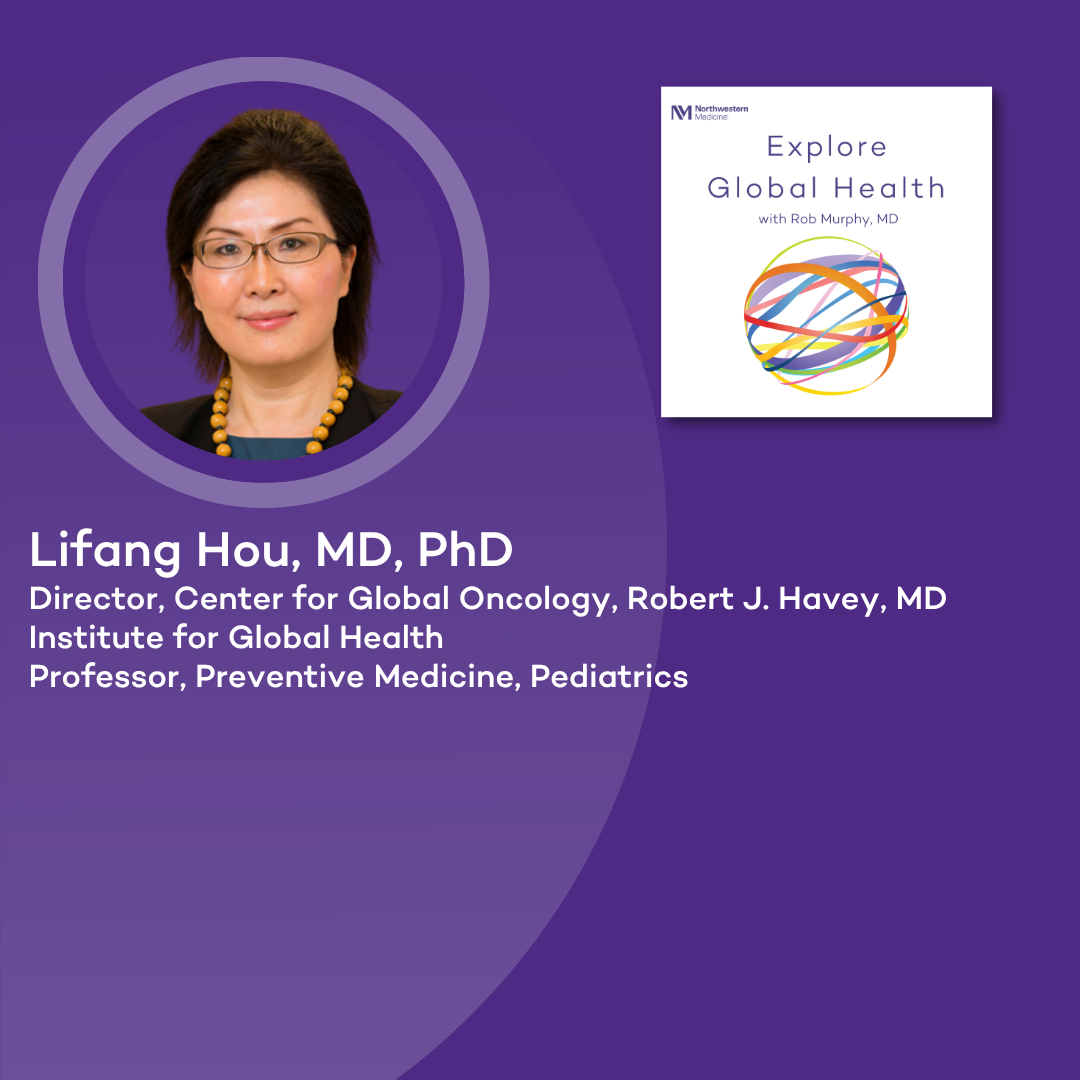
- Director, Center for Global Oncology, Robert J. Havey, MD Institute for Global Health
- Professor, Preventive Medicine, Pediatrics
Topics Covered in the Show:
- Hou initially dreamed of becoming a journalist, but her father encouraged her to attend medical school, believing it would provide independence and stability. She became a physician at just 21 years old in China and quickly found herself asking bigger questions about why some patients developed diseases while others did not. Those questions sparked her lifelong interest in understanding the environmental, lifestyle, and biological factors that influence health.
- Seeking answers beyond clinical care, Hou pursued a master's degree in community medicine and a PhD in human genetics in Japan. Inspired by the scientific literature coming from the United States, she joined the National Cancer Institute as a postdoctoral fellow, where she spent more than five years integrating her clinical, public health, and genetics training. There, she learned how environmental exposures, behavior, and genetic background interact to influence disease risk.
- After joining Northwestern University in 2007 and beginning her independent research career, a pivotal moment came when her father developed lung cancer in 2008, after years of smoking. The experience reinforced her determination to study how environmental and lifestyle factors contribute to cancer. This led her to focus on epigenetics, a field that examines how environmental influences interact with genes to affect health outcomes and disease development.
- Through collaborations in Africa and later Latin America, Hou helped build major cancer screening and research initiatives focused on cervical cancer, oral cancer, and breast cancer. What began with projects in Nigeria and Mali grew into a network spanning multiple countries across West Africa, East Africa, and South America. Her team's goal is to generate scientific evidence, improve implementation of screening programs, and help low- and middle-income countries adopt effective cancer prevention strategies.
- Hou describes her work developing biomarkers that may one day detect cancer risk from a simple blood sample, as well as noninvasive screening methods for cervical cancer using patient-collected swabs. Recognizing that many women face financial, geographic, and cultural barriers to healthcare, her team launched mobile clinics that travel into underserved communities. These clinics allow women to self-collect samples, receive testing, and obtain treatment in a private and accessible setting, an accomplishment she says will remain one of the proudest achievements of her career.
Show Transcript
[00:00:00] Dr. Rob Murphy: Welcome to the Explore Global Health Podcast. I'm Dr. Rob Murphy, Executive Director of the Havey Institute for Global Health here at Northwestern University Feinberg School of Medicine.
[00:00:21] Dr. Rob Murphy: My guest today, Dr. Lifang Hou, has spent much of her career trying to understand environmental and lifestyle risk factors that lead to chronic disease and cancer around the world, and how early interventions may help prevent these diseases. She is director of the Center for Global Oncology here at the Havey Institute and Professor of Medicine and Pediatrics at Northwestern University Feinberg School of Medicine. Today we're gonna discuss her career journey from early years in China and her training as a physician to her work building global cancer prevention programs and training the next generation of researchers around the world. Welcome, Lifang.
[00:00:57] Dr. Lifang Hou: Thank you, Rob, for having me.
[00:00:59] Dr. Rob Murphy: Let's start at the very beginning where you were born and raised in China. Tell me about your early years, what your childhood was like, and how did you get set on your path for a career in medicine?
[00:01:11] Dr. Lifang Hou: Rob, I grew up in China. My mom was a physician, so I have seen her always treating patients, but I was not interested in medicine at all because I saw her busy schedule; someone was always coming to get her to go to their home to treat them. I was really interested in being a journalist. However, when I was in high school, I was actually only 16. Because of the system in China, we can go to medical school right after high school. So, my father asked me to apply for medical school. I was like, "No, I'm not interested in that." But my father said, "I see your heart. I see how good you are with people. And also, I want you to be an independent woman who can support herself no matter what." Back then, my father had gone through the Chinese Cultural Revolution and he always worried if I was not able to support myself. So, I just went to medical school. Actually, that was my father's will, and I became a physician at 21, when I was very young. So I started treating patients. I always had questions about my patients who came to me: Why did these patients develop this disease, and why didn't this patient's family member? Is there any pattern? Is it any lifestyle factors or environmental factors causing their diseases, instead of only focusing on treating the patients? Actually, I was very much liked by our patients because I was always thinking and asking questions. Those questions led me to my master's program in Japan. That was in community medicine. So I had the opportunity to go to Japan to study community medicine. After my master's degree, I became very interested in genetics. I was wondering what genetic factors can affect people's health, so I became a PhD student in human genetics in Japan.
[00:03:20] Dr. Rob Murphy: In Japan. Oh, so you got a PhD and a master's degree in Japan.
[00:03:24] Dr. Lifang Hou: Yes.
[00:03:25] Dr. Rob Murphy: What school were you at in Japan?
[00:03:27] Dr. Lifang Hou: It was at Tsukuba University, which is in a Japanese scientific city, Tsukuba City, nearby Tokyo.
[00:03:35] Dr. Rob Murphy: Was that training in English or was it in Japanese?
[00:03:38] Dr. Lifang Hou: We read all the papers in English, but when we did presentations and had discussions with our PhD supervisors and group meetings, we had to speak English or Japanese. But sometimes, of course, we are foreigners there, so we mixed Japanese and English—whatever we could do to convey our message. After my PhD in Japan, you know, I read all the papers in English. Most of them were published by U.S. scientists. So, I developed a dream to come to the U.S. because I thought that was the top of science in the world. I went to the National Cancer Institute in Bethesda to become a postdoctoral fellow, where I had the opportunity to combine my clinical training, my community health training, and my genetic training from my PhD all together. This was back at the time when genetic variants were first being introduced to disease studies.
[00:04:43] Dr. Rob Murphy: How long were you at the NCI?
[00:04:45] Dr. Lifang Hou: I was there for five and a half years. Yeah, to me, that was a very critical time for my career development. I had the opportunity to interact with top-class scientists who were using human samples, epidemiology, and clinical data to link people's behavior, environmental exposure, and genetic background to their disease risk.
[00:05:13] Dr. Rob Murphy: You came to Northwestern in 2007 and you built your research program focused on early detection and prevention. What were you hoping to accomplish when you first arrived?
[00:05:24] Dr. Lifang Hou: After my training at the NCI, I felt I was ready to develop my own career and become an independent scientist to answer the scientific questions I always wanted the answer to. I had the opportunity to join Northwestern as a junior faculty member. I started applying for my own NIH grants using my own scientific ideas. I had to, of course, reach out to develop my own collaborations and find my own research resources, which really helped me to develop my own independent scientific career. In 2008, my father, who was a heavy smoker, developed lung cancer. That made me even more determined. I wanted to go into science that would really help us understand how environmental exposure or lifestyle factors can affect our health, and in particular, cancer development. So, I started doing my research on epigenetics instead of only genetics, because epigenetics is the field that studies the interaction between environmental factors and our genetics and how they can together affect our health outcomes. I started working on my epigenetic projects. And Rob, that's when you invited me to go to Africa. That changed my whole research portfolio by expanding my research into global oncology.
[00:07:04] Dr. Rob Murphy: That was a nice shift for you and for us, of course, to get your expertise translated globally.
Today you're the director for the Center for Global Oncology here at the Havey Institute for Global Health. And when you look at cancer globally, especially in the low and middle income countries, what gaps in prevention and early detection concern you the most?
[00:07:26] Dr. Lifang Hou: Rob, as you know, we have been working toward cancer prevention globally. I think in low- and middle-income countries, the challenge is access to the innovative, advanced technologies that we are using in the U.S. for cancer prevention and treatment. That also makes cancer prevention much more important—to join the efforts between us and our LMIC partners. Prevention costs much less, and many things can be done if we do them correctly and timely, even decades before cancer develops. So, that's where I feel the gap is: there's a knowledge gap, of course, a systemic gap, and also a financial gap. But as scientists, I always say we cannot change everything, but at least we can do what we do as scientists. That's to work with our partners in LMICs to develop the right strategies by providing the scientific evidence to the policymakers and the government to see what we can do together to perform cancer prevention effectively. We have also been working together, not only among our center members but also by collaborating with our innovative technology center team members and reaching out to any industry that has affordable, easy-to-use, and implementable technology for LMICs to use. In the meantime, we also do implementation studies to understand the barriers and facilitators to implementing WHO recommendations. For example, cervical cancer screening recommendations have been changed by the WHO from VIA to the HPV DNA test.
[00:09:29] Dr. Rob Murphy: That's great. Your global health projects span several countries including research, training programs and cancer prevention efforts. Can you walk us through the major global health projects you're currently involved in today and what you're trying to accomplish?
[00:09:45] Dr. Lifang Hou: Yes, the Center for Global Oncology initially focused mostly on West Africa, in particular two countries, Nigeria and Mali, because of the long-term partnership—thanks to you, Rob, for the opportunities and the research capacity you built for us as a pioneer. We set up our NIH-funded U01 on cervical cancer screening and also an R01 on oral cancer studies. In the meantime, we also established our mobile clinic network in these two countries. However, our efforts to expand our influence, our impact, and our work in Africa never stopped with only those two countries. We expanded to several other West African countries, including Ghana and Burkina Faso.
[00:10:41] Dr. Rob Murphy: And Senegal.
[00:10:42] Dr. Lifang Hou: Senegal, yes. In the meantime, we expanded our network to East African countries. Now we are in Kenya, Tanzania, and Ethiopia. So, now we are not only working in African countries; we have also expanded our cervical cancer research and breast cancer research to several South American countries, including Chile, Argentina, Colombia, and Mexico. These new initiatives are still in their infant stage because we want to really establish solid collaborations instead of rushing into any immature collaborative relationships. We are going slowly at the beginning, but I have a good feeling that all these initiatives will lead to a bigger achievement in the future for us to really fulfill our mission, which is global cancer prevention.
[00:11:37] Dr. Rob Murphy: It's really great to look back at the history that we have here, in that it really started in the late 1990s with a focus primarily on HIV. We were very much involved with PEPFAR. I was the country director for Nigeria, but we had our footprint in Tanzania and Botswana, and we evolved through the years to the point where we can actually include cancer prevention and even some surveillance and treatment as well. It's really been an incredible story. Let's talk about the focus of your work. You've mentioned it already, but I think it's so fascinating. Much of what you're doing involves biomarkers and early detection. How do you translate discoveries from the laboratory and population research, which you're so good at, into tools that can be used in resource-limited settings?
[00:12:26] Dr. Lifang Hou: First, my research focused on using white blood cells, but that has limitations because epigenetic biomarkers are tissue- and cell-specific. So, sometimes when we find significant biomarkers, we don't know if those biomarkers are tissue-specific or cancer-specific. We shifted, Rob, as you recall, to our liver cancer project, using circulating cell-free DNA for our liver cancer biomarker development. This will help us to really use one drop of blood in the end to detect if a person has a higher risk for certain cancers. We were using circulating DNA several years ago when people were still in LMICs using whole blood for genetics. We were very ahead of the game, and that study has led us to several high-impact publications. I think our next step is really working with industry and even our own Northwestern collaborators with different expertise and science focuses to develop these biomarkers into affordable, easy-to-use technology that can be brought back to our LMIC partners. So, I think that's the way to go. Also, in terms of cervical cancer, the tissue is very accessible. We are not only using biopsy or tissues; we are also using swabs because it's non-invasive. We can easily get the samples. If we can establish biomarker assays that can be easily used non-invasively to detect cancer at a very early stage—because the earlier you diagnose them, the better treatment outcome the patients will get.
[00:14:21] Dr. Rob Murphy: Yeah, I understand that the focus of that West African cervical cancer screening program is actually the specimens that can be collected by the patient.
[00:14:29] Dr. Lifang Hou: Yes. So, that's another thing. As I mentioned, the WHO has recommended—and even the U.S. Cancer Society has made the recommendation—to use patient-self-collected vaginal swabs for HPV tests because certain HPV virus strains cause cervical cancer. So, if we know who has this viral infection, that means we know they are at high risk, and then we can monitor them regularly to see if they develop cancer. We will know at a very early stage and then intervene. So, that's something we are also doing in several African countries, as we just mentioned.
[00:15:11] Dr. Rob Murphy: I think it's really very unique for you as a medical researcher and cancer prevention specialist to go from developing molecular biomarkers to an easier collection system that lowers the price and makes things much easier. And then finally, to get that process out into the field with these mobile clinics that you're working with that were generously funded by the Flanagan Foundation. Very few people, actually, have that span of that portfolio in the same area. Could you comment on that? How did that even happen? How does a person actually do all those things?
[00:15:50] Dr. Lifang Hou: Thank you, Rob. Our mobile clinic was developed out of all our previous interactions with local partners and the challenges we faced during our previous studies. Many women living in underserved communities in Africa have no access to healthcare, let alone preventive measures. We learned that we needed to reach out to them and go to their communities instead of always asking women to come to the clinic. Some women cannot afford to travel to the clinic, and there are also cultural barriers. If they visit a doctor, their neighbors and families might suspect something is wrong. Cervical cancer is related to sexual activity, and a diagnosis can affect a woman's life in her community and family. We communicated with several foundations, and after discussions with the Flanagan Foundation, they liked our idea and funded two mobile clinics. We designed the trucks to be durable enough for rough roads, which enabled our team to go to underserved communities to screen women. We carefully designed the trucks so women testing positive for certain viral infections would not be seen by their friends or neighbors; they do their own sample collection on the bus. We test their viral infection status on the same bus. If they need to be treated, we examine and treat them on the bus as well. It has been a very successful initiative that I will be proud of for the rest of my life, as will all our team members.
[00:18:03] Dr. Rob Murphy: I have one last question for you, Lifang. I ask everyone I interview for this podcast series: What advice do you have for young people who are just embarking on, or thinking about embarking on, a career in global health? It is a challenging time, as you know.
[00:18:20] Dr. Lifang Hou: Yes. I would say never give up. The future sometimes looks uncertain, but please do not give up on your dream. When I was little, I wanted to be a journalist, as you mentioned, because I wanted to make an impact. That is how I thought I would be able to do so. I went into the medical field because of my father, but in the end, I think I linked my own dream with the dream my father had for me, and I made it happen. So my advice is: never give up. Making an impact on society and on people will be your drive, and then you will succeed.
[00:19:00] Dr. Rob Murphy: Well, thank you very much, Lifang. It has been a pleasure. I know more about you now than I ever did before—and I know you pretty well—so thank you very much for joining us today and telling us this remarkable story.
[00:19:11] Dr. Lifang Hou: Thank you, Rob, for having me.