BONUS: Why Africa's Microbiome Matters to Global Health with Thulani Makhalanyane, PhD
Africa is home to extraordinary microbial diversity, yet much of it remains understudied, leaving critical gaps in our understanding of human health, disease and the environment. In this bonus episode recorded at the 2026 Stellenbosch University–Northwestern University Global Health Knowledge Hub Conference, Rob Murphy, MD, speaks with Thulani Makhalanyane, PhD, a professor at Stellenbosch University and leader of the African Microbiome Project. They explore how studying Africa's microbial communities could transform our understanding of health, why African scientists must lead research on the continent, and how equitable international partnerships can expand scientific infrastructure, training and opportunities for the next generation of researchers.



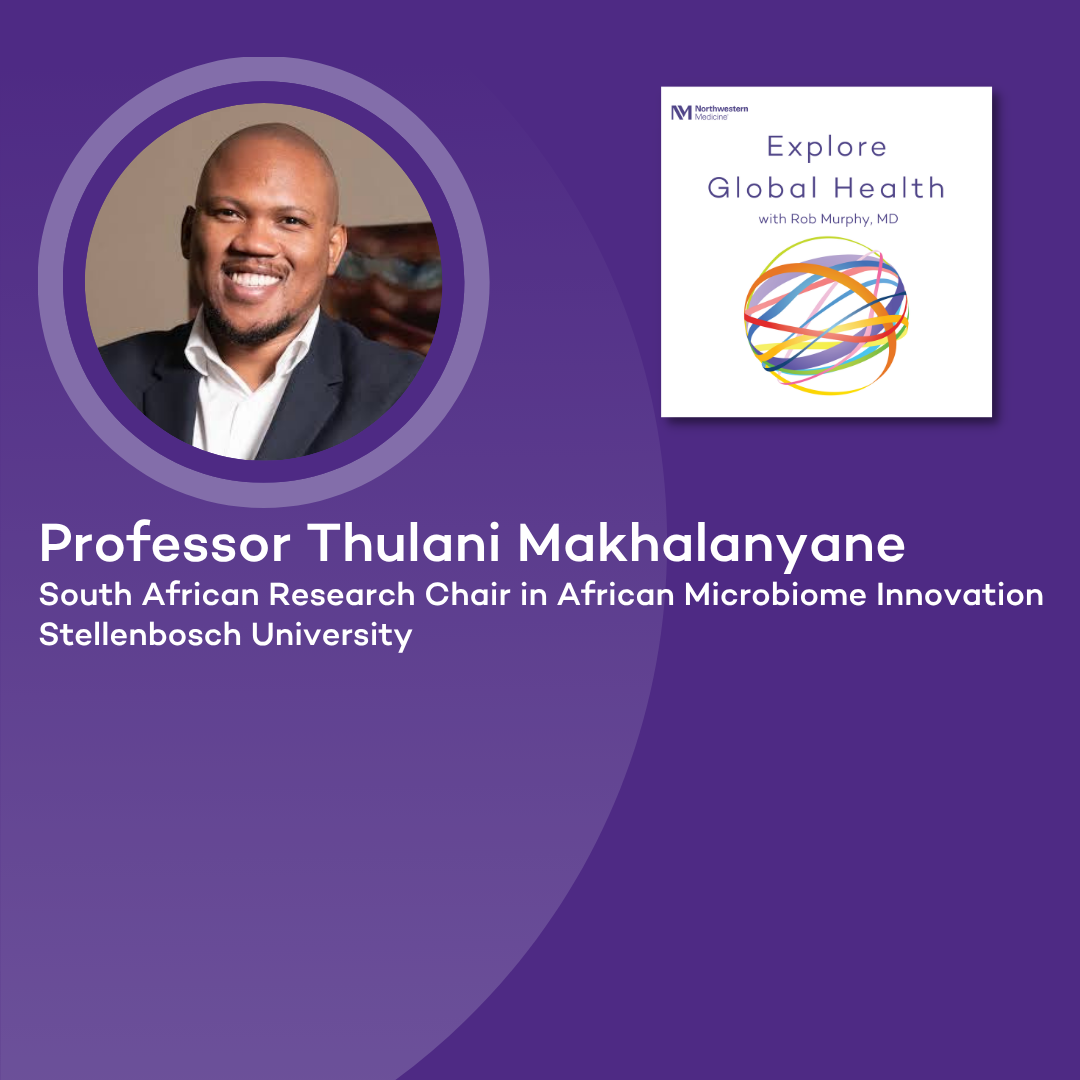
The wonderful thing is that through our collaborations and partnerships with Northwestern, you tend to meet people who are very much aligned. Because we all have, in addition to our scientific curiosity, a desire to do good. And part of doing good is ensuring that the capacity and resources that are available in South Africa are shared quite equitably across the continent.”
- Thulani Makhalanyane, PhD, professor in the Department of Microbiology and the School of Data Science and Computational Thinking at Stellenbosch University
Topics Covered in the Show:
- Understanding Africa's microbial diversity: How the African Microbiome Project is uncovering previously understudied microbial communities and why differences in diet, environment and microbial composition matter for human health and medical research.
- Strengthening African-led scientific research: The need to expand genetic sequencing infrastructure, research policies and scientific training across Africa to enable local scientists to lead discoveries and establish research priorities.
- Building equitable global health partnerships: How the longstanding collaboration between Stellenbosch University and Northwestern University can support shared scientific expertise, cross-institutional training and new research opportunities for early-career scientists.
Show Transcript
[00:00:00] Dr. Rob Murphy: Welcome to the Explore Global Health Podcast. I'm Dr. Rob Murphy, executive director of the Havey Institute for Global Health here at Northwestern University Feinberg School of Medicine. Welcome to a special edition of Explore Global Health. Coming to you from the 2026 Stellenbosch University, Northwestern University Global Health Knowledge Hub Conference on the Northwestern campus. My guest now is Professor Thulani Makhalanyane, an internationally recognized microbiologist and research leader at Stellenbosch University, where he's a professor in the Department of Microbiology and the School for Data Science and Computational Thinking. He also leads the African Microbiome Project, an ambitious effort to better understand Africa's microbial diversity while building research capacity across the continent. We're thrilled to have him on the show to talk about the enormous potential for African-led science, why international research partnerships matter, and what bringing together researchers from Stellenbosch and Northwestern could make possible. Professor Makhalanyane, welcome to Explore Global Health.
[00:01:09] Thulani Makhalanyane: Thanks Rob. It's good to be here with you and thanks for the opportunity.
[00:01:13] Dr. Rob Murphy: You are helping lead the Stellenbosch delegation here as our universities come together to discuss some of the biggest challenges in global health. From your perspective, what makes this partnership and this moment to come together so important?
[00:01:26] Thulani Makhalanyane: Yeah. As you know, universities tend to sign many agreements with institutions around the world. Agreements exist only on paper. So it's quite rare to have partnerships that are in a sense living as the one that we have with Northwestern University. It's important because we have lots of challenges from a global health perspective. The relationship has existed for about 20 years where we tackle a range of different issues ranging from noncommunicable diseases. The intention of this event is just to ensure that we think of new ways of broadening our partnership, and also think about how we can bring in the next generation so that we ensure that the relationship thrives.
[00:02:11] Dr. Rob Murphy: We're in complete agreement on those comments. I can tell you, I think interpersonal relationships are so important and we have to learn how to rebuild them, especially since COVID where everything completely shut down. But just in general I agree completely that it's essential to develop the strongest possible relationship. Your own work is a great example of the kind of ambitious interdisciplinary science happening at Stellenbosch through the African Microbiome Project you're working to better understand Africa's enormous microbial diversity. Why is filling that gap so important for health and science globally?
[00:02:47] Thulani Makhalanyane: I have a biased answer because I think microbes are the most important thing in the world. So there's essentially no question that you can ask where you don't look at microbial diversity and understand the role and functional attributes that we derive from microbial communities. So there is a little bit of imbalance here. So although we know quite a bit, let's call it the genetic repertoire of microbial communities across different systems, there is a pretty big gap when it comes to our understanding of microbiomes on the African continent. This matters because we've got probably some of the most biodiverse ecosystems and some of the most diverse populations, and we know as well that the microbiome changes and differs depending on the context that you look at it. So the environment shapes the microbiome. So if we think for example, that understanding our microbiome has implications for how we metabolize certain drugs, it's important to study the core microbiome in African individuals to be able to tease out and understand the mechanisms involved.
[00:03:52] Dr. Rob Murphy: I'm just curious, do you find significant differences in the microbiome around South Africa in general? Because geographically, it's pretty large. And you have very different populations in different parts of the country. Have you found big differences?
[00:04:08] Thulani Makhalanyane: Yeah, so we have found a lot of differences. It depends on the context, so just to maybe simplify it, I'll stick to one or two examples. So when we look at soil microbiomes, we know soils are probably some of the most diverse systems when we use metagenomics and microbiome analysis to look at questions related to who's there and what those microbes are doing. We uncover a lot of new diversity that is not similar to what has been reported. Although the broader taxonomic groups are similar, there are several species that we find that are not similar to what's on the representative culture databases. So there's a significant degree of novelty there. We also know just to get to an example that impacts on human health, 'cause humans like to talk about ourselves, that when you look at things like the diet that we eat, African populations have a higher proportion of foods that are fermented. And that is quite important because it also shapes the microbiome in our guts. And when you look at even fungal diversity in African populations, as we have shown in previous studies, the type of diversity of fungi differs quite considerably to other populations. Whereas, for example, if you look at bacteria, some species—Prevotella, for example—when you look at studies that are conducted in the U.S., people tend to think that it's more associated with the health of people who are immunocompromised. But when we look at its abundance in African populations, it's actually a core microbiota. So that has important implications in terms of treatments and understanding what the core microbiome is in African populations.
[00:05:46] Dr. Rob Murphy: That's a great example of how important this is really to study it across different cultures and continents. You've talked about the importance of African scientists not simply contributing data to global research, but leading the science and setting research priorities. What will it take to build that kind of research capacity across Africa?
[00:06:05] Thulani Makhalanyane: How much time do you have to answer this question? So we've thought of it across different spheres. The challenge is that there are significant gaps in terms of not just the infrastructure that's required to study microbial communities. We don't have as much genetic sequencing capability as you would find in the U.S. and other places. We have called for more or less the establishment of what we'll see as core microbiome facilities to centralize capacity. And we are working with our partners, so we've got about a—let's say about 14 countries as part of the African Microbiome Project where we work together to marshal resources from international funders but also from local funders to fill the gap in terms of infrastructure. The second big issue is that when you look at policies that are linked to studying or acquiring samples on the African continent, that there is a big gap because in many places, if you want to, for example, get samples from individuals to study their gut microbiome, there isn't the capacity in that country to be able to submit ethical applications. There isn't the infrastructure in the institutions to be able to undertake this research as we would do in our local institutions. So we are having to essentially build it from scratch, right? Develop policies that support the establishment of being able to undertake that recruitment. And so it continues, if you look at environmental microbiomes and so on. So you are having to create the infrastructure. You are having to create the policies that enable and facilitate the research on African microbiomes. But we are also working to create the capacity, so the people who will do this work gradually through training programs, because that's the third area that's quite important towards creating capacity on the African continent.
[00:08:05] Dr. Rob Murphy: Well, I can tell you in my visits to the Tygerberg Medical Campus, which is the medical campus for Stellenbosch University, I was remarkably impressed by the sequencing abilities that you have at that institution and identifying the omicron variant and many other things going on there. You certainly have the central core laboratory capacity. I know that South Africa in general had been the biggest recipient of U.S. government research. That, of course, came abruptly to a halt not that long ago, but it has been reinstated. What it leaves out is further capacity development in the country. But it actually flips that capacity development training over where, although you can't send your junior scientists through that program, you can train them. So it's pushing South Africa into a training center for other African scientists. Yeah, and our experience is it's so difficult to bring people from another continent to the United States for a variety of reasons. The two biggest are expenses—one, it's so much more expensive here—and the other is we are even having difficulty getting visas even if the NIH or some other agency is paying for it. So we look forward to the partnerships we have with Stellenbosch and other universities to help us with all the training. So it is just shifting the whole training capacity equation. And that's another reason why this relationship is so important to all of us.
[00:09:33] Thulani Makhalanyane: Yeah. I fully agree with you. As you mentioned, South Africa is better endowed compared to other African countries. But that almost gives a sense of—it's not a burden, but it's a responsibility, right? Because as they say, to whom much is given, much is expected. So in our field and the microbiome field, we've thought about how we can use the relationships that we have with partners like Northwestern and other institutions to undertake the type of training and capacity development for... One doesn't live in a vacuum, but we can't expect to develop without ensuring that the countries around us and the people around us are as prosperous as we all wish the world to be. The wonderful thing is that through our collaborations and partnerships with Northwestern, you tend to meet people that are very much aligned because we all have, in addition to our scientific curiosity, we want to do good. And part of doing good is ensuring that the capacity and resources that are available in South Africa are shared quite equitably across the continent.
[00:10:41] Dr. Rob Murphy: Along that same vein, what role can international partnerships, like our relationship between Stellenbosch and Northwestern, what can that play in advancing that vision while making sure the research relationships remain truly collaborative and bidirectional?
[00:10:57] Thulani Makhalanyane: I think we have in many ways a combination of—can we call them variables—that make partnerships like the one that we have somewhat perfect. At Northwestern there is capacity in fields that may not be as well developed in South Africa. South Africa has some skills that, whether it's in terms of organization or intellectual leadership in various fields, that may not exist in institutions like Northwestern. So it's thinking about how we complement these to solve not just one or two research questions, but how can we generalize the findings that we have across those questions to model what the type of partnership that we're hoping to build can achieve. Because I think once we do that and once we do that well, we model how we can better train students from both our institutions. We model how people from the Global North and the Global South can collaborate equitably, becoming a shining example of the type of things we can achieve through these sort of partnerships.
[00:12:01] Dr. Rob Murphy: My final question to you this morning is: You lead a large group of students and early career researchers. What could a partnership between Stellenbosch and Northwestern make possible for young scientists at both institutions?
[00:12:15] Thulani Makhalanyane: It's arguable to say whether I lead the group. I feel like sometimes they lead me, but I think having a partnership like Northwestern, having an opportunity, especially for early-stage Ph.D. and M.Sc. students to undertake a research visit to another lab, they come back almost renewed. They've got a better sense of what the global standards and expectations are in the field. They know what it takes to publish in the leading journals in the field that we do in South Africa to be impactful globally. So we are not really interested in answering small questions, and I think having this network is really important because our students get to, in a sense, judge themselves based on global standards. We're hoping that by creating this sort of partnership and opportunities, we have a pretty wide-ranging program that lots of people that I've spoken to at Northwestern over the past three days where we share interest in terms of the questions that we ask. I'm hoping in the next few years we can start leveraging on those links, have them over in South Africa to start developing grants together so that we can expand the type of work that we do in South Africa, but working together.
[00:13:29] Dr. Rob Murphy: Professor Makhalanyane, thank you so much for joining me today. It's been great having you here, visiting us in Chicago, and I wish you well for the rest of this trip and trip home.
[00:13:40] Thulani Makhalanyane: Thanks so much, Rob, for the opportunity and thanks for being such a gracious host.
[00:13:44] Dr. Rob Murphy: Follow us on Apple Podcasts or wherever you listen to podcasts to hear the latest episodes and join our community that is dedicated to making a lasting positive impact on global health.