How the HIV Pandemic Shaped a Global Health Leader with Yukari Manabe, MD
From the HIV wards of New York City in the 1980s to leadership roles in Uganda during the scale-up of antiretroviral therapy through PEPFAR, Dr. Yukari Manabe has seen major transformations in infectious disease diagnostics, treatment and care. In this episode, she talks about her journey in medicine and global health and why her work in building local capacity in the Global South may be her most important legacy of all. She is the Associate Director of Global Health Research and Innovation at Johns Hopkins University.



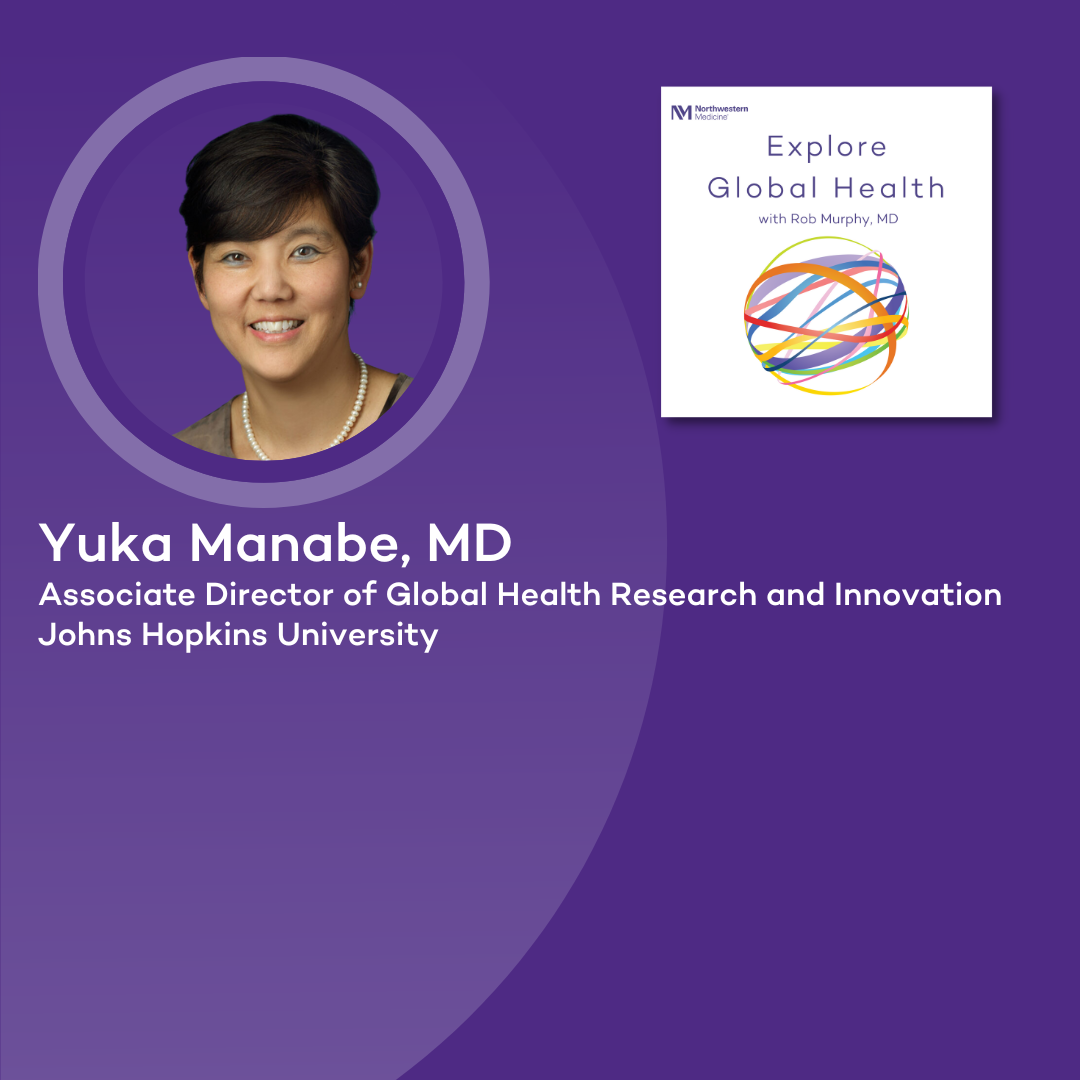
Keep an open mind. You really don't know when opportunities will come. And when they come and they resonate with you, even if it seems like you're stepping off the path that you thought that you set out for yourself, seize the opportunity.”
Dr. Yukari Manabe, Associate Director of Global Health Research and Innovation, Johns Hopkins University
Topics Covered in the Show:
-
Dr. Manabe’s childhood was shaped by growing up in Princeton, New Jersey, with her sister, her father (Suki Manabe, a scientist and Nobel Prize laureate) as well as her socially-gifted mother, who hosted dinner parties that brought global thinkers to her dining room table. This upbringing instilled both curiosity and an appreciation for collaboration that would later help define her approach to medicine and global health.
-
During her medical school training in New York City during the height of the HIV/AIDS crisis, she witnessed firsthand the devastation of an emerging epidemic, caring for young patients with opportunistic infections at a time when diagnostics were limited, treatments were ineffective, and fear reshaped medical practice itself.
-
Dr. Manabe says 1996 was the best year of her life, because that was when successful antiretroviral therapy regimens allowed people with HIV/AIDS to recover and leave the hospitals instead of dying from the virus. This time period motivated her to specialize in infectious diseases during a period of unprecedented discovery.
-
In 2006, she was asked to relocate her family, which included her husband and four school-aged children, to Uganda, where she took on a leadership role at the Infectious Diseases Institute, focusing not only on HIV and TB research but on building lasting infrastructure—data systems, regulatory oversight, training programs, and mentorship models—to ensure long-term local capacity and sustainability. She calls her time there some of the nicest years of her career.
-
Today, her work centers on diagnostic innovation advocating for low-cost, high-impact tools developed with affordability in mind. She often asks the makers of new diagnostic tests and tools: How can you make this less expensive? How could the device be cheaper? And how can the consumables be cheaper? Or how can the whole single use throwaway be less expensive?
Show Transcript
[00:00:00] Dr. Rob Murphy: Welcome to the Explore Global Health Podcast. I'm Dr. Rob Murphy, executive director of the Havey Institute for Global Health here at Northwestern University Feinberg School of Medicine. My guest today, Dr. Yukari, better known as Yuka Manabe, is an infectious diseases physician, scientist, and global health leader whose career has been shaped by the arc of the hiv aids epidemic. And it has created a legacy in global health that has led to better capacity building in mentorship in many places, including Uganda. She is a professor in the Division of Infectious Diseases in the Department of Medicine at Johns Hopkins University, as well as the Director of the Center for Innovative Diagnostics and Infectious Diseases, also at Hopkins and Associate Director of Global Health Research and Innovation at the Center of Global Healthcare. She's been doing operational and translational research focusing on tuberculosis and HIV co-infection, as well as evaluating TB and other infectious disease diagnostics and is particularly interested in rapid point of care, infectious disease diagnostic, suitable for resource limited settings, particularly in Sub-Saharan Africa. And we've worked very closely together on some of those projects 'cause it's one of our big interests too. We welcome her to the show today to talk about her path to global health and her advice for young people today who want to make an impact in this field. Welcome, Yuko.
[00:01:29] Dr. Yuka Manabe: Thanks, Rob. Nice to see you.
[00:01:30] Dr. Rob Murphy: Your career in global health has been fascinating, and we are going to dig into your career path much more. But I wanna go back to the beginning, to your childhood. For those of you who don't know your father. Orbi is a Nobel laureate who won the Nobel Prize in physics in 2021. He pioneered the use of computers to simulate global climate change and natural climate variations. Tell me a little bit about him and your mother and sister and growing up in Princeton, New Jersey, and how your family and childhood impacted your career today.
[00:02:03] Dr. Yuka Manabe: We moved to Princeton when I was in middle school. I actually grew up in a town next to Princeton that was a smaller, sort of blue collar neighborhood. Our house looked exactly like everybody else's house, so I didn't have to ask where the bathroom was 'cause it was either in one place or the mirror opposite. So it was one of these planned neighborhoods and a couple of people who also worked in my dad's lab, which was a US government facility funded by Noah, the National Oceanographic and Atmospheric Association funded lab had a big super computer and people from all over the world, but they had hired a few Japanese Americans who really could not find a job in post-war Japan but were very talented and given the right resources could really be very productive. So we moved to Princeton. To Lawrenceville and then to Princeton from Washington, DC where my dad was originally based and then moved to the area. It was a great place to grow up actually. It's a very international community with an incredible diversity of opinions and thoughts. It's also a really nice place to go back to. My sister didn't do science at all. She is a person that works in marketing. She used to be the chief marketing officer of the US Postal Service. She's worked in a bunch of different companies and has been incredibly successful. I would say that my dad's success, though behind every very successful man, is usually an important woman as well. And my mom had something that my dad didn't have. She was socially incredibly gifted. So we would have dinner parties at our house all the time. I was the official dishwasher and my mother would serve dinner to 30 people, bring over graduate students, other faculty members from Princeton University and also from the lab where my dad worked, and would have these fabulous parties where people got to know each other on a different level. So I really think that part of my dad's success was also that my mom kept him very networked and it was a very special place to come to dinner. My mother had a notebook where she never served the same meal twice to any given guest. She's a gourmet chef. She can make all kinds of food, not just Asian food. So it was really a fun way to hobnob with a lot of very interesting people at the house. And an enjoyable town to grow up in.
[00:04:09] Dr. Rob Murphy: Oh, that's incredible. I actually grew up in between Boston and Chicago and lived in neighborhoods, just like what you're talking about. And I remember the one in Chicago was actually in Park Forest, Illinois, and there were seven different types of houses. So whenever you walked into a, you knew exactly where every room was. People had one of seven things. Ours was called the celebration. . Let's move on. What made you pursue a career in medicine?
[00:04:31] Dr. Yuka Manabe: As many children do, they take the advice of their parents, and so my dad told me you would be a great doctor. And I think sometimes that works out. Sometimes it doesn't. But it turns out that I think both my parents knew my personality well, and it was good. Fit for me. So I think even when I was in high school, I used to volunteer at the hospital and I enjoyed interacting with patients and I didn't mind, I was at the front desk and so I was like the patient information person. I enjoyed that very much. I went to college and in college I volunteered at the hospital again in the emergency department. I also enjoyed that. So I've never regretted my decision to go into medicine though. Maybe the original reason was. Not as good of one where it was one that one my parents told me to do. So I said, okay I'll do that. I will say that I come from legions of doctors. There are many physicians in my family. My dad's father was a country physician who used to treat people on horseback across the countryside. Many of my uncles are physicians as well, and many of their children became physicians. I think my father was supposed to be a physician, but he was, he used to say, I'm not very good under pressure. I panic, so I can't imagine having to do an operation. And he was not very fond of blood either. So he decided to do physics instead of medicine. So I think maybe I was fulfilling something that he thought he was supposed to do, but that he was not really particularly well cut out to do.
[00:05:47] Dr. Rob Murphy: You've said that HIV was the pandemic of my lifetime. Take us back to your days as a medical student in New York City in the 1980s. What was it like to witness the HIV crisis so early in your training?
[00:05:59] Dr. Yuka Manabe: Yeah, I think it was life changing. You know that New York City was the epicenter of HIV. There were many young gay men who were falling ill who would come to the hospital. Many were short of breath because they had pneumocystis pneumonia, and many of them unfortunately suffered and died alone. I think it was really difficult to watch when I did my medicine rotation as a third year medical student. Probably 50% of the people that I admitted were HIV and opportunistic infections. In fact, I used to joke that I was better at an arterial blood gas than I was at regular phlebotomy. ' cause I had done so many ABGs as a medical student. So it was a time where you could see the need. We really didn't have good diagnostics. It was the time where we were just starting to flip over into universal precautions. So when I started medical school, nobody used gloves. And by the time I exited, everybody used gloves. And I remember the residents used to rip the finger, just the tip of the. Pointer finger off of the glove so that they could feel the vein to put in an iv because they weren't used to having to feel the vein through a glove. And so they would rip that off, put alcohol on their finger, and then try to feel the vein and then put in the needle. And I just think it's interesting. It was a really interesting time to be there. And then when I, as a resident came down to Baltimore, the epidemic kind of followed me and I would say that my internship was really influenced by taking care of patients with HIV. But there was an amazing floor for HIV admissions called Osler eight. At the time, Osler was a building that was named after Sir William Osler, and on the eighth floor was the HIV ward. And that was a group of people who did multidisciplinary care before it was called that. The nurses really ran the show. They knew more about the patients personally and professionally sometimes than I think the doctors who rotated through there. We also had a physician's assistant named Joe Leslie, who used to serve tea in the back at four o'clock so that everybody could decompress because somebody died on the floor every single day. So, Yes, HIV was the pandemic of my lifetime and very much influenced the choices that I made going into internal medicine and particularly specializing in HIV.
[00:08:05] Dr. Rob Murphy: It was really the same with me. It was the first week of my ID fellowship, infectious Diseases fellowship. We had our first patient in 1981 come in, we had the classic pneumocystis pneumonia looking X-ray, which was pneumocystis. That was our very first case in Illinois that I know of. And from that. I ended up with John Fair, my mentor starting the first outpatient clinic and the first inpatient service, and at one time took care of a third of the patients in Illinois. But of course the numbers just got so huge that, other people uh, of course stepped up to the plate. But yeah, it was a similar thing. It was just overwhelming.
[00:08:42] Dr. Yuka Manabe: Yeah, there's a certain cough that I still recognize. So when I hear this kind of dry, non-productive, consistent cough I can almost know it's gonna be pneumocystis. I heard it so much as both a medical student and as a resident.
[00:08:56] Dr. Rob Murphy: In 1996 when you began your fellowship at Hopkins. That was the beginning really of successful antiretroviral therapy regimens, how did that breakthrough shape your career path in infectious diseases?
[00:09:10] Dr. Yuka Manabe: 1996 was the best year of my life. It was one of those years where you saw people who were surely gonna die, rise up and get fat and have a life. The medications that we gave at the time still make me cringe. We would give Ritonavir escalating 100 milligrams every day we would escalate till we got to 600 BID. And it was just a horrible regimen. And then there was a time where they couldn't make the pill and it was this kind of motor oil liquid. And we used to convince people that they had fewer taste buds in the back of their mouth. So if you would just flip it back. Really quickly to the back of the tongue, they wouldn't taste the bitter taste of liquid Ritonavir. You know, we think about Paxlovid now and it has a hundred milligram tablet to up the amount of vir and, people complain about how they get heartburn and they don't like the way they feel. Imagine taking six times that amount.
[00:09:58] Dr. Rob Murphy: a day.
[00:09:58] Dr. Yuka Manabe: Yeah, and patients took it and they suffered through it because they knew that it would give them a chance to live. And then we got better and better treatment, and it happened relatively quickly and in retrospect, it was a time of incredible discovery. So many people. Smart people had moved in this direction because if you had a heart, you wanted to work on HIV. And so much happened to try to keep up all the time. We had extra conferences in order to make sure that everybody was aware of the latest treatments. And it was an amazing time. And it was also great to see less children get orphaned. People who had a family who had a low CD four count, who didn't think they were gonna see their children until their next birthday were suddenly getting a new lease on life and we saw admissions go down. It was a really incredible time in medicine.
[00:10:43] Dr. Rob Murphy: 1995 I was actually the biggest admitted to the hospital. Every one of my patients had aids. Two years later, 1997, I admitted nobody. It was really, that was a remarkable year. Let's fast forward again. 2006. You were invited to take a leadership role at the Infectious Disease Institute, also just referred to as IDI, it's the biggest city in Uganda. During this time, you and your husband, who's also a physician scientist, had young children and active research careers. What was it about that moment in time that convinced you and your whole family to go to Kampala?
[00:11:17] Dr. Yuka Manabe: So PEPFAR happened in 2004. That was the president's emergency plan for AIDS relief, as many people know. And, we started the rollout. Uganda was one of the early countries to be able to adopt antiretroviral therapy. And in 2006, when I was offered that job, after having told you that 1996 was the best year of my life, it was impossible not to wanna go and be part of the solution overseas. I'm not really one of these people who all my life said I wanna do global health. There are so many people who are like that, who've been so committed from the beginning. But mine was really just a calling more than anything else, where I said, how could I not go? So I went and it was around the time where research, particularly epidemiologic research could really offer something to say what worked, what didn't work? Could we look at longitudinal data? Could we create cohorts? Could we also look at routinely collected data and learn whatever we could to try to do the greatest good for the greatest number with a limited resource? And that kind of attitude and a feeling of being on the ground and being part of the solution, I have to say, was intoxicating. It was impossible to not wanna do it. so I really focused all my efforts on trying to build research capacity at the Institute. And in so doing, obviously ran a lot of studies that were important for HIV and for opportunistic infections in Uganda. It was super fun. I don't regret it at all. And having, I think the little kids weren't so little. They range in age from five to 14 when they finish high school there. It was an incredible experience for them. I would say it was really a crash course in common sense. There's not a lot of signs that say, don't go here, don't go swimming here. you have to kind of use your wits and get around. They went to a lovely international school and made friends from all over the world. I think they all enjoyed themselves immensely.
[00:13:05] Dr. Rob Murphy: One of the things, the people that listen to this podcast uh, some of the younger trainees uh, you know, they're worried, well, you know, I have children, or I'm going to have children, and they're, nervous about it. But to you, it ended up being a win-win situation.
[00:13:19] Dr. Yuka Manabe: You have to have logistical skills 'cause there's a lot of people involved. And, get, getting everything together. And Uganda's not always straightforward, but I not only met a lot of lovely Ugandans who worked in our house and worked with us at the Institute that I feel overall we had a collaborative approach to everything and it was great. But I, I will honestly say that you can spend a lot more meaningful time with your children when you live overseas because sometimes you don't have to do things that take up a lot of time here. That makes it easy to thrive and for your children to thrive.
[00:13:50] Dr. Rob Murphy: I was the PEPFAR Country Director of Nigeria through the Harvard School of Public Health program at the same time. And we did not move there. Their philosophy was a little bit different, but we had to go there every month. I was back and forth quite a bit and some of those relationships, all matter of fact, most of those relationships still go on today.
[00:14:08] Dr. Yuka Manabe: I have four children and I also now have a Ugandan daughter who joined our family when we lived in Uganda. And a lot of people say well, how did you do that? How did you have an academic career and have five kids? And I always say pick a good partner. So my husband's wonderful. He dropped everything. He dropped 27 clinical trials to move to Uganda. He found a job with the US CDC in Uganda and worked on the Partners Prep trial. So that was a, um. state site trial that was run by Connie Kellum and Jared Baton, where they took discordant couples and gave tenofovir to the negative partner and showed that they could prevent transmission. And it was very successful, leading to the FDA approval of Tenofovir and Tenofovir three DC, and all of that. To say that he took his clinical trials skills and applied them to a different study and really built a lot of capacity. He recruited probably up to a quarter of the patients that were in that study at two sites in Uganda.
[00:15:04] Dr. Rob Murphy: You were not there just to do research. You were also there building infrastructure of that Institute systems such as data management, regulatory oversight, financial tracking, that really allowed it to grow. Can you tell me more about the infrastructural components of what you were doing in ug?
[00:15:22] Dr. Yuka Manabe: I think the Institute is actually built on something called the Capacity building pyramid. This was a paper written by Chris Potter and Richard Buff. And Richard Buff was actually the head of Grants management and strategic planning at the Institute. He helped, he really wrote with input from all of the senior management team, the first logistic framework and strategic plan for the IDI. Capacity building pyramid talks about how things at the top of the pyramid are easy to accomplish. Teaching people skills bringing equipment and tools. All of those things are easy and fast, but the infrastructure capacity needed to have longevity and sustainability and independence comes from the bottom part of that pyramid. So what does that mean? For the research department, it meant. Putting in a data management unit that could be used both remotely and in places with good internet access. It meant putting in monitoring. It meant having regular GCP training and GCLP training for people in the lab so that everybody was on the same page. There was already a great college of American Pathologists certified laboratories. So people could, at a place where they could do lab tests. But then other things like teaching people the soft skills that allow them to craft good collaborative partnerships. Having training all the time, having a research forum where people learn to handle questions. The first research forum we ever had, nobody asked any questions by the last research forum when I left. They were just. Questions coming from every corner. And that friendly fire really helps prepare you when you go overseas, say, to present in a meeting. So these are the sorts of infrastructure capacity that are necessary to have a department that makes each person more likely to succeed. If you don't have that kind of infrastructure capacity, you could be Albert Einstein and you may not do well. But when you have that kind of ecosystem, it maximizes the likelihood that each trainee that you have come through will reach their maximum potential. And I think that's really the great joy of building research capacity, of training people overseas and seeing what they can accomplish.
[00:17:21] Dr. Rob Murphy: Why was the capacity building component so important to you?
[00:17:23] Dr. Yuka Manabe: I think 'cause I wanted to teach myself out of a job. I loved uh, working in Uganda. It was five of the nicest years of my life. I've made lifelong friends. Every time I go back there, I feel very at home. That being said, I don't think I was meant to stay there forever. And so I am really proud of watching the students that we trained while I was on ground now, watching them give their own students a hard time, making sure that they live up to the bar that we set for everyone. Again, taking advantage of all of this infrastructure, the capacity that is at the IDI. I am really proud of what all of them have accomplished and I think that the reflected, sort of light of all of those people is perhaps better than being in the spotlight yourself. Many of those trainees have gone on to be heads of department. One is now a vice chancellor to a major university. There, one became principal of the College of Health Sciences, they've all been really successful. And I do think that they were a special group, but I can say that I didn't choose them. Somebody else chose them. But they did really great things. Now, not all of them are finished. Some of them went off and did other things where they started to realize that your career path should be the thing that you find easy, that other people find hard. And when you. Put it in that light. You do the thing that you find easy and then you don't have to spend as much time on it. You can be highly efficient and you can be great at it. And so some of them went on to the Ministry of Health, others went on to become advocates for groups of people that didn't have a voice. And all of them have really been quite successful.
[00:18:58] Dr. Rob Murphy: Let's talk about innovation and diagnostics and the technology around that. You've talked about frugal innovation and have said scarcity can be a powerful driver in global health. Tell me more about this and how you saw this play out in Uganda in particular.
[00:19:16] Dr. Yuka Manabe: Despite the Abuja declaration asking governments to spend 15%. Of their GDP on health, that has really not happened largely many of them struggle even to spend 5%. So the per capita expenditure on everything in health is relatively small. And as a result, if you want diagnostic certainty, if you wanna know what a person actually has, it's gonna have to be inexpensive. If you think that the absolute expenditure on a single person's health is gonna be low. So a lot of times in resource limited settings, we see empiric algorithmic care where you just give your best guess and you don't really try to make a diagnosis. The problem with that is that you can get things like antimicrobial resistance. You don't really know the epidemiology of new zoonotic spillover infections that could actually have pandemic. Potential, but you don't know about them. So those are just two examples of the reasons that you might wanna really know what the diagnosis is, but probably the most important is in order to treat the person in front of you the best way possible, it's often better to know what the problem is. So if you take those things together, you would like a diagnostic to be inexpensive. And certainly right now we're in this incredible explosion of diagnostic innovation. We ask people to think about cost upfront. How can you make this less expensive? How could the device be cheaper? And how can the consumables be cheaper? Or how can the whole single use throwaway be less expensive? And I think it's also gonna take in the future south South collaboration where places where it's cheaper to manufacture diagnostics have the kind of quality management systems that allow good diagnostics that are the same every time they're produced to be shared with other countries in the global south. So I'm really interested in trying to help people think through, before they freeze the design, how they might make it less expensive, more affordable, allowing people to have diagnostic certainty and targeted treatment.
[00:21:11] Dr. Rob Murphy: Expand on that a little bit and tell us about what you're doing right now. Particularly as it involves low and middle income countries.
[00:21:18] Dr. Yuka Manabe: we developed some diagnostics. In fact you're a center. Funded one of the innovations that came out of Hopkins. It's a new kind of smear diagnostic, which appears to have similar sensitivity to experts. And how it does that is that there's a polymer on a piece of plastic that's been put on there in a way that allows it with centrifugation to capture the tb. So you take a lot of sputum and you can. Capture more tb and so you get higher sensitivity because you've put the TB all in one place where you can see it on a slide and it uses the S mirror microscopy workflow. So that's just one example. It's about 15 cents to produce. Now there are obviously other parts that add to cost, but overall it could be inexpensive and would allow us to have a high sensitivity smear that could be used also in follow-up. So I think that's very cool. That's something that was worked on by master students who went and saw the unmet need came up with a solution and then passed it off to another set of master's students who passed it off to another method set of Master's students who in the end were able to move it across to a company and to get. Individual countries interested. So that's just one example. There are other people in Stanford. There's a guy named Manu Prakash, I think he's incredibly interesting. He's made a microscope that's made out of pieces of paper, and he calls it the. Origami microscope, and it's because it has a crystal in it that allows you to train the light and magnify the image of the slide that's in there, and you can project it anywhere you like. You can project it on the ground, you can project it on a wall, and then everyone can benefit from seeing microbes. So you can imagine all the little kids that sit around, they fold up their own microscope, they stick in a slide and they look at something at magnification to be thrown off the top of a building. It doesn't break and it doesn't get stolen 'cause it costs less than a dollar to make. So this kind of frugal innovation, not just for diagnosis, but also for learning and other things. I think the wave of the future, and that's why we continually need young people to come in, see the unmet need and create innovation that will lead to programmatic and problem solutions.
[00:23:20] Dr. Rob Murphy: To add to that, some of these innovations are really incredible. They would never happen if people like you and me were not working in resource constrained settings, because here, there's no reason to have a microscope that cost $1. Everything works quite well with our expensive equipment here, but it doesn't actually have to be the best. We're gonna learn a lot from what we're developing over there.
[00:23:42] Dr. Yuka Manabe: Yeah, and the market competition is not just in the us so clearly there is a Willingness to pay here in the us it makes it attractive for outside companies, but at volume, you can make a lot of money by selling a lot of whatever it is that you make. And so I think that the global market is changing, and by having less expensive things come on the market, it puts pressure on companies here in the US to start thinking about cost upfront. So I think competition is a good thing. I want as many. Companies to get something across the finish line as possible. We remain totally agnostic. I'll look at anything and try to help you make it better because I think more is going to be better in this space, and it should be a culture of abundance, not scarcity.
[00:24:24] Dr. Rob Murphy: Tell us a little bit about your experience with the COVID-19 pandemic. We worked very closely together on that through the Pran group, the point of Care Research Technologies network funded by N-I-B-I-B. Tell me a little bit about that and what do you think will impact the next crisis in global health, the next pandemic.
[00:24:46] Dr. Yuka Manabe: I think that it was a terrible time, don't get me wrong. COVID-19 is something that if it had never happened I would be the first one to say that would've been a good thing. But in science and in particular for us, it was really fun to be part of the solution and to see so many smart people marching in the same direction. Or maybe even running in the same direction to try to come up with solutions as fast as possible. I think what we did during the rapid acceleration of the diagnostics program was amazing and a model. I think there's some tweaks that we could make, but overall the framework was quite good. And I think it led to diagnostics, getting to people's houses faster. People were able to make a diagnosis and even do a self test by the end, which was not the original vision. But it morphed over time and people were flexible and I think it was fun maybe in quotations 'cause I don't wanna minimize what a terrible time it was. I also think it's amazing that the capacity that people have to just absorb more and more work at a time that was stressed. Both of us were in the hospital a lot, rounding on patients trying to do what we needed to do for patients who had COVID to 19 in our own hospitals. But to also have this other thing where we could work on a more holistic solution was really quite remarkable. I also think that we worked on diagnostics, but a lot of the work that we did gave insights into viral dynamics, gave other insights into how the infection goes and how best to try to diagnose it. And maybe I wasn't expecting that. I was just expecting to try to get as many things across the finish line. And in fact, some of the other work that we did turned out to be incredibly rewarding and led to some really nice publications that I think led to policy and practice changes that I think are important.
[00:26:29] Dr. Rob Murphy: I think the general public has at least heard of Operation Warp Speed, which was the very rapid development of the first vaccine for COVID and the impact that had, but the RAD X, this rapid acceleration of diagnostics for coronavirus, the program you and I working on. People don't appreciate that. In 2020 you couldn't even get a test for COVID. Even if you had all the symptoms and whatever, it was almost impossible to get it. That program was instituted. We worked very hard on that in addition to taking care of patients, and we went from zero tests per day to 8 million tests per day. During the beginning part of that program. And it really, it was a phenomenal thing and it was exciting to be part of the solution. And I think that's one of the big attractions to people that maybe wanna work in global health. Now, the last question. I ask this of every person who comes on the podcast, what advice do you have for young people who are just now embarking or wanting to embark on a career in global health?
[00:27:28] Dr. Yuka Manabe: Keep an open mind. You really don't know when opportunities will come. And. When they come and they resonate with you, even if it seems like you're stepping off the path that you thought that you set out for yourself, seize the opportunity. I can't tell you how many visiting professors we have here at Johns Hopkins and Infectious Diseases who talk about how something random happened and in some ways. The reason that I got the job in the Infectious Disease Institute and started doing global health was quite random. In fact, the then executive director came to visit my division chief here at Hopkins, and he's down the hall from me. And he came into my office and said, Hey, you wanna come and be the head of research? It was completely random. And then most people were like this is career suicide. Why are you going abroad? And for me, it turned out to be five of the nicest years of my life, it really changed the trajectory of my career. And I think it led to a lot of self-discovery, which overall was just fantastic for me. So keep an open mind. Don't squander the chance to do something. If it resonates with you, go for it and enjoy it.
[00:28:30] Dr. Rob Murphy: Incredible career. Great colleague and friend. Thank you very much for joining us today.
[00:28:35] Dr. Yuka Manabe: It was a pleasure Rob.
[00:28:36] Dr. Rob Murphy: Follow us on Apple Podcasts or wherever you listen to podcasts, to hear the latest episodes and join our community that is dedicated to making a lasting positive impact on global health.