Bonus Episode: The Future of Global Health | Live from CUGH Annual Meeting with Keith Martin, MD
Recorded at the Consortium of Universities for Global Health annual meeting in Washington, D.C., this special episode of Explore Global Health explores what lies ahead for the future of global health at a critical moment in time. Rob Murphy, MD, sits down with CUGH Executive Director Keith Martin, MD, to discuss the challenges shaping the field—from funding cuts and geopolitical conflict to climate-driven health threats—and the reasons for optimism, including a new generation of leaders committed to collaboration and impact. This episode offers a front-row seat to the conversations defining the future of global health—and a call to action for those ready to shape it.



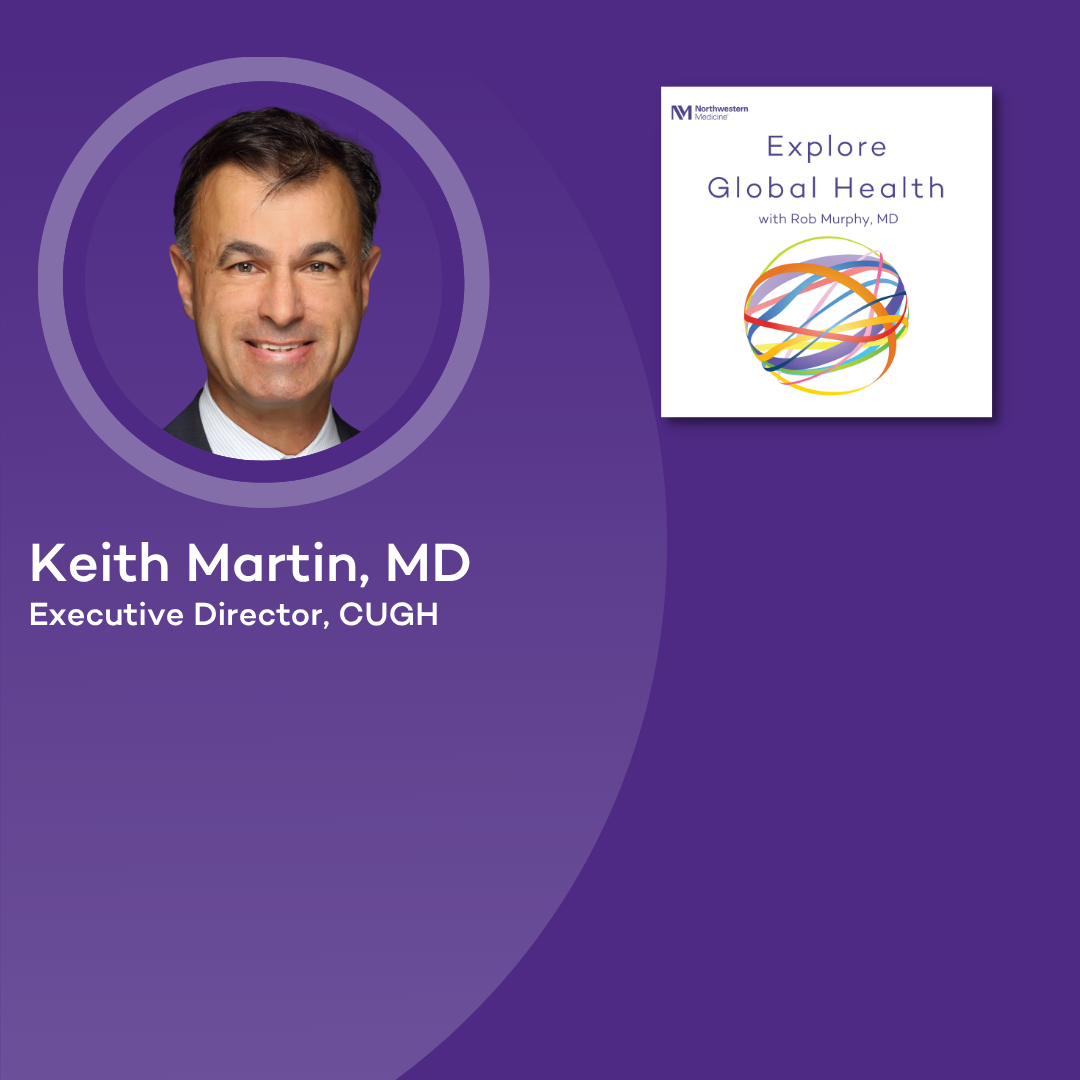
What gives me hope is the fact that people are willing to come together. They're willing to convene, they're willing to put their best foot forward. They're willing to take their knowledge, capabilities, passions, and desires to be able to improve the health of people and the health of our planet.”
Topics Covered in the Show:
-
Martin points to the passion and commitment of attendees at the CUGH conference, many traveled to Washington, D.C., from around the world as a reason for optimism in the field of global health, but warns that declining empathy, political polarization, and weakening democratic values could undermine global health progress if left unaddressed.
-
He outlines two underutilized strengths of academic institutions working in global health—research and training—and calls for stronger partnerships with governments to build public sector capacity, improve decision-making, and address the social determinants of health more effectively.
-
Drawing on his experience as a previous member of Canada’s parliament, Martin highlights the disconnect between academic research and policy implementation, stressing the need to translate evidence into action and build trusted relationships with policymakers—even across political divides.
-
Looking ahead, Martin emphasizes the importance of practical skills like communication, leadership, and project management, and urges global health professionals to engage the public more effectively—because building public understanding and trust is essential to driving meaningful change.
Show Transcript
[00:00:00] Dr. Keith Martin: that people are willing to come together. They're willing to convene, they're willing to put their best foot forward. They're willing to take their knowledge, capabilities, passions, and desires to be able to improve the health of people and the health of our planet. So in spite of this moment. When I think all of us are seeing that we are in a ruptured moment that, the folks out here are willing to do that.
[00:00:39] Dr. Rob Murphy: Today we're recording in Washington DC at the annual meeting of the Consortium of Universities for Global Health or CUGH. This year's theme is the Future of Global Health. This comes at a critical moment where around the world we're facing overlapping challenges such as emerging infectious diseases, climate driven health threats strained health systems, and the funding suspensions of major global health initiatives. At the same time, we're seeing rapid advances in technologies from artificial intelligence to new diagnostics that have the potential to transform how we prevent, detect, and treat disease. Universities sit right at the center of this moment. We are training the next generation of global health leaders driving innovation and building partnerships across countries and communities. In this special episode, we're bringing you conversations from leaders shaping that future, starting with the executive director of CUGH, Dr. Keith Martin. He is the founding executive director of CUGH, a physician and former member of Parliament in Canada who has spent decades working at the intersection of medicine, policy and global development. We interviewed him on this show back in 2023. go take a listen to that episode if you're interested. At this particular point, I just wanna thank Keith for joining me today.
[00:01:58] Dr. Keith Martin: Thank you, Rob, very much.
[00:01:58] Dr. Rob Murphy: This year's meeting theme is the future of global Health. When you think about that future, what gives you the most hope and what concerns you the most?
[00:02:10] Dr. Keith Martin: Well, I think what gives me the most hope is really seeing the people who are outside this door. Young people, people of all ages have come together and sometimes in, as you know, very, very difficult circumstances. So we have probably 17% of the people here are from our country. Outside of this country, some have traveled half a world away to be here at this conference. And so what gives me hope is the fact that people are willing to come together. They're willing to convene, they're willing to put their best foot forward. They're willing to take their knowledge, capabilities, passions, and desires to be able to improve the health of people and the health of our planet. So in spite of this moment. when I think all of us are seeing that we are in a ruptured moment that the folks out here are willing to do that. And what worries me the most is that, defunding is a huge problem, conflicts are an enormous problem and a challenge. But what worries me, I think the most is a lack of attention and interest and empathy and the values that. Underpin what we do in a broader audience. If society keeps on rolling in a direction of autocracy and, anti-democratic efforts, pitting one group against another, that worries me a lot.
[00:03:29] Dr. Rob Murphy: Can you get into what unique role universities play in addressing global health challenges today?
[00:03:36] Dr. Keith Martin: Well, that's a great question, Rob, and in fact, that is something that is front and center in this particular meeting. So we really see that we can't do business as usual in the past. But there are significant assets within academia that I believe have been, uh, underplayed, but need to be used in this moment. This moment to show impact and value. So what are those two assets? One is the research capabilities of universities. The second, uh, is really the training capabilities and. What I mean by training is not only training, uh, people and students and for the jobs of tomorrow, but importantly being able to train and build capacity within governments. If we stand back and, and, and this is an issue in an area that, you know, we and I have discussed in the past, it's an area that gets very little attention, but it's an area that's critically important for any country to develop sustainably and effectively. So. The ability of a public service. The public service across ministries, not only health, but importantly in justice and in finance, in public works, in other ministries. You as a minister have to have an effective, competent public service, so. What we wanna do is to build and forge relationships between academic institutions and governments to be able to provide value that will ultimately lead to better and more effective public programs that are sustainable to improve the essentially the social determinants of health that we know are going to be most impactful.
[00:05:08] Dr. Rob Murphy: I think that's a really good message, uh, for the people out there because typically university trainees, students, faculty. They're in the university. Um, but there's a much bigger world and they've got to engage more. I, I think, uh, in your background, being in Parliament in Canada, I think, uh, probably was an incredible resource.
[00:05:29] Dr. Keith Martin: Well, it also shows what I, I'll share with you a little story. So I'd have, uh, been one of five physicians in Canada who were in Parliament. Um, we'd be the people that scientists would come to with their reports. Doing a lot, you know, a lot of work in international development. Global security. Um, so science would come with their research in a 300 page document, and the full expectation was that the minister or I would have a chance to read it. And there's just a huge chasm that remains between the amazing research that's produced and outside this door. We have 250 amazing posters from around the world who we're showcasing today in two 50 tomorrows, that research, we need to breathe life into it. We need to bridge that gap between policymakers and academia, and that's one of our goals here and one of our goals at CUGH.
[00:06:20] Dr. Rob Murphy: What are the biggest gaps you see right now in global health and how can universities, uh, help close them?
[00:06:27] Dr. Keith Martin: Well, I think that we have to. Show value to outcomes.And those two areas in research and training are two areas to do that. I also think it's really important, we have to build bridges, trust relationships with people within the political space, and that takes a lot of elbow grease. So you have to be able to work with these individuals. You have to meet with individuals in the. Politics space. You have to learn and listen to what their interests are. And then you have, you can be an amazing source, a trusted source of advice, guidance, knowledge for them and help them work out the problems. 'cause most people, regardless of political stripe, really want to do the right thing for their constituents and their country. We can play an important role to that, but it takes a concerted, strategic, uh, effort to be able to build those bridges with, uh, politicians, particularly those who you don't agree with, which is difficult sometimes, but important
[00:07:23] Dr. Rob Murphy: We are now in the US anyway, forced to, uh, take this America first, uh, policy. Now you can define that in a lot of different ways. I'm interested in your opinion on it. Um, we have found that it's not that difficult. To say, Hey, we are working with all these global partners. How is it helping us? And it is helping us, uh, in many ways. What, what do you think of that whole concept? It's not necessarily completely bad.
[00:07:53] Dr. Keith Martin: No, not at all. I think I, I think the reality of it, of course, is that these are taxpayers' monies that are being used for work. Mm-hmm. I think that the challenge that maybe we haven't articulated well enough is what are the benefits to the country that's, that's providing the official development assistance. Um, but I think we need to move away from the official development assistance paradigm. Uh, it's important, but, but. Often not as important for a country's development as one would think. If you look at the poorest countries in the world with the worst health outcomes, they're often some of the richest countries in the world from resources.
[00:08:28] Dr. Rob Murphy: Mm-hmm.
[00:08:29] Dr. Keith Martin: And right now what's happening in many of those countries, which are poor, is that their resources have and continue to be taken from them, uh, by, by. And predatory behaviors and there's very little outcome for those countries. And so the challenge and the opportunity I think for academia is to be able to work with governments to build up their capacity to manage their internal assets more effectively. And that will generate the real funds that are necessary , to address the development needs that those countries have. Because if you look at an interesting data point. If you look at, uh, low income countries mm-hmm. And if you just looked at the health bucket aid represents 29% of that health bucket, which is a lot. But if you look at low middle income countries, it's 3% and it declines after that. So other than the lowest income countries, which many of which are, are actually quite rich resource wise. The other ones. Is largely not consequential. So the value proposition, I think, for academia and global health is to build partnerships that help to build domestic capacity and sustain that with local partners, with local governments. And they get paid to do that, which funders can also need to reform in this whole equation too. And they need to be able to provide the investments that, um, enable other countries to, uh. To build up their own capacity and in fact, to share some of the innovations they're doing. Um, with regard to, the needs of, for example, say a high income country like the us there's lots of, lots of.Um, uh, innovations taking place in low income countries and those innovations don't see the light of day here, which could be very important for improving health outcomes for this country, which sits at the bottom of health outcomes for all developed countries. Well, I think that I add one more point. The section we didn't talk about is the public, Rob. Mm-hmm. And those in us, in global health and academia in particular, we need to be. Public communicators, we need to be public scientists and we need to communicate to the public. So you build a public constituency for what you're doing. 'cause the public moves the political, and if we're able to go and, and communicate, uh, to the public in language, they understand that meets their needs. We'll go a long way to supporting the work everybody's doing.
[00:10:49] Dr. Rob Murphy: We've been trying to, uh, encourage that among our junior faculty. We wanna encourage it to, uh, everybody thinking about going into global health or just in medicine in general. Don't forget the community that you're working in. Mm-hmm. And, uh, they're only gonna be our biggest supporters. Uh, uh, down the line. One last final, uh, kind of area I wanna cover with you is, uh, as you look ahead. Uh, what should the next generation of global health leaders be preparing for that maybe we're not talking enough about yet?
[00:11:22] Dr. Keith Martin: Well, I, I think that, that, we did a little study a while ago that asked a question about, um, what new graduates wish they had more of in training, and then what employers wished the new graduates had. And what was interesting is that they were pretty much the same. Things like project management. Uh, monitoring, evaluations, statistics, leadership, communication, using, and how do you use our effective communicators in this new environment, which is deeply fractured, where people's attentions are very, very short, and platforms are very different from what they were even five or six years ago. This is the world we live in and we need to adapt to it. And these are some of the skill sets that. Young people in global health and anybody in global health, in fact, I would argue need to, um, need to, uh, uh, improve, uh, and, uh, take. And by the way, you know who won our top. He's not gonna say this, but I'm gonna say it because Dr. Murphy. It's the co-winner of the 2026, uh, global Health Leadership Award, uh, here at CUGH. That is our top award recognizing, uh, a really outstanding global health leader who is given a lot for their careers. And Dr. Murphy is the co-winner of that with Dr. Va Trina Smith from uc, Davis. So Rob, congratulations.
[00:12:44] Dr. Rob Murphy: Well, thank you.
[00:12:45] Dr. Keith Martin: And you were voted on it by your colleagues,
[00:12:46] Dr. Rob Murphy: But thank you very much. I really do appreciate it, especially at this point in, uh, in my career. Uh, I've had a, uh, very rewarding career and, uh, I, I try to encourage as many people as possible to, if they have it in, if they have it in their passion, uh, to, uh, to go for it. So, Dr. Keith Martin, uh, thank you very much for, uh, being here, for your leadership, uh, and, uh, we look forward to, uh, our future together too.
[00:13:16] Dr. Keith Martin: Wonderful. Thank you very much, Rob. Be well everybody.