BONUS: Empowering the Next Generation of Global Health Scientists Through International Partnerships with Caitlin October
In this bonus episode of Explore Global Health, recorded at the 2026 Stellenbosch University–Northwestern University Global Health Knowledge Hub Conference in Chicago, Dr. Robert Murphy speaks with Caitlin October, a PhD candidate at Stellenbosch University in South Africa. October shares how her background in psychology informs her work on drug-resistant tuberculosis and why understanding patient experiences, stigma and community perspectives is essential to improving care. She also reflects on how international partnerships create opportunities for the next generation of global health scientists.



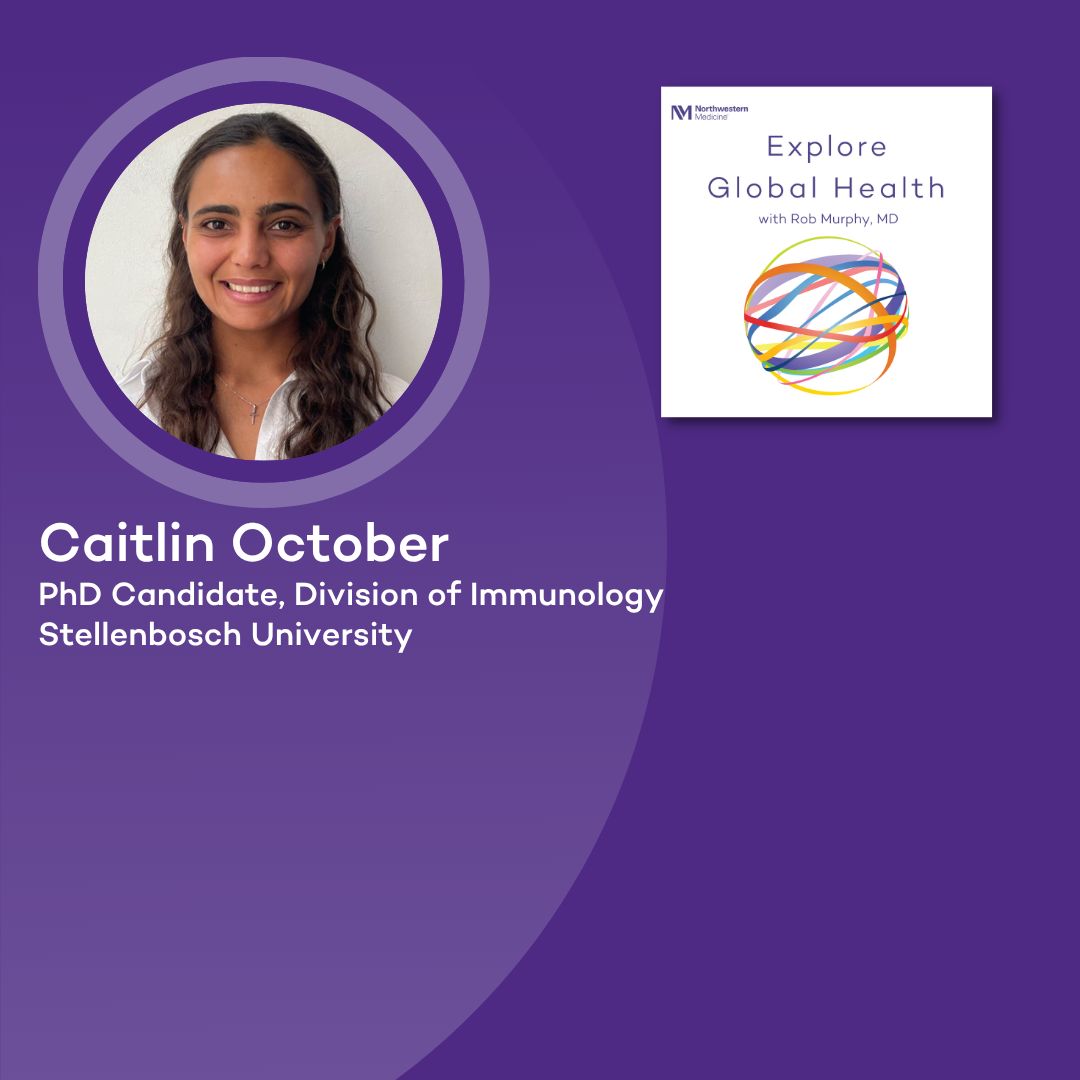
I think that as students we're a lot closer to the ground. We're within the communities doing our PhD, master's research and we have a fresh perspective on longstanding health concerns, just because of how deep we are within the communities that we aim to serve. So, I think together with everyone here, we can create really amazing research.”
Topics Covered in the Show:
-
October reflects on the value of the Global Health Knowledge Hub Conference, her unconventional path from psychology to immunology, and her current work examining patient and healthcare worker experiences with drug-resistant tuberculosis and emerging treatment technologies.
-
Drawing on her work with patients in South Africa, October explains how stigma, psychosocial challenges, community context and patients' understanding of their disease influence treatment decisions. She also discusses the gap between scientific advances and their implementation in everyday healthcare.
-
October discusses how the Stellenbosch–Northwestern partnership fosters collaboration, gives early-career scientists a platform to share their work and creates opportunities to contribute to global health beyond their individual projects.
Show Transcript
[00:00:01] Rob: Are you interested in making a difference in global health? Northwestern University's online Master of Science in Global Health, or MSGH, program prepares professionals to tackle healthcare challenges around the world. With flexible coursework, expert faculty and hands-on experience, you can build skills to make a lasting impact. The MSGH program includes flexible one- or two-year options, and all candidates are offered an in-country experience in a global setting. There is also a non-degree certificate program that consists of just taking four courses. Find out more at sps.northwestern.edu. Welcome to a special edition of Explore Global Health, coming to you from the 2026 Stellenbosch University–Northwestern University Global Health Knowledge Hub Conference here in Chicago. My guest now is Caitlin October. She's a PhD candidate in the Division of Immunology at Stellenbosch University whose research focuses on tuberculosis, mental health and community wellbeing. We're going to hear her perspective as an emerging global health researcher and explore what partnerships like the Stellenbosch University–Northwestern University Global Health Knowledge Hub can offer to the next generation of leaders. Caitlin, welcome to Explore Global Health.
[00:01:13] Caitlin October: Thank you. Thank you for having me.
[00:01:14] Dr. Rob Murphy: What has it been like for you to be part of this conference and what do you think students and early career researchers like yourself can contribute to conversations like the ones taking place here?
[00:01:26] Caitlin October: It's been a great, valuable learning experience for me, especially being in the midst of all these different researchers and clinicians with different expertise, experience and divisions across the two universities coming together with a common goal and bringing all these ideas to one table. It's been really valuable to see how everyone here can work together and bring fresh ideas as a student trying to figure out where my research fits into the global health situation. I think that as students, we're a lot closer to the ground, and while it's been really valuable learning from everyone else, I think that we have something special to contribute to the conversation, too. Since we're within the communities doing our master's and PhD research, we have a fresh perspective on longstanding health concerns just because of how deep we are within the communities that we aim to serve. So I think together with everyone here, we can create really amazing research.
[00:02:23] Dr. Rob Murphy: Tell me a little bit about your educational background, your original training, your bachelor's degree and any master's degrees. Tell me also about your specific PhD program. Stellenbosch University in South Africa is very different from the pathway in the United States. We'd be curious to hear how you got to where you are right now.
[00:02:42] Caitlin October: I'm fascinated by my own pathway because my undergrad and my master's were all in psychology. I did my master's thesis in research psychology at Stellenbosch. My undergraduate and honors degrees were at UWC, the University of the Western Cape. And then during my honors, I...I had a call with someone from the Desmond Tutu TB Centre, and I did my master's project on a psychosocial intervention for children who are hospitalized with TB. So that's where psychology and the TB started to come together. Since then, I've been working on multiple TB projects at the Desmond Tutu TB Centre, and then...I found my way into the Division of Immunology, where I'm now doing my PhD in molecular biology, which is very confusing because my background is in psychology and now I'm doing molecular biology. But that's because I am working on a project that looks at an AI treatment recommender for drug-resistant TB that uses whole-genome sequencing. I'm the qualitative researcher on the project, so I'm looking at patient experiences, healthcare worker experiences with whole-genome sequencing, and just the general management of drug-resistant TB.
[00:03:49] Dr. Rob Murphy: How long is a PhD program at your university?
[00:03:52] Caitlin October: It's meant to be a minimum of two years, so I aim to get it done in two years.
[00:03:57] Dr. Rob Murphy: I ask that question because the system here in the United States is very different. PhD programs can be four, five or six years. So I love hearing about experiences outside of the U.S. What drew you to global health, and specifically to TB?
[00:04:11] Caitlin October: For my master's, I started doing a psychosocial intervention with children, and that's what drew me to the topic. At the time, I honestly had no interest in TB and didn't know a lot about it. But coming into this space, I learned so much about the psychosocial impact that it has on TB patients, especially within our communities in South Africa, and how the context really influences their experience, the treatment process and relationships with families. Learning about that through my research, I just got more interested in trying to close the gaps between psychosocial issues, healthcare work and understanding what patients are experiencing during treatment.
[00:04:53] Dr. Rob Murphy: A lot of research is focused on the biology of diseases like tuberculosis, but we know the science is only part of the story. What could we learn by listening to patients and people in communities that we might miss if we focus only on the disease itself?
[00:05:07] Caitlin October: For any kind of disease, the WHO definition remains the same worldwide. But what is the definition in the communities that we're serving? What is the definition of TB in a European country versus a low-income community? That's where qualitative research is really important to me, because I feel like you can't treat a patient without really understanding their background. For example, with the research I'm doing on next-generation whole-genome sequencing technologies, it's amazing, but the patient doesn't necessarily understand what that means. They don't understand what drug resistance is, let alone the issue that we're trying to solve regarding which drugs can cure their TB. If the patient doesn't understand what drug resistance is, why would they take all these medications? Also, stigma is a really big issue, which has a major impact on disclosure. How are you going to treat contacts of TB patients if you don't actually know if they've disclosed their status, or if you don't understand why they're disclosing their status? So it's really important to understand community perspectives when treating the disease, regardless of how advanced the science behind it is.
[00:06:19] Dr. Rob Murphy: Your work also involves implementation, science, taking what we learned through research and making it work in the real world. Where do you see some of the biggest gaps between what research tells us and what actually reaches people and communities?
[00:06:32] Caitlin October: Scientific research is improving at a rapid rate, which is wonderful to see. But the rate at which scientific research is advancing versus the rate at which it's reaching patients creates quite an interesting tension. With that increase in science, patients' contacts are not necessarily understanding what is going on. I think that creates a distrust between patients and the healthcare system. So that to me is where the biggest gap lies: where patients are not understanding their disease, the risks of coinfection or what it means to take their treatment.
[00:07:20] Dr. Rob Murphy: I've done a lot of work in TB and other opportunistic infections. TB is a curable disease, but if you don't take your medicine, it can be deadly. It's critically important that people follow the regimen rigorously, otherwise they can suffer really terrible consequences.
[00:07:38] Caitlin October: Yeah, I agree. But consider the pill load they have to take every day, especially with extensively drug-resistant TB. I've talked to TB survivors who have taken more than 20 pills a day for over a year. Personally, I struggle to swallow two pills, so I can only imagine how tough adherence is for them.
[00:08:01] Dr. Rob Murphy: One last question: Looking ahead at your own career, what would you like a partnership like the Global Health Knowledge Hub to make possible for you and other young researchers at Stellenbosch and Northwestern?
[00:08:15] Caitlin October: Northwestern students and Stellenbosch students are all involved in really important research. Personally, you can get almost stuck in your own bubble working on your project, so coming here is amazing because you see all of this other work being done and want to get your foot in the door there. I really loved the case competition that we got to be involved in because it gave us a platform to show what we're capable of. Having that platform for our voices to actually be heard was amazing.
[00:08:45] Dr. Rob Murphy: When do you finish your training?
[00:08:47] Caitlin October: It's moving at a rapid pace, so I hope to submit my final thesis by the middle of next year.
[00:08:55] Dr. Rob Murphy: All right. Well, good luck to you. We definitely need more people like you out there to improve therapy and approaches to treating people with tuberculosis. Thank you so much for joining me today.
[00:09:06] Caitlin October: Thank you so much.
[00:09:07] Dr. Rob Murphy: Follow us on Apple Podcasts or wherever you listen to podcasts to hear the latest episodes and join our community dedicated to making a lasting positive impact on global health.