The impact of a global health relationship, a global health collaboration, can really be multiplied by bringing our colleagues here and then having them have the opportunity to interact with many more trainees than they otherwise would have.”
Bonus Episode: Breaking Down Barriers in Global Health Education with Tracy Rabin, MD, and James Hudspeth, MD
Recorded at the Consortium of Universities for Global Health annual meeting in Washington, D.C., this special episode of Explore Global Health features Tracy Rabin, MD (Yale University) and James Hudspeth, MD (Boston University) about the future of global health education. They explore the importance of truly bidirectional partnerships, the policy barriers that limit international clinicians from training in the U.S., and what institutions can do now to create more equitable, impactful collaborations.



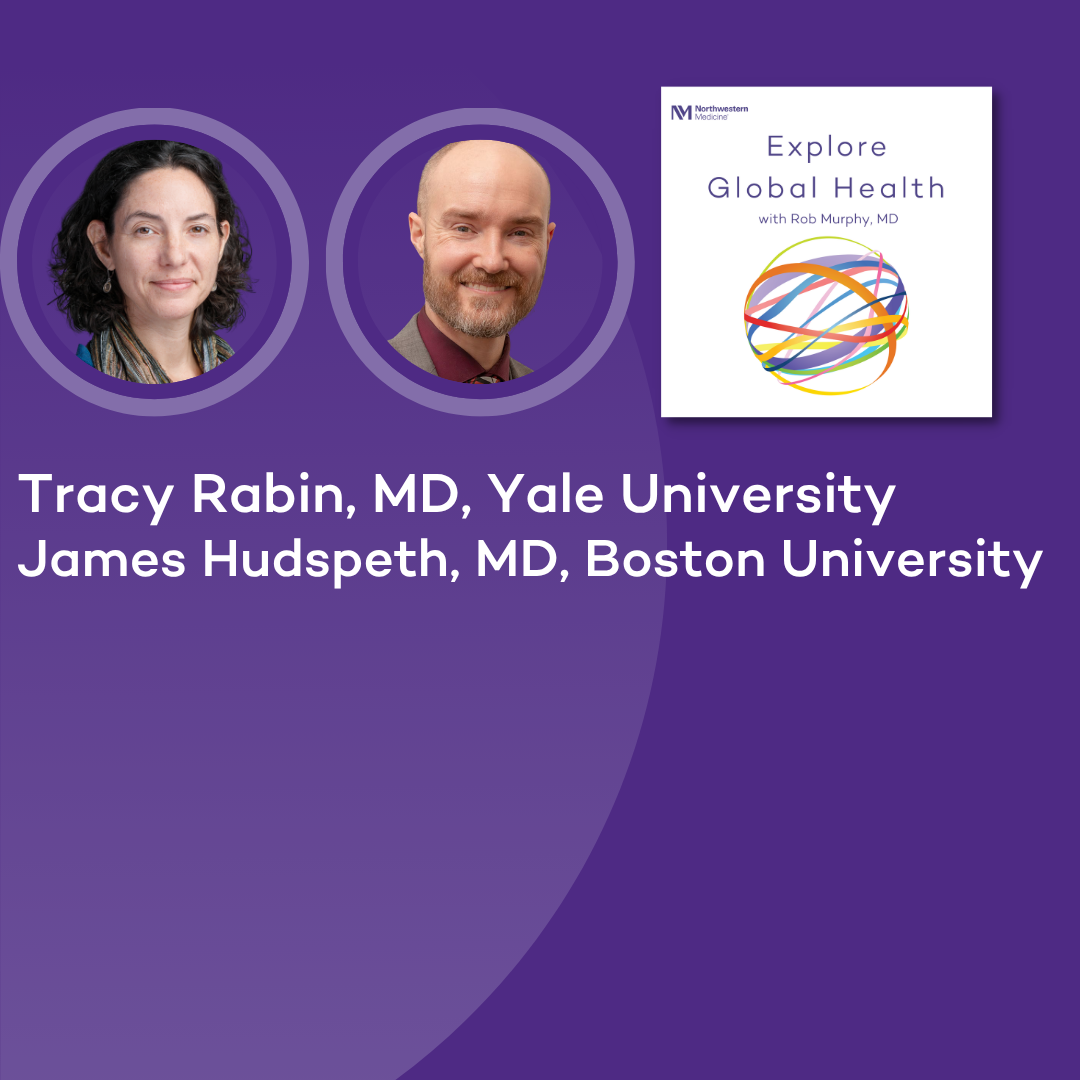
You could be a medical student from Uganda. You can come here, you can be seeing patients. If you go back to Uganda, you graduate and come back a month later with a license behind your name and presumably even better trained, you cannot actually touch patients. You are only allowed to be an observer. And so that is the kind of fundamental thing we're trying to shift.”
Topics Covered in the Show:
- What truly defines a bidirectional global health partnership: Rabin explains that equity is not about equal exchange, but about ensuring that both partners receive meaningful, self-defined benefits from the collaboration.
- How structural barriers limit hands-on training for international clinicians: Hudspeth outlines how visa restrictions and state licensing rules often prevent visiting clinicians from engaging in patient care, reducing valuable learning experiences to observation alone.
- Why these limitations matter for global health systems and U.S. institutions: The conversation highlights how restricting clinical training opportunities not only impacts partner countries, but also limits the exchange of knowledge and perspectives that strengthen healthcare delivery in the United States.
- Where momentum for change is emerging: From state-level advocacy for new licensing pathways to institutional efforts to better structure observerships and partnerships, there are tangible steps being taken to improve access and equity in global health education.
- How institutions and individuals can move the field forward: By evaluating existing partnerships, centering partner needs, and engaging in coordinated advocacy efforts, the guests share practical ways to create more equitable and impactful global health collaborations.
Show Transcript
[00:00:00] Dr. Rob Murphy: Welcome to the Explore Global Health Podcast. I'm Dr. Rob Murphy, Executive Director of the Havey Institute for Global Health here at Northwestern University Feinberg School of Medicine. We're recording in Washington, D.C., at the annual meeting of the Consortium of Universities for Global Health, or CUGH. As we look to shape the future of global health, we may need to rethink how we educate the people who lead it. Now I'm joined by two leaders in the global health field here, Dr. Tracy Rabin of Yale University, where she's director of global health. She's med-peds trained, and Dr. James Hudspeth, who's in the Department of General Internal Medicine at Boston University. They co-lead the CUGH working group on equitable opportunities in clinical investigation, and they've been very generous with their time at this busy conference to join me here today for the podcast. Their work here at CUGH focuses on improving bidirectional global health partnerships. It's really key to the whole concept here—especially addressing the barriers that limit opportunities for international clinicians to train in the United States. The work spans institutional change, state and federal policy, and broader advocate efforts, including co-founding Coalition Bright, which they're going to tell us about, to expand access to clinical education opportunities. Tracy and James, thank you very much for joining me today. Tracy, can you just tell me a little bit about your training and background?
[00:01:20] Dr. Tracy Rabin: When I think about my global health training, I really think about after college. I spent a year as an AmeriCorps member in Chicago, basically working in a federally qualified health center in Chicago, and having an opportunity to sort of learn about different populations in Chicago. And then following that, I actually went to Harvard and did a two-year master's in public health. Had the opportunity to work at WHO during that time and for a little bit after, and then really start doing more work around the ethics of doing international health research. That's kind of how my entry into global health came, was through public health a few years of that work. Then I sort of couldn't resist the call of medicine, decided to go to medical school, so I did my medical school at University of Rochester. I was fortunate enough to match at Yale for my med-peds residency. Stayed on as a global health chief resident and then the rest is history as I joined the faculty.
[00:02:09] Dr. Rob Murphy: When we talk about bidirectional global health education, what does that ideally look like and where are we falling short?
[00:02:15] Dr. Tracy Rabin: I honestly have come to believe that it doesn't necessarily look the same for every partnership, for every collaboration. I think the most important piece of that bidirectionality is that both partners in a relationship are achieving some degree of benefit that they feel is appropriate out of that relationship. So in some instances, that has to do with people moving physically from place to place. And so in terms of the type of clinical exchange that I'm involved in. If we are going to send our trainees to work with colleagues in another place, we want to be bringing their faculty or their trainees to come and work with ours. But I do think that there are a lot of different ways that different partners can define benefit. And so it may not necessarily mean that you need to be moving people from A to B in order to achieve that.
[00:02:59] Dr. Rob Murphy: Now we'll move on to James. James, tell us a little bit about your training, how you ended up where you are.
[00:03:04] Dr. James Hudspeth: I think for myself, you know, going into medical school, I was exposed to people who were doing advocacy work around global HIV during my first year, and then we were actually doing a federal push at that point to the presidential candidates trying to advocate for what was going to ultimately become PEPFAR. So that kind of pulled me into the topic and I think having been exposed to the idea that this was an area of interest and being involved in the campaign there, that led to me doing research through some of my faculty and my institution in South Africa. That led to me doing a Fogarty fellowship in South Africa for a year between third and fourth year. And then consequent to that in residency, connecting with colleagues who are interested in global health. Ultimately for me, I had a bunch of friends who were working in Haiti in various ways. After the Haitian earthquake, we kind of worked together to do support for organizations they were partnered with down there. And then that led to us building out an NGO that provided support around nursing and medical education for several partners. And that's kind of what I focused on for the first half of my career. That and doing work around training our residents in global health and educating them around that.
[00:04:01] Dr. Rob Murphy: There are real federal and state level barriers that limit international clinicians from training in the United States. What do those barriers look like in practice and how do they impact global health partnerships? This is a problem we all have.
[00:04:13] Dr. James Hudspeth: Yeah, absolutely. And so I think the impact, kind of going in reverse a little bit, I think the impact we see on global health partnerships is that this fundamentally limits what our partners can come to learn from us. I think this is interesting because this emerged somewhat organically in discussions across our group at the education committee here at CUGH. We all just independently noted to one another that we had a lot of trouble bringing our colleagues over. And obviously you can pick out things like surgery where you really have to be hands-on, but even things like palliative care where I brought one of my colleagues from Haiti up here. The experience she had was a good one, I think. But I do think that it is degraded when she can't actually talk to patients. She can't actually practice the skills that she's being taught, and it's just shadowing and observing. Regarding what exactly these barriers are: There's sort of this complex interlocking, which has good intent behind it. You know, the rationale is we want to make sure that our patients are kept safe. We want to make sure that the people taking care of patients are appropriately licensed and supervised. But the consequence of the way it is structured, we have a lot of difficulty with. Both how the state licenses are structured as well as how visas work out. One place where we see this in particular, or one thought experiment you can do that I think sheds some light on this, is that you could be a medical student from Uganda. You can come here, you can be seeing patients. If you go back to Uganda, you graduate and come back a month later with a license behind your name and presumably even better trained, now, you cannot actually touch patients. You are only allowed to be an observer. And so that is the kind of fundamental thing we're trying to shift. We just want to be able to get to a point where our colleagues who have already become faculty, who are often, as Tracy mentioned, the folks that their institutions would like to send here preferentially, that those people have the same opportunity to get education that the students from their same organizations and institutions would have as well.
[00:05:51] Dr. Rob Murphy: Have you had any success at all in changing things at your institution?
[00:05:57] Dr. Tracy Rabin: I think what has been particularly exciting for us, James and I, as well as a number of other colleagues, have been thinking about this for a number of years. And so I think what's been really energizing is that along the way, to just sort of see how many other colleagues are interested in engaging in advocacy. So this started off with a project which ended up with a paper that was published in Academic Medicine to really lay out what the issues were. A few years later, we were able to start this working group, and given the federal, state, and institutional layers of the barriers, these types of exchanges have been able to really attract other people who are just as interested in advocating because they want to be able to do what's right for their partners. There have been some successes in terms of being able to document what the problems are and sort of think about creating advocacy tools that individuals could use if they want to go to their state medical boards and say, I want to advocate for a special type of medical license that will allow for a short-term visit. Also, in terms of working with colleagues to lay out what are some of the things institutions should be thinking about when they're bringing colleagues, whether they're coming for observerships or not—here are ways that we need to be thinking about how to organize those visits to maximize the benefits. So I think the biggest successes, particularly in this political moment, have been at the state level. And thinking about how to get organized. And then at the institutional level, we have been working with colleagues, and an introduction—you mentioned Coalition Bright—which is an amazing collaboration with colleagues at the American College of Surgeons and others coming together to really think about this federal level of barriers and thinking about. Well, what would be the ideal visa category to allow for these short-term clinical trainings? We spent a number of years trying to talk with individuals at the State Department level and thinking about, you know, do we really need a new visa category or can we just reinterpret existing categories? What is the best way to approach this? So I would say we've learned a lot. And there are a number of colleagues. Again, this has been a multidisciplinary group who's been working on this, multiple organizations involved, but I think the most success we've had has been thinking about the state and institutional level advocacy. I don't know if you would agree, James.
[00:08:00] Dr. James Hudspeth: Yeah, I mean I would definitely agree and I think the challenge here is that there's a complex interdependence. Like even if you have a visa category, you can't do anything unless you have an appropriate license category and vice versa. But to the degree that we can move things on the state level, we lay the groundwork. And I think it also helps create a bit more impetus from the federal level. You know, be it at the State Department, be it talking to Congress. To point to states and be like, look, there are states that have license categories that we can use. All we need is the visa category to go with it and we can proceed accordingly.
[00:08:27] Dr. Rob Murphy: Where are you seeing the most momentum for change right now? Where do you think another institution, people who are listening to this podcast, where do they start?
[00:08:37] Dr. James Hudspeth: I think for this particular topic, in terms of places people can start, I think we both view this as an inextricable portion of how do we improve partnerships at large? And I know that's a big focus for CUGH. I think on this particular topic, it has a lot of bearing just because the U.S., you know, imports about a quarter of our physician workforce. And so to the degree, and interestingly, just from a historical perspective, the statutory language for the J-1 visa that we bring most of our residents and fellows on was actually initially intended to be a visa that brings people over for skill building and then has them return to their home country. But we've subverted that and turned it into something that is basically used to just augment the U.S. workforce. So there's a kind of a moral charge from my perspective to actually build out an opportunity for legitimate exchanges that do the skill-building, capacity-building we're trying to target. I think for most people, starting at your institution and trying to make sure that if you have global health partnerships, as Tracy mentioned at the onset, that you really are taking an equity frame toward them. You're not just kind of doing a one-to-one equal exchange of whatever you might have, or let alone no exchange. But you're asking, what does your partner want? What can you put on the table for them? And making sure both sides of it are feeling good about it. And then I think beyond that, if you specifically want to work on this topic, I think it's a matter of working with partners, you know, trying to find the other global health oriented institutions across your state. Building a coalition to think about how you might influence the state policy. And then from a federal level, emailing us and joining our working group there.
[00:09:56] Dr. Rob Murphy: We want to clearly differentiate the J-1. I'm coming here and I want to stay longer to work forever. I mean, that's the one group, and plenty of people I know have gotten the exemption, too. They didn't have to go back for the two years because they were working in an underserved area and they ended up doing quite well here. But to focus on the training and experiences here that they can be taken back—I think that's really the primary focus of your group.
[00:10:23] Dr. Tracy Rabin: Yes, exactly, and just as an example, so I co-direct with a colleague of mine at MCC University in Uganda, a bidirectional collaboration. For the last 20 years, we've been sending Yale trainees and Yale faculty to work with our colleagues in Uganda, and we've been bringing Ugandan faculty and Ugandan trainees to Yale for various types of training. Because of the regulations, the faculty are only able to do observerships when they come. And that said, they have been able to do amazing things with the knowledge that they've gleaned from those observations, what they go back and are able to implement in Uganda have really been incredible. So I don't want to devalue observations in any way. I think there's a lot that you can do if you structure them appropriately. Nowhere near the degree of skill-building that they could have had if they had been able to come.
[00:11:09] Dr. Rob Murphy: For institutions that want to do better today, considering all the different levels and complexities, are there any concrete steps they can take now to actually start moving the needle forward for at least for bidirectional training in general, and then for more specific clinical training?
[00:11:27] Dr. James Hudspeth: I think it begins again with institutions evaluating the partnerships they presently have and really having those discussions with the partners to make sure that both parties are getting what they would like. This is also a space where I think CUGH can play a role in terms of helping to set the standard for the field, because I think it is easier to go to your dean and tell them that as part of your partnership, there really is an expectation that there's some money on the table that goes to the partner institution and helps support their interests as well as whatever your trainees might be getting out of it or faculty might be getting out of it. And to the degree that CUGH makes it clear that is really the gold standard for the field, I think it makes it easier to make that argument consequent to people who are not within global health, but are often the people who are holding the purse strings. I think then within the clinical space, it is to some degree trying to be as liberal as possible within their institution. So again, I think having leadership go to talk to people like the lawyers, who often are the ones that ultimately make decisions about what is possible within your institution, within the present regulations, can be helpful to make sure you're doing as much as is possible. That's a place also where we're trying to garner good examples because I think a lot of the times lawyers feel good. Lawyers feel good if the lawyers think something's appropriate, that makes them feel a bit better that none of us are going to get nabbed by the State Department. But then I think the larger kind of institutional advocacy, be it on a state level or a federal level, is something that we obviously would like to have more people joining with us on. And if institutions are interested in doing that, they're very welcome to reach out to us directly, and we're happy to pull them into those campaigns.
[00:12:46] Dr. Tracy Rabin: I think part of the advocacy at our own institutions also should revolve around the benefits that our learners in the U.S. receive from having colleagues from other places who are coming to do observerships and just having them as part of the conversation, having them in the mix. You know, there are limited funds to send U.S. trainees to other places. So really the impact of a global health relationship, a global health collaboration can really be multiplied by bringing our colleagues here and then having them have the opportunity to interact with many more trainees than they otherwise would have. Thinking broadly about the different benefits of having this sort of bidirectional exchange piece is important for advocacy at your institution.
[00:13:24] Dr. Rob Murphy: Where are we going to be in five years or 10 years in this area?
[00:13:27] Dr. James Hudspeth: I think it's a good question. I am hopeful that in 10 years we'll be able to move this and actually be at a space where we are able to have our colleagues come over, regardless of the level of training and productive clinical experiences. I think that this is an issue that inherently doesn't have a particularly partisan nature to it. I think most people when offered the question of whether or not they would like, you know, physicians from other countries to come and learn at one of the greatest medical educational spaces that we presently have across the world, and most folks I think are in support of that. And I think particularly if this is framed carefully and thoughtfully such that we are not building back doors to residencies, but really are sort of fostering the kind of exchange that is the intent behind it. I'm very hopeful we can make it happen. I think our discussions, we've talked with a number of state medical boards. I think state medical boards by and large are very happy to kind of think through these sort of licensure agreements. So I don't think there's a big challenge there. And I think on the visa level where it's more complicated, I do think even there we have found a fair amount of support and allies amongst the pertinent organizations. So I think there's real opportunity. I think, so I'm hopeful in five to 10 years that we'll actually have made the move, Tracy?
[00:14:27] Dr. Tracy Rabin: In terms of the trajectory of being able to bring people here, I agree with James. I am hopeful. I think that enough people who are running programs at institutions have sort of agreed that thinking about bidirectional benefit is the appropriate way to go, and we shouldn't just be sending our trainees somewhere else without considering the value that we can provide for our partners. But even one step further: for those who have been engaging in bidirectional clinical training, the whole goal is to increase clinical capacity, educational capacity at our partner institutions. And so I think one of the exciting things is to watch our partner institutions develop their own training programs and then think about how within their country, within their region, how do they become sort of the ones with the most skills who are then receiving colleagues from other institutions. And then how do U.S. partners sort of remain part of that equation, but not necessarily requiring that people come to the U.S. for that type of skill-building, but sort of what are the other things that we can add to help facilitate that type of intra-country or intra-regional exchange? I think to me that's kind of the ultimate goal of all of this is to think about how you can develop the capacity for training more broadly.
[00:15:37] Dr. Rob Murphy: One final question for you both. What advice do you have for young people today who are just now embarking or wanting to embark on a career in global health?
[00:15:46] Dr. James Hudspeth: Almost anywhere within clinical medicine or a clinical profession can be brought to bear on global health because global health encompasses broadly the health issues of all humans. I often frame this to my trainees that you can either build expertise within a given area and then look to see if there are colleagues and partners out there who are looking for someone who's got that expertise. Or you can find a partner you want to work with. Figure out how you can bring and build up the skills that they're seeking and asking you for. But those, to my mind, are kind of the two best paths to be effective and partner-centered as you're trying to build out your career in global health. Tracy?
[00:16:17] Dr. Tracy Rabin: I love that. There's no one path to global health. And I actually think that for people who are just sort of starting out and starting to think more about being in this field, I think the most important thing is to learn about who you are and what your values are and to explore things that are interesting to you. Because I think, you know, the people that I've encountered in my career who I think have had the most interesting careers and have really been able to craft careers that center on deriving meaning from their work have been people who have just had very broad exposures and not necessarily thinking about, if I do one plus two is going to necessarily equal three, but really just saying, oh, this is an opportunity to explore this. Think about some of the other skills that are so necessary for this work. Thinking about empathy, thinking about cultural humility, and really just thinking about what are your values and how do values translate into a career? I think a lot of the other pieces—these are skills that you can learn through the training programs—but I think it's so important to figure out who you are as a person, what you value, and then letting that guide you towards hopefully global health.
[00:17:17] Dr. Rob Murphy: Well, thank you both very much for joining me today. I am so happy you're doing what you're doing in CUGH. I think it's really important to kind of keep somebody focused on this, to keep it growing, alive, and better. Follow us on Apple Podcasts or wherever you listen to podcasts to hear the latest episodes and join our community that is dedicated to making a lasting positive impact on global health. Follow us on Apple Podcasts or wherever you listen to podcasts, to hear the latest episodes and join our community that is dedicated to making a lasting positive impact on global health.