How Earth Science Is Shaping the Future of Global Health with Stephen Volz, PhD
Recorded at the Consortium of Universities for Global Health (CUGH) annual meeting in Washington, D.C., this episode of Explore Global Health features physicist and former NOAA satellite director Stephen Volz, PhD, whose career spans NASA, Earth observation, and global environmental science. He explains how satellite data and Earth system science are transforming our understanding of planetary health—and why that matters for human health outcomes worldwide. From the "triple planetary crisis" to the critical role of finance, Volz explores how environmental data, global collaboration, and local action must come together to build a sustainable and healthier future.



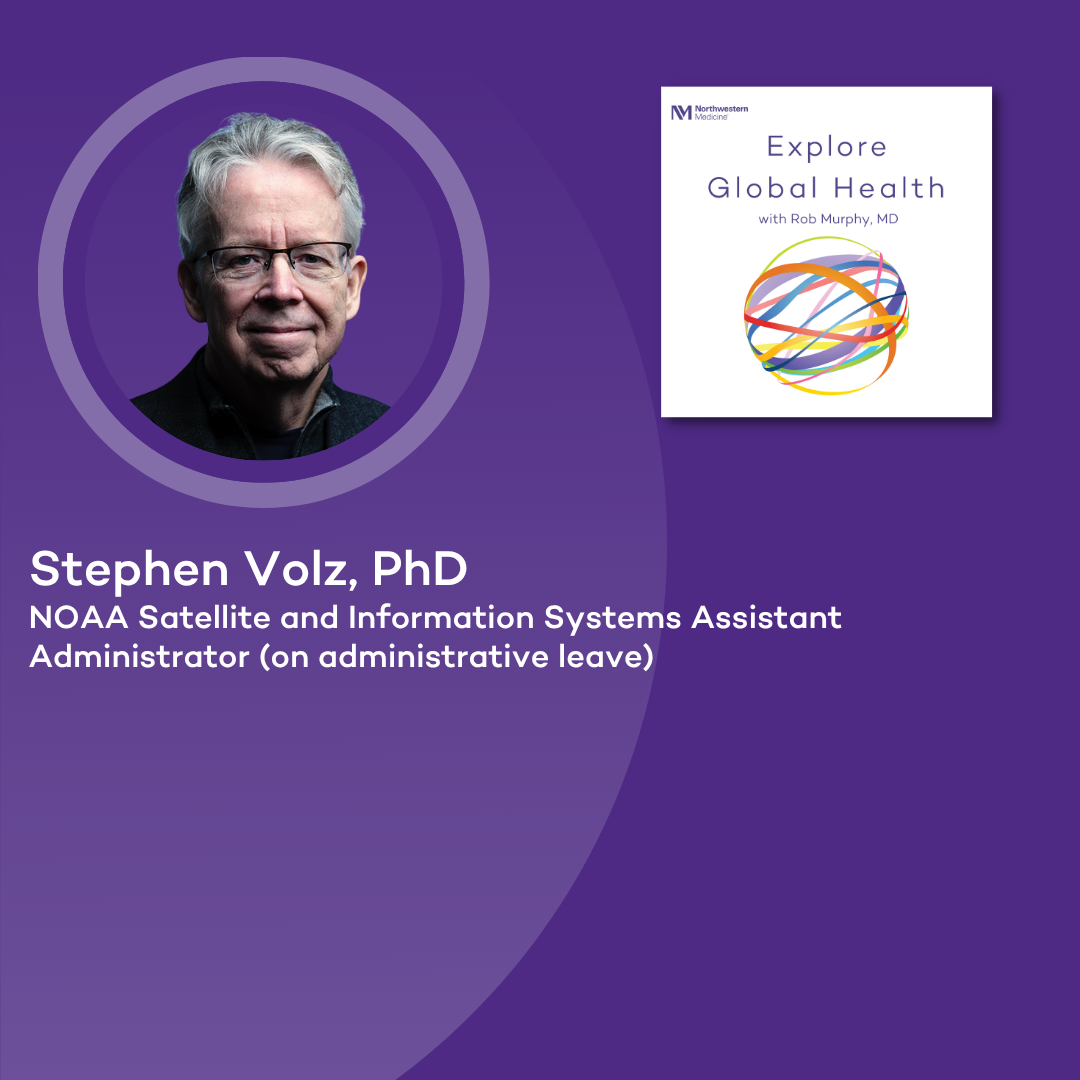
We're supporting 8 billion people instead of 1 billion in the last 100-year change. We've changed the life expectancy from 32 years to 72 years. These are incredibly beneficial to humanity. The consequence has been we have damaged the environment in a way that's non-sustainable.”
- NOAA Satellite and Information Systems Assistant Administrator (on administrative leave)
Topics Covered in the Show:
- Volz’s early inspiration was “the Space Age” which led him on an academic path through physics, and his transition into satellite-based science. He says curiosity, mentorship, and teamwork shaped his career, from quantum physics research to leading major NASA missions studying the universe and eventually the Earth.
- Drawing on his work at NASA and NOAA, Volz shares how satellite systems provide a holistic understanding of Earth’s interconnected systems—weather, oceans, land, and atmosphere—and how this data underpins essential services like weather forecasting, environmental stewardship, and public health decision-making.
- Current federal budget cuts to NOAA have led to a risk of abandoning comprehensive environmental observation, Volz says. He outlines the “triple planetary crisis” of pollution, biodiversity loss, and climate change, arguing that humans are now active drivers of planetary change and must take responsibility for sustainable action.
- He highlights key gaps and opportunities ahead such as: translating global environmental data into local, actionable health solutions; the importance of financial systems in shaping sustainable development and how global collaboration, advancing technology, and data accessibility can empower communities to improve health outcomes while protecting the planet.
Show Transcript
[00:00:00] Dr. Rob Murphy: Welcome to the Explore Global Health podcast. I'm Dr. Rob Murphy, executive director of the Havey Institute for Global Health here at Northwestern University Feinberg School of Medicine.
[00:00:21] Dr. Rob Murphy: Today's episode comes to you from the annual meeting of the Consortium of Universities for Global Health, where there's a growing recognition that the future of global health depends on how well we understand and protect the natural world that sustains life on Earth. Our guest, Dr. Stephen Volz, has spent his career at the center of that work. A physicist by training, he's held leadership roles at NASA and NOAA, overseeing one of the most advanced Earth observation systems in the world. Now he's bringing that perspective to CUGH, where he is speaking about how sectors like finance play a critical role in shaping planetary and human health. We are delighted to have him on the show today to talk about his work with CUGH and share his career path to global interdisciplinary work that impacts human health. Dr. Volz, welcome to the show.
[00:01:08] Stephen Volz: Thank you, Rob. Glad to be here.
[00:01:09] Dr. Rob Murphy: Tell us what brings you to CUGH this year and how do you see planetary health shaping the future of global health?
[00:01:17] Stephen Volz: Well, to be fair, I was not aware of CUGH until about a month ago when I met one of your colleagues, Frank, who's a member of the organizing committee for this conference. But when I read about it and heard more, I realized that a lot of the work I've been doing in Earth science and in satellite observations is so central to the applications that this community relies on. The information that we collect and the knowledge we generate is really essential to making good choices when it comes to public health and environmental protections. So, it's a pleasure to be here, even though I come from a very remote environment—literally from satellites in space—observing what happens here.
[00:01:57] Dr. Rob Murphy: Let's start by talking about your particular career journey. As a young person, who first drew you into science?
[00:02:04] Stephen Volz: Well, I'm a child of the Space Age. I was born the same year that NASA was formed. I grew up in the '60s with all of the cartoons—Lost in Space, Space Ghost, Astro Boy. My father was an aerospace engineer, so he would bring home pictures of the Apollo program. To me, that was the most exciting, enticing idea. It wasn't just that rockets are cool, but that we could build these things and the universe was vast. Both the Space Age and science fiction led me to an appreciation of the wonder of the universe and a feeling that you could understand it. You could be an astronaut or a scientist and actually understand what was going on. That breadth, from the minuscule to the universal, was appealing to me. The understandability with work was the part that really drew me in. The more you learn, the more you realize what you don't know, feeding a constant positive feedback of trying to understand more and do something with it.
[00:03:35] Dr. Rob Murphy: You started your academic journey at the University of Virginia and then earned your PhD at the University of Illinois Urbana-Champaign. How did that transition shape your path into physics and eventually Earth science?
[00:03:48] Stephen Volz: When I got to the University of Illinois, they had 80 faculty members and 300 grad students in physics. I found an advisor who was personable and curious like I was. Finding people I liked working with on fascinating projects was always the hallmark of my path. He was doing low-temperature physics—quantum mechanics of superfluid helium. I liked the idea of quantum mechanics and jumped into that, studying superfluid helium physics for two-dimensional superconductors.
[00:04:29] Dr. Rob Murphy: Is it true that you applied to be an astronaut in your mid-20s?
[00:04:33] Stephen Volz: I did, several times. Most people who apply don't become astronauts. My vision wasn't great, which I credited for not being picked, but it's just a really hard thing to get. It goes with my earlier theme: being an astronaut looked really cool.
[00:04:55] Dr. Rob Murphy: You spent years at NASA on major Earth science missions. What did that experience teach you about understanding our planet at scale?
[00:04:55] Dr. Rob Murphy: You did spend years at nasa on major Earth science missions, what did that experience teach you about understanding our planet at scale?
[00:05:03] Stephen Volz: When I started at NASA, I built cryogenic detectors and cooling systems for astrophysics satellites to measure infrared telescopes in space. My first project was the Cosmic Background Explorer (COBE). It won NASA the Nobel Prize for determining without a doubt that we have a microwave background originating from the Big Bang. Looking at the origins of the universe in your first job out of grad school was so cool. After about 10 years, I moved to Colorado working on the industry side before coming back to D.C. to work in Earth science. I learned that my career development wasn't just about the observables, but about the team. I found I was very good at bringing smart experts together as a science and project leader. In Earth science, we started looking down instead of looking up. When you see the Earth, you're swamped with data. You have to narrow your focus—perhaps looking at infrared emissions from leaves to see if they're healthy or checking ocean altimetry. I ran a satellite program at NASA managing a dozen satellites at once, and I realized a holistic view of Earth is what is really fascinating. Understanding how weather, oceans, land, and atmosphere are all interconnected teaches you more about each part. Seeing the real-time cause and effect of those interdependencies hooked me on comprehensive Earth system observations. It's the master puzzle of our era.
[00:07:48] Dr. Rob Murphy: At NOAA, you led one of the world's most comprehensive Earth observation systems. How does that system connect to real-world health outcomes? And tell us a little bit about NOAA.
[00:07:58] Stephen Volz: There's a rivalry between NOAA and NASA regarding Earth observations. NASA's mission is discovery and making headlines. The mission of NOAA is to be "boring." NOAA provides weather forecasts, fisheries management, coastal zone management, and tide updates. You want those to be reliable and predictable. We provide science-based services and stewardship of the environment. For example, we set catch limits for fisheries based on scientific understanding of species health. We model the entire world's atmosphere and weather through numerical prediction models, which give us those three-, five-, and seven-day forecasts. Everyone in the country—and to a large extent, the world—is a customer of NOAA. Airplanes fly because of the information we provide about storms and solar activity.
[00:09:43] Dr. Rob Murphy: What's happened to the budget in the current administration?
[00:09:46] Stephen Volz: It has not been pleasant. Proposals have reduced the budget by as much as 25%. They call it "focusing on the weather mission," but the weather mission can't be done without focusing on the entire environmental observation mission. You can't study the air without studying the ocean-atmospheric interface that drives weather patterns or the land and vegetation that drives soil evaporation. If we walk away from that holistic assessment of the planet and its ecosystems, we will lose the benefits we've been gaining over the last 30 years.
[00:10:33] Dr. Rob Murphy: I imagine it's been very tough on the staff.
[00:10:36] Stephen Volz: It has been. I am currently on administrative leave, taken away from my position of responsibility. I was the director of the satellite program for 10 and a half years. I think largely because I was advocating for these holistic missions. For the staff who remain, they're trying to do their jobs without the distraction. When you hear about 25% budget cuts or stopping atmospheric and air quality measurements, it's a blow to the history of what we've done and to the people who focus in those areas. It's a personal disappointment to them.
[00:11:40] Dr. Rob Murphy: You've said that we are no longer just the observer in the world; we've become the actors. Tell me about that.
[00:11:45] Stephen Volz: We reference the "triple planetary crisis," which is the combination of pollution, biodiversity loss, and climate change. All three are driven largely by human activity. We've massively farmed the land, changed habitats, depleted the oceans, and driven CO2 into the atmosphere with fossil fuels. Until about 200 years ago, we were not the engines of action in planetary evolution. We are now. To paraphrase: with great knowledge comes great responsibility. Since we know our actions have consequences, we have a responsibility to take the right actions. When you try to change the status quo, you get pushback from those who benefit from it, but we are the engines of change.
[00:13:08] Dr. Rob Murphy: The panel you're on today focuses on nature financing. Why is it so important for the global health community to understand the role of the financial sector in shaping health outcomes?
[00:13:23] Stephen Volz: Without resources, you can't make change. Economic development has raised our awareness of health and led to many good outcomes—supporting 8 billion people instead of 1 billion and increasing life expectancy from 32 to 72 years. However, we damaged the environment in a non-sustainable way. The financial sector comes in when we force economic developments, like clearing forests for palm oil exports. This displaces people and creates different health environments. Solutions have to be not just viable, but sustainable in the long term. We don't have the runway anymore to locally optimize without worrying about what's going to happen in 10 or 15 years.
[00:15:04] Dr. Rob Murphy: Where do you see the biggest gaps today between environmental data and how it's actually used in global health decision-making?
[00:15:14] Stephen Volz: We have a great global understanding of trends at moderate resolution—perhaps a quarter-mile scale. We can tell you the productivity of land and where people are living using satellite data combined with ground truthing. But people act on a much narrower scale. We need one-meter resolution to know what someone is doing tomorrow with their fuel oil to cook a meal. The gap is translating global information into action at the local scale. This afternoon's panel will discuss examples like heat health, mosquito tracking, and dengue fever. We need to connect with practitioners at the community scale, giving them forecasts and ideas they can use to help their families. Scaling allowed us to take local problems, see them globally, and then find solutions to expand in a holistic way.
[00:17:10] Dr. Rob Murphy: You've worked across governments and international agencies. What have you learned about what makes global collaboration actually work?
[00:17:20] Stephen Volz: I'll start with what doesn't make it work. I think big-name entrepreneurs are not what make change work at the local level. What happens is people spend their lives on a passion that is important to them and their communities, then find others with similar interests. This conference is a perfect example—Ugandan practitioners talking to someone from Guatemala. Creating a sustained environment for that connection creates a community of practice. We have examples like the World Meteorological Organization (WMO), where 180 countries share best practices. It's that global approach of looking at the Earth as a whole with no boundaries. The problems are common, and the solutions can be as well. We just need to keep reinforcing our common humanity.
[00:19:23] Dr. Rob Murphy: We've been working in point-of-care diagnostic technologies with nine sites in Africa. They have very similar health needs to ours, and the information is bi-directional. We can learn a lot from our partners.
[00:19:39] Stephen Volz: A message for a mother in Botswana can have the same solution as one for a mother in Mississippi. You've got to learn how to communicate and listen. The differences are much smaller than the commonalities between us.
[00:19:43] Dr. Rob Murphy: Exactly. We're finding that the technologies developed with our African partners are often less expensive and more efficient. In the U.S., diagnostic networks are so complicated. It's not going to work everywhere; it's too expensive.
[00:20:33] Stephen Volz: Most people don't have that end-to-end view, and they don't need it. The essence of a good collaboration is finding where an individual's expertise and passion can contribute to a global performance. Someone testing in the suburbs of Cincinnati doesn't necessarily need to know their work is helping someone in Cape Town, but they need the right framework to get it there. That networking is the joy of working as larger teams—letting people see they are part of a larger mission without having to own the entire thing.
[00:21:34] Dr. Rob Murphy: Looking ahead, what gives you hope about the integration of planetary and global health?
[00:21:41] Stephen Volz: The barriers to data utilization are coming down. Increases in computing power and the explosion of observing systems—from satellites to drones—are enabling a greater collective understanding of the Earth. The ability to ask questions and have them answered is in front of us now. This, combined with the people growing up and recognizing these problems, puts the power to change in the hands of those committed to a better future.
[00:22:29] Dr. Rob Murphy: What advice do you have for young people wanting to embark on a career like yours?
[00:22:36] Stephen Volz: I've always chosen paths that were interesting and challenging. What I learned early on is that the most important thing you can do when joining a new group is to add value to what they want to achieve. Don't just come in as an "expert." Listen to what they are doing, figure out how you can help them, and if it's a good fit, do the things you want to do as well. People open up about their passions when you come in with that perspective. It's served me well to join teams of passionate people.
[00:23:43] Dr. Rob Murphy: Stephen, thanks so much for being on the show today.
[00:23:45] Stephen Volz: Thank you for having me, Rob.
[00:23:46] Dr. Rob Murphy: Follow us on Apple Podcasts or wherever you listen to podcasts to hear the latest episodes and join our community dedicated to making a lasting positive impact on global health.