Northwestern’s Health on the Roll Mobile Clinic Breaks Barriers to Cancer Prevention in West Africa
At the Robert J. Havey, MD Institute for Global Health Center for Global Oncology cervical cancer research is at the forefront of their priorities. According to the World Health Organization (WHO), cervical cancer remains the second most common cancer among women in Kenya, with an estimated 5,845 new cases and 3,600 deaths annually. Globally, cervical cancer is the fourth most common cancer among women, 90 percent of which occur in low- and middle-income countries. The highest rates of cervical cancer incidence and related death occur in Sub-Saharan Africa where approximately 60 percent of all cervical cancer cases are in women living with HIV/AIDS. One major hurdle for screening is access to healthcare. The disease is largely preventable through human papillomavirus (HPV) vaccination and early screening, but factors such as distance, cultural barriers and access to services prevent many women from receiving a timely diagnosis.
This makes cervical cancer screening a critical part of healthcare for women in these countries. With the support of funding from the Strohm family, research led by Principal Investigator (PI) Lifang Hou, MD, PhD, director of the Center for Global Oncology and chief of Cancer Epidemiology and Prevention in the Department of Preventive Medicine at Northwestern University Feinberg School of Medicine, has extended to low- and middle-income areas in Ghana and Kenya.
This project aims to expand community health worker training for cervical cancer screening to rural and peri-urban communities in Ghana and Kenya, with partners at the University of Ghana and the Nyanza Reproductive Health Society. This program has been developed and implemented in a similar way to ongoing programs in Nigeria and Mali, utilizing strong partnerships with national and local leaders. Through needed philanthropic funding, along with existing resources and training, the center is implementing a new cervical cancer screening program with local community health workers in Ghana and Kenya, with the goal of building capacity and a sustainable program for cervical cancer testing for women in high-risk populations for years to come.
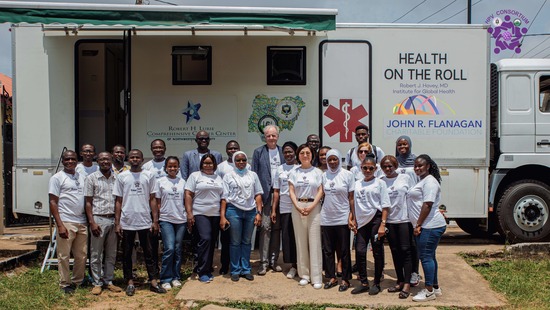
Among the Center for Global Oncology’s other innovative cancer research are key cervical cancer-focused projects: the Flanagan Foundation Health on the Roll HPV-Associated Cancers Prevention and Control Program in Africa mobile clinic and the National Cancer Institute (NCI) U01 grant West Africa Self-Sampling HPV Based Cervical Cancer Control Program (WA-SS-HCCP) for WLWHA: Barriers, challenges, and needs. These projects, in conjunction with the Strohm family funding, allow critical cervical cancer research to extend throughout West Africa and build upon the successful mobile clinic testing and treatment programs developed in countries such as Nigeria and Mali, bolstering their cervical cancer research throughout more African countries.
“In high-income countries, these preventive strategies have led to a steep decline in cervical cancer; however, they remain largely inaccessible to women in low- and middle-income countries,” Hou said. “Innovative, cost-appropriate and culturally adaptive strategies for cervical cancer screening are needed for countries with limited resources.”
The Center for Global Oncology is a shared center with the Robert H. Lurie Comprehensive Cancer Center of Northwestern University and Havey Institute for Global Health.
Lifang Hou, MD, PhD, is a member of the Havey Institute for Global Health, Institute for Public Health and Medicine (IPHAM), Robert H. Lurie Comprehensive Cancer Center and Northwestern University Clinical and Translational Sciences Institute (NUCATS).
For details on events, news and funding opportunities, sign up for the Havey Institute for Global Health newsletter.