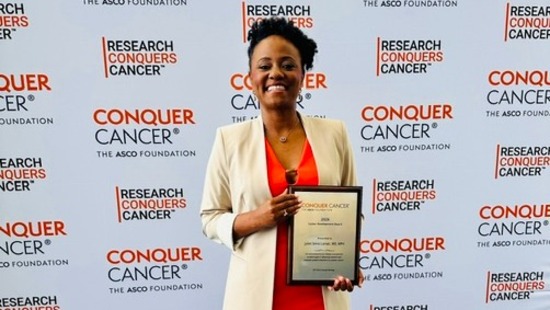
Lumati Awarded Career Development Award from ASCO’s Conquer Cancer Foundation
As a pediatrician, the Fogarty experience transformed how I view global health. It taught me that the community is not just a beneficiary of our work – it must be at the very center of everything we do.”
What type of work do you do and why is it important?
I am a pediatrician working in rural Eastern Uganda, where I care for children with a wide range of infectious and non-infectious diseases. While reducing mortality remains a priority, advances in healthcare mean that many children are now surviving conditions that were once fatal. As they live longer, attention must also shift to the long-term consequences of these illnesses, including neurodevelopmental and cognitive outcomes that can affect their education, quality of life and future productivity.
I am intrigued to understand how acute and chronic infectious diseases influence cognitive performance in children. I am particularly interested in whether we are using culturally appropriate and reliable tools to assess neurocognitive function, and whether these assessments ultimately translate into interventions that improve children's lives and developmental potential. These questions have become the driving force behind my work as both a clinician and a researcher.
Currently, my research titled Rural Uganda Neurocognitive Youth Assessment with Perinatally Acquired HIV studies cognitive performance among adolescents aged 12 to 18 born with HIV. I am using a digital neurocognitive assessment tool that we have translated and adapted to the local language (Runyankole).
What is the goal of your research?
My current research looks at the neurocognitive performance of adolescents with perinatally-acquired HIV in rural southwestern Uganda measured using a novel culturally adapted tool called NeuroScreen.
Who is involved in your research (institutes, faculty members, etc.)?
This work is being done in collaboration with Mbarara University of Science and Technology (MUST), Northwestern University and Columbia University. The study site is Mbarara Regional Referral Hospital. My LMIC mentor is Elias Kumbakumba, MBChB, MMed, from MUST, Sahera Dirajlal-Fargo, MS, DO, co-director of the Robert J. Havey, MD Institute for Global Health and assistant professor in the Division of Pediatric Infectious Diseases at Feinberg, and Reuben Robbins, PhD, from Columbia University.
What interests or motivates you about global health?
My motivation for global health has been shaped by my experiences as a clinician working in a resource-limited setting in Uganda. Caring for children in this environment has shown me that the most pressing health challenges rarely have a single solution. Instead, they require a multidisciplinary approach, where every intervention is like a piece of a larger puzzle. Success depends on understanding how each piece fits together from clinical care and public health to research, community engagement, health systems and policy. It also requires collaboration among healthcare professionals, researchers, communities and political leaders. This realization has inspired me to pursue global health, where I can contribute to developing integrated, sustainable solutions that improve health outcomes for vulnerable populations.
How did you first get involved in global health?
I first became involved in global health while working as a research medical officer on a multi-institutional study investigating neonatal sepsis and post-infectious hydrocephalus. The project brought together clinicians, researchers and institutions from different countries to address the link between infant sepsis and post-infectious hydrocephalus. Through this experience, I gained firsthand exposure to collaborative global health research and saw how partnerships could generate evidence to improve clinical care and health outcomes. With the guidance and mentorship of experienced investigators, I began to develop my own interests in research and global health, which ultimately motivated me to apply for a Fogarty Global Health fellowship to further build my skills as a clinician-scientist.
What lessons have you learned as a global health researcher?
One of the most important lessons I have learned is that meaningful global health research is built on collaboration, mentorship and sustained investment in early-career researchers. The support I have received through the HBNU Fogarty Global Health Fellowship, together with the mentorship of investigators at Northwestern University and Columbia University, has been transformative to my career.
Applications for the 2027-2028 HBNU Fogarty Global Health Fellowship are being accepted until September 25, 2026. For more information and to apply, visit the fellowship webpage.
For details on events, news and funding opportunities, sign up for the Havey Institute for Global Health newsletter.
