Northwestern’s Health on the Roll Mobile Clinic Breaks Barriers to Cancer Prevention in West Africa
Chronic hepatitis B virus (HBV) infection remains a major public health challenge across sub-Saharan Africa, particularly among individuals co-infected with HIV who are at risk of accelerated liver disease progression and poorer outcomes. Despite global efforts toward HBV elimination, persistent clinical, programmatic and research gaps remain, limiting the access to and the effectiveness of HBV prevention, diagnosis and treatment. To address this, a team from the Robert J. Havey, MD Institute for Global Health established the African HIV/HBV Co-infection/HBV Clinical Research Network (H2Net), a collaborative research partnership.
In 2023, the team created H2Net, a partnership among Jos University Teaching Hospital (JUTH), Lagos University Teaching Hospital (LUTH), and University College Hospital Ibadan (UCH) in Nigeria; the University of Sciences, Techniques and Technologies of Bamako (USTTB) in Mali; and Muhimbili National Hospital (MNH) in Tanzania. The project is led by principal investigator (PI) Claudia Hawkins, MD, MPH, professor of Medicine in the Division of Infectious Diseases and director of the Center for Global Communicable and Emerging Infectious Diseases at the Havey Institute for Global Health.
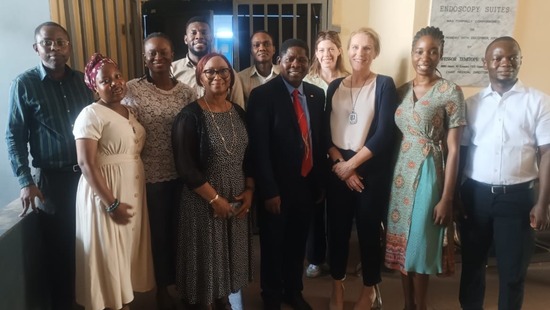
Collaborators from University College Hospital Ibadan (UCH), Jos University Teaching Hospital (JUTH) and Northwestern join PI Claudia Hawkins and mPI Edith Okeke for a site visit at UCH in Ibadan, Nigeria in February 2026.
H2Net was established to conduct research and implement activities addressing critical gaps in HBV, with a focus on improving clinical outcomes, strengthening HBV care delivery and advancing translational science to support HBV elimination and future cure strategies in Africa.
“The work we do is critical because effective HBV elimination and cure strategies cannot succeed globally without addressing the disproportionate burden, care gaps, and implementation challenges faced by African populations,” said Hawkins.

The work we do is critical because effective HBV elimination and cure strategies cannot succeed globally without addressing the disproportionate burden, care gaps, and implementation challenges faced by African populations.”
The research is funded by the Havey Institute for Global Health Global Innovation Challenge Award which has created opportunities for faculty who aim to catalyze research and educational programs. The award funds high-risk/high-reward research with $250,000 in funding for two-year projects.
The Global Innovation Challenge Award has supported the establishment of a multisite HBV cohort aimed at improving understanding of HBV across H2Net network sites.
“One of our first core activities was an observational study of HBV outcomes to better characterize HBV and HIV/HBV co-infection across diverse populations, disease stages, and treatment exposures and identify candidates for future HBV curative trials,” said Hawkins.
To date, the team has enrolled more than 900 participants with chronic HBV – with and without HIV – at H2Net sites.
Sub-studies are also being conducted within H2Net, spanning implementation work to improve access to treatment and integration of HBV care into primary care and HIV clinics; the evaluation of point-of-care diagnostics to improve HBV testing uptake; and the study of novel HBV biomarkers to inform curative strategies.
Working with Hawkins are project collaborators from Nigeria, Mali, Tanzania and the United States. Team members include:
To learn more about the Global Innovation Challenge Award, read IGH news stories highlighted throughout March and visit their website.
For details on events, news and funding opportunities, sign up for the Havey Institute for Global Health newsletter.