Lumati Awarded Career Development Award from ASCO’s Conquer Cancer Foundation
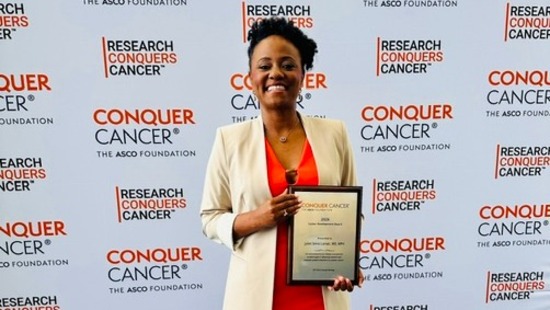

The most meaningful global health solutions are built with communities, not just for communities.”
What interests or motivates you about global health?
I am motivated by the belief that where someone is born should not determine their opportunity to live a healthy life. Many of the world's greatest health challenges are preventable, yet access to evidence-based care remains highly unequal. What inspires me most about global health is the opportunity to work across disciplines and in partnership with communities to co-create sustainable, contextually relevant solutions that strengthen health systems and improve health outcomes. I am particularly passionate about implementation science because it bridges the gap between scientific evidence and real-world practice, ensuring that proven interventions reach the communities that need them most.
How did you first get involved in global health?
Growing up in Nigeria, I witnessed how gaps in primary healthcare disproportionately affected young people. Those experiences shaped my "why" and inspired my career in implementation science — specifically, understanding why some evidence-based programs are successfully adopted and sustained while others fall short, and partnering with communities to design interventions that strengthen chronic disease care and respond to the needs of young people and organizations to improve health systems and chronic disease prevention and care.
What is the goal of your research?
My research seeks to develop, implement and sustain evidence-based, community-to-clinic interventions that address the behavioral, social and cultural determinants of health among young people. By partnering with communities and applying implementation science, I aim to strengthen health systems, improve chronic disease prevention and care, and advance health equity in resource-constrained settings.
What countries/regions is your work focused on?
Nigeria, South Africa and Botswana
Who is involved in your research (institutes, faculty members, etc.)?
My work is embedded in collaborative networks at Northwestern and globally, including partnerships with my primary mentor Lisa Hirschhorn, MD, MPH, Sara Becker, PhD, and Ashti Doobay-Persaud, MD. Internationally, I collaborate with teams at the University of Abuja Teaching Hospital and Lagos State University Teaching Hospital in Nigeria, as well as partners in Botswana and South Africa.
What type of work do you do and why is it important?
My research lies at the intersection of global health, implementation science and community-engaged research. In collaboration with Drs. Lisa Hirschhorn, Dike Ojji and Mark Huffman, I contribute to two NIH-funded studies in Nigeria that aim to strengthen cardiovascular health. One study evaluates the implementation of the World Health Organization’s HEARTS package to improve the hypertension care cascade in primary healthcare clinics, while the Nigeria Sodium Study examines strategies for implementing evidence-based sodium reduction policies to reduce population-level dietary sodium intake and prevent cardiovascular disease. Building on lessons learned from this work, I am now collaborating with Dr. Hirschhorn and colleagues on a newly funded study in Botswana to strengthen hypertension care in primary healthcare clinics. Beyond cardiovascular health, I collaborate with Dr. Becker on a study funded by the National Institute on Alcohol Abuse and Alcoholism evaluating alcohol screening and brief interventions within HIV care in South Africa, and with Dr. Doobay-Persaud to advance pediatric palliative care integration in Nigeria.
Applications for the 2027-2028 Post-Graduate Fellowship in Global Health are being accepted until February 1, 2027. For more information and to apply, visit the fellowship webpage.
For details on events, news and funding opportunities, sign up for the Havey Institute for Global Health newsletter.
