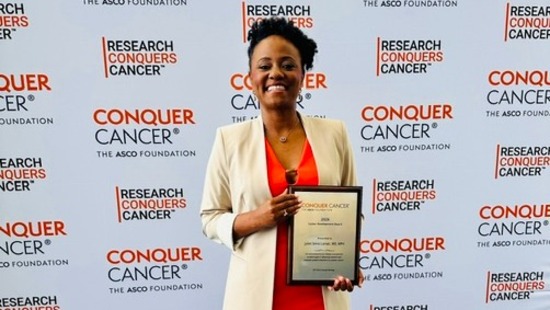
Lumati Awarded Career Development Award from ASCO’s Conquer Cancer Foundation
Advancing Parkinson's disease care means not only developing new treatments but also ensuring that existing standards of care are available to patients worldwide.”
What interests or motivates you about global health?
My interest in global health stems from a desire to reduce disparities in access to neurological care. I was born in Haiti and immigrated to the United States as a teenager, both of which are experiences that gave me an early appreciation for how geography and available resources shape health outcomes. As a movement disorders neurologist, I have seen how people living with Parkinson's disease often face delayed diagnosis, limited access to specialists and fewer educational resources in many parts of the world. I am motivated by the opportunity to work alongside local clinicians, patients and communities to develop practical and culturally relevant approaches that improve care while learning from diverse healthcare systems.
How did you first get involved in global health?
I first became involved in global health during my neurology residency at the David Geffen School of Medicine at UCLA when I had the opportunity to work in Zambia. That experience exposed me to the challenges of providing neurological care in a resource-limited setting and highlighted the profound inequities faced by people living with neurological diseases. It also reinforced the importance of building lasting partnerships with local clinicians and communities.
What is the goal of your research?
My research aims to improve access to high-quality Parkinson's disease care and expand opportunities for research participation in low- and middle-income countries. In Zambia, the goal is to develop and implement a culturally adapted self-management toolkit to empower patients and caregivers with practical knowledge and resources to better manage Parkinson's disease. In Nigeria, the goal is to understand attitudes toward clinical trial participation among individuals with Parkinson's disease and the barriers and facilitators to research engagement. Together, these projects seek to improve patient education, increase representation of underrepresented populations in clinical research and inform sustainable approaches to Parkinson's disease care across sub-Saharan Africa.
Who is involved in your research (institutes, faculty members, etc.)?
My work is a collaborative effort between Feinberg and international partners. In Zambia, I collaborate with clinicians at the University Teaching Hospital in Lusaka under the mentorship of Dr. Lorraine Chishimba, alongside Drs. Jennifer Adrissi and Vivian Shen at the University of California, Los Angeles. In Nigeria, I work with professor Njideka Okubadejo and colleagues at Lagos University Teaching Hospital. These collaborations bring together complementary expertise to address locally identified priorities and improve Parkinson's disease care and research.
What type of work do you do and why is it important?
My research combines implementation science, community engagement and clinical research to improve Parkinson's disease care in low-resource settings.
One of my primary projects examines attitudes toward clinical trial participation among individuals with Parkinson's disease in Nigeria. By identifying barriers related to trust, awareness and access, this work seeks to improve the representation of diverse populations in Parkinson's disease research and promote more equitable participation in future clinical trials.
I am also leading the development and evaluation of a culturally adapted Parkinson's disease self-management toolkit for patients and caregivers in Zambia. In partnership with patients, caregivers and healthcare professionals, we are co-designing educational materials and practical resources to improve disease knowledge, symptom management and self-efficacy.
Together, these projects aim to strengthen patient-centered Parkinson's disease care while expanding opportunities for meaningful participation in research across historically underrepresented communities.
What countries/regions is your work focused on?
My current work focuses on sub-Saharan Africa, particularly Zambia and Nigeria. While these projects are specific to these countries, many of the lessons learned will hopefully have broader applications for improving neurological care and research across other low- and middle-income countries.
Anything else you'd like to mention?
What draws me to global health is the opportunity to work with colleagues across different healthcare systems to address shared challenges. I hope to contribute to research that is practical, sustainable and responsive to the needs of the communities it serves. As an early-career neurologist, I aspire to build a career that combines clinical care, research and international collaboration to improve neurological care worldwide.
Applications for the 2027-2028 Post-Graduate Fellowship in Global Health are being accepted until February 1, 2027. For more information and to apply, visit the fellowship webpage.
For details on events, news and funding opportunities, sign up for the Havey Institute for Global Health newsletter.
