Podcast Rewind: Trailblazing a Path in Global Health with Lisa R. Hirschhorn, MD, MPH
Hospitalized patients need continuous monitoring of their vital signs in order for medical staff to respond in case their condition deteriorates. Most public hospitals in Ghana, however, rely on intermittent vital signs monitoring by nurses to track the health of their patients. This leads to the potential for increased risk of deterioration of patients’ condition before nurses can administer follow-up checks. A team including members from the Buehler Center for Health Policy and Economics and Center for Innovation in Global Health Technologies (CIGHT) at the Robert J. Havey, MD Institute for Global Health is researching how to improve hospital care through innovative wearable technology systems.
The goal of Implementing a hospital-based continuous patient monitoring system using consumer wearable devices in Ghana is to validate and implement a continuous vital sign monitoring system using widely available consumer wearable devices in hospital settings in Ghana. Consumer wearable devices offer an opportunity to address challenges and provide a wireless system for monitoring vital signs. By continuously tracking patients’ vital signs, this system aims to help healthcare providers identify early signs of clinical deterioration.
The need for affordable and reliable patient monitoring is critical because early detection of clinical deterioration can save lives, especially in hospitals with limited resources.”
Collaborating on the project are co-investigators Soyang Kwon, PhD, research associate professor in the Department of Emergency Medicine and member of the Buehler Center, and Matthew Glucksberg, PhD, co-director of CIGHT and professor of Biomedical Engineering at McCormick School of Engineering.
The team also includes William Appeadu-Mensah, MBChB, and Elsie Effah Kaufmann, PhD, MPIs from the University of Ghana; Hassan Ghomrawi, PhD, MPI from the University of Alabama at Birmingham; Fizan Abdullah, MD, PhD, MPI from Loyola University Chicago; and Jane Holl, MD, co-investigator from University of Chicago. This multidisciplinary, international team is the first group of investigators to receive approval from Ghana’s Food and Drugs Authority to use consumer wearable devices for patient monitoring in healthcare settings, marking an important milestone for technology-enabled global health innovation.
“The work we do is important because it helps bring timely, life-saving monitoring to hospitals where continuous vital sign monitoring is often not available,” Kwon said.
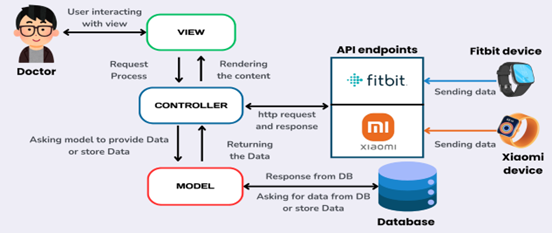
This research concept image details the flow of information between a doctor and a wearable device.
Kwon serves as a wearable technology and data analysis expert on the project. She advises on how wearable devices are used in real-world settings and guides the analysis of the large amount of health data they generate. This work helps to ensure that the technology is both scientifically sound and practical for real-world healthcare settings, especially in resource-limited environments.
“The need for affordable and reliable patient monitoring is critical because early detection of clinical deterioration can save lives, especially in hospitals with limited resources,” Kwon said.
Though focused on Ghana, the project addresses a critical gap in hospital care in many low- and middle-income countries, where continuous vital sign monitoring is often limited due to shortages of equipment, reliable electricity and healthcare personnel.
The Buehler Center for Health Policy and Economics within the Institute for Public Health and Medicine (IPHAM), Northwestern Feinberg School of Medicine and the Havey Institute for Global Health provides the economic and health policy expertise needed when investigating a broad range of health and medical issues.
This project is supported by a National Institute of Health Fogarty International Center R21/R33 grant and was previously supported by a Havey Institute for Global Health Global Health Research Catalyzer.
To learn more about the Buehler Center for Health Policy and Economics, visit their website.
For details on events, news and funding opportunities, sign up for the Havey Institute for Global Health newsletter.