Podcast Rewind: Trailblazing a Path in Global Health with Lisa R. Hirschhorn, MD, MPH

Public health students at the University of the Witwatersrand (Wits) in South Africa convened in August 2025 to learn decision-analytic modelling from Ciaran Kohli-Lynch, PhD, MS, assistant professor of Epidemiology in the department of Preventive Medicine and member of the Buehler Center for Health Policy and Economics within the Institute for Public Health and Medicine (IPHAM), Feinberg and the Robert J. Havey, MD Institute for Global Health.
Decision-analytic modelling is the comparison of expected costs and consequences of various outcomes through the synthesization of information and the application of mathematical techniques in order to reach the best decision.
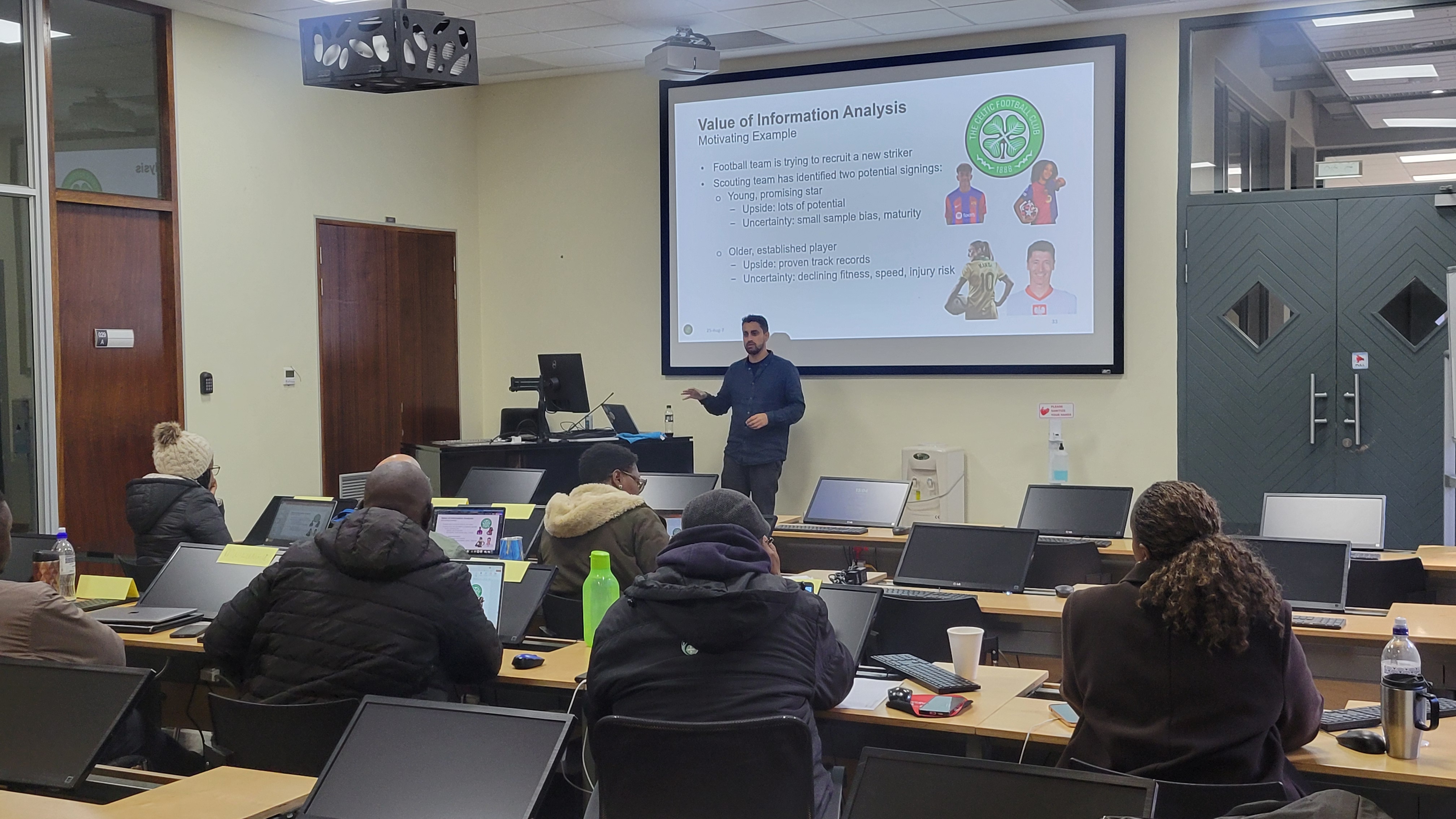
Ciaran Kohli-Lynch, PhD, MS, leads a lecture on decision-analytic modelling for public health students at the University of the Witwatersrand (Wits) in South Africa in August 2025.
Since 2018, Kohli-Lynch has served as a visiting lecturer at the Wits School of Public Health, teaching a biannual module on decision-analytic modelling for health economic evaluation. In this course, Kohli-Lynch teaches core health economic theory and computer simulation methods and instructs students on how to implement these methods in both practical sessions and individual projects.
Kohli-Lynch is a health economist with research interests in cost-effectiveness analysis, decision-analytic modelling and cardiovascular epidemiology. His research has focused on the cost-effectiveness of preventive interventions for cardiovascular disease, economic evaluation in global health and analysis of pooled longitudinal cohort data.
“Contributing to teaching at Wits is important because it helps to train skilled investigators from across Southern Africa,” Kohli-Lynch said. “Students have gone on to various roles after completing the module, including clinical practice, policymaking and industry.”

Many students have decided to employ decision-analytic modelling in their dissertations, leading to published research on a variety of important issues including, cost-effectiveness analyses of seasonal influenza vaccination programs and maternal support grants in South Africa.”
The course is run by the South African Medical Research Council (SAMRC)/Wits Centre for Health Economics and Decision Science (PRICELESS SA), and Kohli-Lynch has maintained a research and teaching role with this department for several years. In addition to teaching, Kohli-Lynch has contributed to health economic research at Wits that has been funded by various organizations, including the Government of South Africa, UNICEF and Bloomberg Philanthropies.
Many students from an array of different backgrounds across Southern Africa are enrolled in the MPH program. These students have backgrounds in medicine, policymaking and economic research. Developing skills in health economic evaluation helps to strengthen health economic research in Southern Africa and train skilled healthcare decision-makers. In addition, it expands the network of skilled health economists around the world, enabling ongoing collaboration.
“Many students have decided to employ decision-analytic modelling in their dissertations, leading to published research on a variety of important issues, including cost-effectiveness analyses of seasonal influenza vaccination programs and maternal support grants in South Africa,” Kohli-Lynch said. “Additionally, maintaining a visiting lecturer role at Wits has allowed me to work on various economic evaluation studies in Southern Africa and may lead to a fruitful partnership between Northwestern and Wits in the future.”
To learn more about the Buehler Center for Health Policy and Economics, visit their website.
For details on events, news and funding opportunities, sign up for the Havey Institute for Global Health newsletter.